Artificial intelligence is often discussed as a single technology wave, but its economics are better understood as a layered system. From electricity and silicon to software platforms and applications, value is created and captured at different points in the AI stack. For investors, this distinction matters. Returns, capital intensity, and competitive dynamics vary sharply across layers, making “AI exposure” far from uniform.
The current investment cycle has made this architecture impossible to ignore. Capital spending on AI infrastructure has surged globally, while monetisation remains uneven and concentrated. Understanding where durable economics sit and where competition is likely to compress margins is now central to evaluating AI-linked investments.
Why the AI stack matters more than you think
At its core, AI is not just software. It is an industrial system dependent on power generation, specialised chips, data-centre capacity, foundational models, and enterprise platforms that turn capability into revenue. Each layer carries its own constraints: regulation and long asset lives at the power level, manufacturing bottlenecks in chips, balance-sheet sensitivity in data centres, and pricing pressure at the application layer.
Treating AI as a monolithic theme risks misallocating capital to segments where returns are structurally capped. A stack-based framework, by contrast, allows investors to separate scarcity from commoditisation and pricing power from hype.
From power to platforms
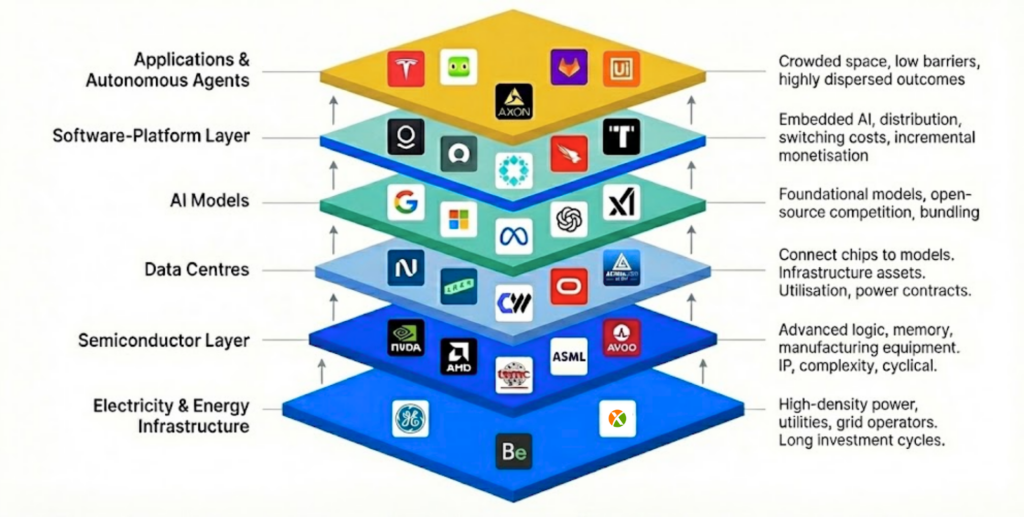
The bottom of the stack begins with electricity and energy infrastructure. Training and running large AI models requires continuous, high-density power, renewing focus on utilities and grid operators. Demand visibility has improved, but returns remain shaped by regulation, long investment cycles, and commodity inputs.
Above the power sits the semiconductor layer, where economics are more asymmetric. Advanced logic chips, memory, and manufacturing equipment have become the gating factor for AI deployment. Structural advantages exist due to intellectual property, scale, and manufacturing complexity, but these businesses also face reinvestment intensity and cyclical earnings.
Data centres connect chips to models and resemble infrastructure assets more than traditional technology companies. Returns depend on utilisation rates, power contracts, and financing costs. While demand has accelerated, margins are sensitive to energy availability and interest rates.
The model layer has drawn outsized attention, but monetisation remains uncertain. Foundational models are expensive to train and increasingly face competition from open-source alternatives, often being bundled into broader cloud or enterprise offerings rather than sold directly.
More durable economics are emerging at the software-platform layer, where AI is embedded into existing workflows. Distribution, switching costs, and long-standing customer relationships allow incremental monetisation without proportional cost increases. At the top sit applications and autonomous agents, a crowded space with low barriers to entry and highly dispersed outcomes.
Key U.S. stocks and ADRs across the AI stack
| Ticker | Name | AI Stack Layer | Performance (1 Yr) |
| PLTR | Palantir Technologies Inc. | AI Software Platforms | 144.41% |
| NXT | Nextracker Inc. | Power & Energy Infrastructure | 138.20% |
| GEV | GE Vernova Inc. | Power & Energy Infrastructure | 97.05% |
| AMD | Advanced Micro Devices, Inc. | AI Chips & Compute | 70.36% |
| GOOGL | Alphabet Inc. | AI Models & Platforms | 59.39% |
| CEG | Constellation Energy Corporation | Power & Energy Infrastructure | 56.76% |
| ASML | ASML Holding N.V. | Chip Manufacturing Equipment | 48.02% |
| TSM | Taiwan Semiconductor Manufacturing Company Limited | Semiconductor Manufacturing | 43.35% |
| AVGO | Broadcom Inc. | Networking & AI Silicon | 40.85% |
| NVDA | NVIDIA Corporation | AI Chips & Accelerators | 32.01% |
| PATH | UiPath Inc. | Automation & AI Software | 25.27% |
| ORCL | Oracle Corporation | Data Centres & Cloud Infrastructure | 13.77% |
| MSFT | Microsoft Corporation | AI Models & Cloud Platforms | 12.78% |
| META | Meta Platforms, Inc. | AI Models & Applications | 9.71% |
Returns as of Dec 23, 2025
How Indian investors can capitalize
For Indian investors, the AI stack framework is particularly relevant because domestic markets offer limited exposure to several critical layers of artificial intelligence. While India has strong IT services companies, it lacks listed leaders in advanced semiconductors, AI accelerators, data-centre infrastructure, and foundational model platforms. As a result, a balanced AI allocation often requires global exposure.
Platforms such as Appreciate make this access more practical by allowing Indian investors to invest directly in U.S.-listed companies across the AI value chain, from power and chip manufacturers to cloud platforms and enterprise software providers. This enables diversification across layers rather than concentration in a single AI narrative, helping investors balance infrastructure-led stability with software-driven growth. For those looking to invest in US stocks from India, this approach provides exposure to some of the most influential companies driving the global AI revolution.
Conclusion
The AI opportunity is not evenly distributed across the stack. Lower layers offer scarcity and visibility but demand patience and capital, while upper layers promise growth yet face intense competition and margin pressure. As the cycle matures, the distinction between where AI is built and where it is monetised will become clearer. For investors, the real challenge is not finding exposure to AI, but allocating capital to the parts of the stack where technical advantage aligns with durable business models rather than excitement alone.
Disclaimer: Investments in securities markets are subject to market risks. Read all the related documents carefully before investing. The securities quoted are exemplary and are not recommendatory.