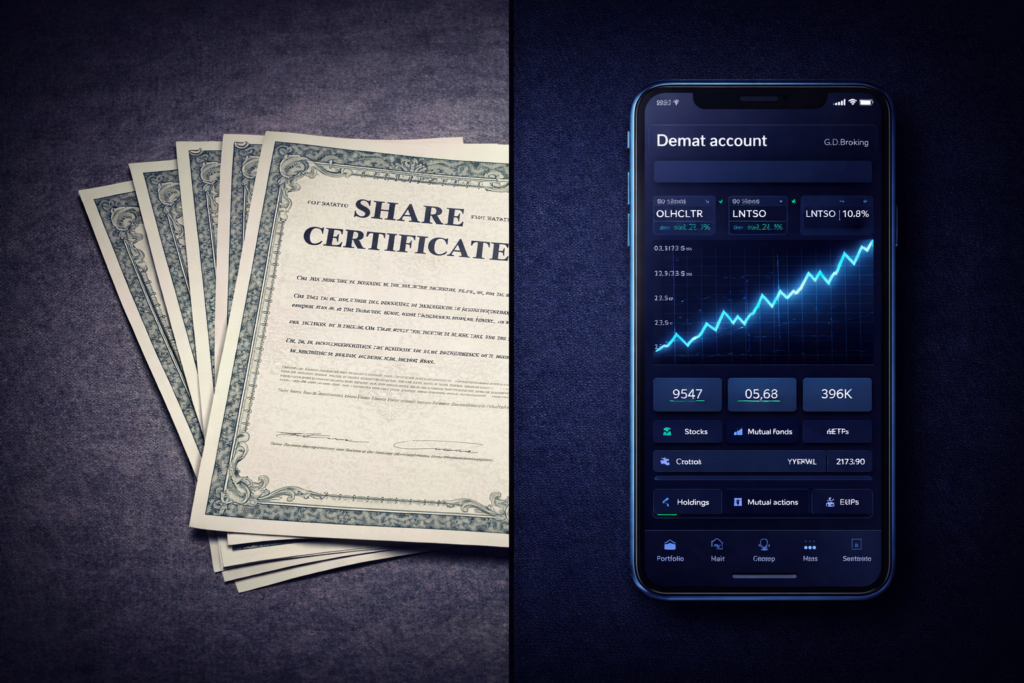
Before 1996, every share you bought came in the form of a physical certificate. These papers could be lost, damaged, forged, or even stolen—making investing risky and inconvenient.
Dematerialisation means converting physical share certificates into electronic form and holding them in a Demat account, which is essential when applying for an SME IPO. It removes the need for paper-based ownership and allows investors to hold and trade securities digitally.
Now, a Demat account is mandatory for investing in the Indian stock market. Dematerialisation forms the base of this entire system—whether you’re buying stocks, ETFs, or mutual funds.
In this guide, we’ll cover what dematerialisation is, how the dematerialization process works, its benefits, charges involved, and what “dematerialized form” really means.
Key Takeaways
- Dematerialisation converts physical shares into an electronic format stored in a Demat account.
- It is compulsory for stock market investing in India.
- The dematerialisation of shares removes risks like loss, theft, and forgery.
- Buying, selling, and tracking investments becomes faster and simpler.
- All modern investments—stocks, ETFs, and even international options—depend on this system.
Dematerialisation Meaning – What Does It Actually Mean?
Dematerialisation means converting physical share certificates into electronic form and keeping them in a Demat account. It replaces paper-based ownership with digital records.
The word breaks down simply: “de-” (removal) + “material” (physical form), so it literally means removing the physical form. You may see two spellings: dematerialisation (Indian/British English) and dematerialization (American English). Both mean the same thing.
Dematerialized form refers to securities that exist only as electronic records, not physical documents. Also, dematerialisation is regulated, legal conversion under SEBI and the Depositories Act, 1996.
Why Was Dematerialisation of Shares Introduced in India?
India moved to dematerialisation to fix a system that was slow, risky, and difficult to scale as more investors entered the stock market.
The Problems with Physical Share Certificates
Before dematerialisation, investing came with multiple risks and delays:
- Physical certificates could be lost, stolen, or damaged
- Forgery and duplicate share certificate fraud were common
- Trade settlements took 14+ days
- Paperwork errors often led to ownership disputes
- Buying or selling small quantities was inefficient
These issues made the system slow, unreliable, and difficult for investors.
SEBI’s Vision for a Digital Market
After the 1991 economic reforms, SEBI pushed to modernise India’s capital markets.
- The Depositories Act, 1996, created the legal framework for dematerialisation
- NSDL (1996) became India’s first depository, followed by CDSL (1999)
- By 2000, SEBI mandated electronic issuance for large IPOs
The result was a major shift—trades that once took weeks now settle in T+1 day, making the market faster and more reliable.
What Is Dematerialization of Shares – Key Concepts Explained
Dematerialisation of shares means holding your investments in electronic form instead of physical certificates. Once converted, your shares are stored digitally and can be accessed, tracked, and traded easily through your Demat account.
To understand how this system works, you need to know the three key components below.
1. Demat Account – The Digital Locker for Your Securities
A Demat account is where all your securities are stored in electronic form, including exchange-traded products like a liquid ETF.
- It works like a bank account, but instead of money, it holds shares and other investments.
- Opened through a registered Depository Participant (DP)
- Stores stocks, bonds, ETFs, and government securities after dematerialisation
2. Depository Participant (DP) – The Intermediary
A Depository Participant acts as the bridge between you and the depository.
- You don’t interact directly with NSDL or CDSL
- The DP manages your Demat account and transactions
- Common examples include Zerodha, HDFC Securities, ICICI Direct, and Kotak Securities
3. NSDL and CDSL – The Two Central Depositories
India has two main depositories that hold securities in electronic form:
- NSDL (National Securities Depository Limited): India’s first and largest depository
- CDSL (Central Depository Services Limited): Widely used by retail investors
Both are regulated by SEBI and are responsible for safely maintaining your securities in dematerialized form.
Step-by-Step Dematerialization Process in India
Converting physical shares into electronic form follows a clear process. Here’s how the dematerialization process works in practice:
Step 1 – Open a Demat Account
Start by opening a Demat account with a registered Depository Participant (DP), such as a bank or broker.
- Complete KYC with PAN, Aadhaar, address proof, bank details, and a photo
- Sign the DP–investor agreement
Step 2 – Obtain and Fill the Dematerialisation Request Form (DRF)
The DRF is the key document for initiating dematerialisation.
- Collect it from your DP
- Mention the ISIN (International Securities Identification Number) for each security
- Write “Surrendered for Dematerialisation” on each physical certificate
Step 3 – Submit Physical Certificates to DP
Submit the filled DRF along with your original share certificates.
- The DP checks your documents
- Then forwards them to the company’s Registrar and Transfer Agent (RTA)
Step 4 – Verification by Registrar/Company
The RTA verifies the authenticity of your certificates.
- Once approved, the physical certificates are cancelled permanently
- They cannot be reused or traded again
Step 5 – Electronic Credit to Demat Account
After verification:
- The depository confirms completion of your DP
- The same number of shares is credited to your Demat account in electronic form
Timeline: Usually takes 15–30 days from submission.
What Securities Can Be Dematerialised?
Dematerialisation is not limited to shares; it applies to a wide range of financial instruments:
- Equity shares (most common)
- Preference shares
- Bonds and debentures (corporate and government)
- Mutual fund units (older physical holdings)
- Exchange Traded Funds (ETFs)
- Government securities (G-Secs)
- Treasury Bills (T-Bills)
- Sovereign Gold Bonds (SGBs)
Key takeaway: Dematerialisation of shares is just one use case. The same process allows you to hold multiple types of investments in a single Demat account.
Benefits of Dematerialisation
Dematerialisation simplifies investing by removing the risks and delays linked to physical certificates. It makes transactions faster, safer, and easier to manage.
1. Safety and Security
With dematerialisation, there is no risk of losing physical certificates or having them damaged by fire or theft. It also removes the possibility of forgery or duplicate share issues. Since everything is recorded electronically, every transaction leaves a clear audit trail, making ownership more secure.
2. Faster Settlement and Trading
The shift to electronic records enables faster settlements, with trades now completed in a T+1 cycle. There is no need to handle or transfer physical certificates, which reduces delays. Buying and selling shares becomes smooth and immediate through your Demat account.
3. Automatic Corporate Benefits
All corporate benefits are handled automatically once your shares are in demat form. Dividends are credited directly to your bank account, while bonus shares, rights issues, and stock splits are added to your Demat account without any manual steps. You don’t have to worry about missing out due to misplaced documents.
4. Reduced Paperwork and Costs
Dematerialisation removes most of the paperwork involved in managing investments. There is no stamp duty on the transfer of dematerialised securities, and you don’t need to spend on getting duplicate certificates. It also removes the need for physical storage or safekeeping.
5. Easy Portfolio Monitoring
All your investments—stocks, bonds, ETFs, and mutual funds—are visible in one place. You can track them anytime through your broker’s app or via the consolidated account statement provided by CDSL or NSDL. This makes it easier to stay on top of your portfolio without managing multiple records.
Dematerialisation Charges – What It Costs in India
The cost of dematerialisation depends on the Depository Participant (DP) you choose. Here’s a general idea:
| Fee Type | Typical Range |
| Account Opening Fee | ₹0–₹500 (often free) |
| Annual Maintenance Charge (AMC) | ₹0–₹750 per year |
| Dematerialisation Request Fee | ₹30–₹150 per certificate/request |
| Transaction/Custody Fee | Varies by DP and usage |
| Rematerialisation Fee | ₹30–₹100 per certificate |
Fees can differ widely across brokers, so it’s worth comparing before opening a Demat account. SEBI has guidelines in place to keep these charges reasonable.
Dematerialisation vs Rematerialisation – What’s the Difference?
Both terms deal with how your shares are held, but they work in opposite directions and serve very different purposes.
| Feature | Dematerialisation | Rematerialisation |
| Direction | Physical → Electronic | Electronic → Physical |
| Purpose | Convert physical certificates into digital form | Convert digital holdings back to physical certificates |
| Common Use | Investors converting old shares | Rare, used in specific legal or personal cases |
| Time Required | 15–30 days | Around 30 days |
| SEBI Trend | Encouraged and widely used | Discouraged |
SEBI’s Mandatory Dematerialisation – What Investors Must Know
SEBI has gradually made dematerialisation compulsory across most categories of securities, including many listed corporate bonds. Physical share transfers are no longer allowed in listed companies—only demat shares can be traded on stock exchanges. Even for unlisted shares, transfers in physical form are restricted.
SEBI has also been pushing private company shareholders to shift to a demat form. In practical terms, if you still hold physical certificates, converting them is no longer optional—it’s required to keep your investments usable and transferable.
Conclusion
Dematerialisation shifted India’s securities market from a paper-heavy, fraud-prone setup to a faster and more secure digital system. The dematerialization process is simple: open a Demat account, submit a DRF along with physical certificates, and receive shares in electronic form within 15–30 days.
With SEBI tightening rules around physical share transfers, converting any remaining certificates is a practical step to avoid delays and keep your investments accessible and easy to manage.
If you’re exploring global diversification alongside Indian equities, US ETFs (Exchange Traded Funds) offer a great opportunity for investors looking to diversify their portfolio with international exposure.
With Appreciate, you can now access these ETFs easily, benefiting from the growth of US-based companies. Investing in US ETFs can be a strategic way to tap into global markets, adding stability and potential growth to your investment strategy.
FAQ Section
Dematerialisation means converting physical share certificates into electronic format and holding them in a Demat account. It removes paperwork and allows you to buy, sell, and track investments digitally.
Dematerialized form refers to securities that exist only as electronic records in your Demat account. There are no physical certificates—ownership is recorded digitally with a depository.
The process is straightforward:
Open a Demat account with a broker or depository participant
Fill out a Dematerialisation Request Form (DRF)
Submit the DRF along with the physical share certificates
The depository verifies and converts them into electronic form
Shares are credited to your Demat account within 15–30 days
Yes. SEBI has made it mandatory for most share transactions to be in demat form. Physical share transfers are largely restricted, so holding shares electronically is now essential for investing and trading.
Both NSDL and CDSL are depositories that hold your shares in electronic form.
NSDL (National Securities Depository Limited): India’s first depository, often used by larger institutions.
CDSL (Central Depository Services Limited): More widely used by retail investors.
For investors, the difference is minimal—your experience depends more on your broker than the depository.
Once your shares are in demat form:
Dividends are directly credited to your linked bank account
Bonus shares are automatically added to your Demat account
No paperwork or manual claims are required
This makes corporate benefits faster, cleaner, and easier to track.
Disclaimer: Investments in securities markets are subject to market risks. Read all the related documents carefully before investing. The securities quoted are exemplary and are not recommended.