India is one of the world’s largest producers of agricultural commodities like pulses, spices, and oilseeds. Yet for decades, price discovery remained fragmented, with farmers relying on local mandis where pricing lacked transparency. This changed with the introduction of a national electronic platform designed specifically for agricultural trading.
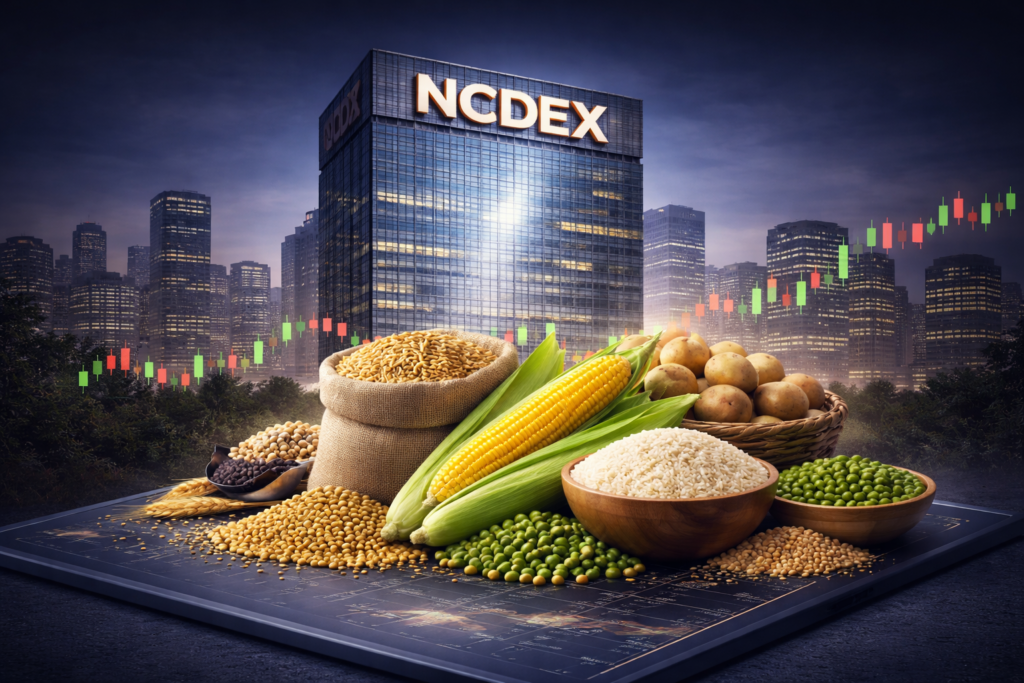
The NCDEX full form is National Commodity and Derivatives Exchange Limited. It is India’s leading agricultural commodity exchange, enabling transparent price discovery and risk management. This guide explains what is NCDEX, how it works, the commodities traded, and why it plays a crucial role in India’s financial and agricultural ecosystem.
NCDEX Full Form and Meaning – The One-Line Answer
NCDEX (National Commodity and Derivatives Exchange Limited) is a SEBI-regulated, fully electronic commodity exchange in India that allows farmers, traders, and investors to trade agricultural derivatives such as futures and options for price discovery and risk management.
Founded in 2003 and headquartered in Mumbai, NCDEX has become the backbone of India’s organised agricultural commodity trading system.
NCDEX Logo and Brand Identity
The NCDEX logo reflects its focus on India’s agricultural ecosystem and commodity markets. Over time, the exchange has modernised its branding to align with its digital-first trading infrastructure. The official NCDEX logo and branding elements are available on its website and are designed to represent transparency, scale, and market integration.
History and Evolution of NCDEX
NCDEX was established in April 2003 by a consortium of leading financial institutions, including NSE, ICICI Bank, NABARD, LIC, and others. It began operations later that year as India’s first fully electronic agricultural commodity exchange.
In its early years, NCDEX replaced fragmented mandi-based trading systems with a national platform where prices were determined by demand and supply. This shift improved transparency and reduced the influence of intermediaries.
A major turning point came in 2015 when commodity derivatives moved under SEBI’s regulation. This transition strengthened market oversight, improved margin systems, and enhanced investor protection.
As of 2026, NCDEX continues to evolve. Certain commodity derivatives, including wheat, chana, and mustard, remain under temporary suspension due to inflation concerns. At the same time, the exchange is exploring expansion into broader financial services, including a mutual fund transaction platform.
What Does NCDEX Do?
NCDEX plays a central role in India’s agricultural economy by enabling efficient price discovery and risk management.
For farmers, it provides a transparent platform where prices reflect national demand and supply rather than local bargaining power. For traders and processors, it offers tools to hedge against price fluctuations.
For example, a farmer expecting prices to fall can lock in current prices by selling futures contracts. Similarly, a food processing company can secure raw material costs in advance by buying futures. This dual function makes NCDEX essential for managing price risk across the agricultural value chain.
Commodities Traded on NCDEX
NCDEX focuses primarily on agricultural commodities across multiple categories.
| Category | Key Commodities |
| Cereals & Grains | Wheat, Maize, Barley |
| Pulses | Chana, Moong, Masoor |
| Oilseeds | Soybean, Mustard, Castor Seed |
| Spices | Jeera, Turmeric, Coriander |
| Industrial | Guar Seed, Guar Gum, Cottonseed |
| Softs | Sugar, Coffee |
Some of the most actively traded commodities historically include guar seed, jeera, and castor seed. However, as of 2026, trading in several major commodities remains restricted under regulatory measures.
How Does NCDEX Work?
NCDEX operates as a fully electronic exchange where all trades are executed through a centralized order-matching system. Participants can access the platform through registered brokers without needing a physical trading floor.
Trading typically runs from morning to late evening, aligning partly with global commodity markets. The primary instruments traded are futures contracts, which specify details such as quantity, price, delivery date, and settlement method.
To trade, participants must open a commodity trading account, complete KYC, deposit margin, and place orders through a broker’s platform. Positions can be squared off before expiry or settled through delivery or cash.
NCDEX vs MCX – Key Differences
| Feature | NCDEX | MCX |
| Focus | Agricultural commodities | Metals, energy, bullion |
| Key Products | Jeera, Guar, Chana | Gold, Crude Oil, Silver |
| Users | Farmers, agri-traders | Industrial and financial traders |
| Regulation | SEBI | SEBI |
In simple terms, NCDEX serves agricultural markets, while MCX focuses on metals and energy.
NCDEX vs NSE/BSE
NCDEX differs fundamentally from stock exchanges like NSE and BSE. While NSE and BSE deal in equities and bonds, NCDEX trades commodity derivatives. Investors need a separate commodity account to participate.
Why NCDEX Matters for Investors Today
NCDEX is not just a trading platform. It reflects how commodity prices influence inflation, supply chains, and economic stability. Even investors who do not trade commodities are indirectly affected by price movements in agricultural products.
For Indian investors looking to go beyond domestic markets, understanding commodity exchanges builds a broader perspective. Platforms like Appreciate complement this by offering access to global assets such as U.S. ETFs, allowing diversification across asset classes, geographies, and currencies.
This combination—domestic understanding and global access—helps investors build more balanced portfolios.
Conclusion
NCDEX has transformed India’s agricultural trading landscape by introducing transparency, efficiency, and risk management. As a SEBI-regulated exchange, it connects farmers, traders, and investors on a single platform.
Understanding what is NCDEX helps investors see how commodity markets function and influence the broader economy. While equity markets dominate attention, commodity exchanges remain equally important in shaping price stability and economic growth.
FAQ on NCDEX
National Commodity and Derivatives Exchange Limited.
A commodity exchange for trading agricultural derivatives.
Pulses, spices, oilseeds, grains, and industrial agri-products.
NCDEX focuses on agriculture; MCX focuses on metals and energy.
Yes, the National Commodity & Derivatives Exchange Limited (NCDEX) is regulated by the Securities and Exchange Board of India (SEBI)
Yes, through registered brokers.
Disclaimer: Investments in securities markets are subject to market risks. Read all related documents carefully before investing. The securities mentioned are illustrative and not recommendations.