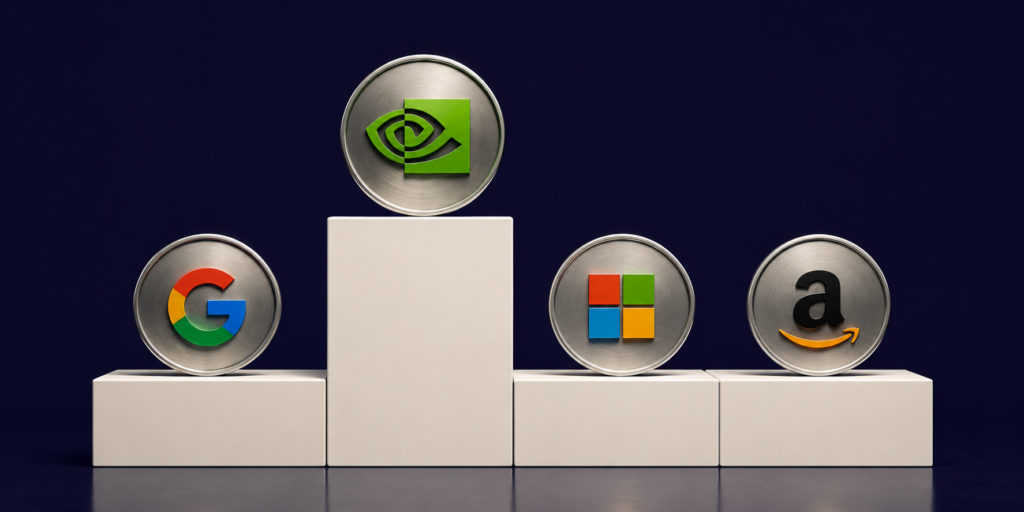
When Nvidia crossed $5 trillion in market capitalization, it reset every benchmark in the process. The question that followed immediately, who gets there next?, is being treated as a matter of speculation. It isn’t. On current data, three companies are in this conversation, and each of them has a credible, data-supported path. The differences between them are not about quality. They are about distance and timing.
The three names are Microsoft, Alphabet, and Amazon. The numbers first, because the numbers set the frame. Alphabet’s market cap sits at approximately $4.79 trillion, roughly 4 to 6% below the $5 trillion threshold. Microsoft is at $3.07 trillion. Amazon is at $2.93 trillion. Alphabet is closest by a significant margin in the near term. Microsoft and Amazon are further away, but both have the operational momentum to get there, and in both cases, the catalysts are unusually visible.
Alphabet’s path requires no heroic assumptions. Getting there from here is a 4 to 6% move. But the more interesting story is what the underlying business looks like right now. Google Cloud grew 63% in Q1 2026. Operating margin on that segment expanded from 9.4% to 32.9% in twelve months. Search revenue grew 19% in the same quarter, against a consensus that had largely written off its durability in an AI-first world. The cloud backlog sits at $462 billion: future revenue already contracted for by enterprise customers.
What makes Alphabet’s position defensible is vertical integration across the full AI stack, the frontier model in Gemini 3, the custom silicon in Ironwood TPU, and the distribution layer across Search, YouTube, Android, and Workspace. No other hyperscaler holds all four simultaneously. The asset most analysts are still underpricing is Waymo, 500,000 fully autonomous paid rides per week, valued at $126 billion in a February 2026 funding round, and barely included in most sum-of-parts valuations.
Microsoft’s case is equally serious; it simply requires more runway. Azure grew 40% year-on-year in Q3 FY26, its highest rate in over a year. Commercial backlog nearly doubled to $627 billion. AI revenue is running at $37 billion annually, growing at 123%. These are not incremental numbers.
The development the market has not fully priced is the Microsoft 365 price increase taking effect July 1, 2026, increases of 5% to 33% across commercial SKUs, applied to an installed base of approximately 450 million commercial paid seats, where switching costs are, in practice, prohibitive. When AI features are embedded at that scale, organisations cannot leave. Pricing actions of this kind flow almost entirely to operating margin. Microsoft already runs at 46.3% operating margins, the highest in mega-cap tech. The July hike makes that structural advantage more durable. Microsoft needs approximately 63% appreciation from current levels to cross $5 trillion. On any reasonable growth trajectory, that is a 2027 story, but the direction is not in question.
Amazon’s path runs through margin inflection rather than revenue growth alone, and there are three distinct streams compounding simultaneously. AWS is growing at 28%, its fastest rate in 15 quarters. The advertising business has crossed $70 billion in trailing twelve-month revenue, growing at 22% year-on-year, built on first-party purchase-intent data that no social platform can replicate. And North American retail operating margin reached approximately 7.9% in Q1 2026, up from 6.3% a year earlier.
That retail margin number is the one to watch. Crossing 10%, which current operating trends make plausible by Q3 or Q4 2026, would prompt a significant analyst re-rating on a business still priced primarily as retail and cloud. The market has not caught up to what Amazon’s cost structure actually looks like today. Amazon’s custom silicon portfolio, Graviton, Trainium, and Nitro, runs at a $20 billion annual run rate, growing triple digits. It is currently valued as a line item inside AWS. It is a standalone semiconductor story in waiting. Amazon needs roughly 71% appreciation to cross $5 trillion. That is a 2027 story, but one with unusually clear and visible catalysts.
Let me zoom out, because the $5 trillion milestone is a useful lens for a more important question, one that is particularly relevant for Indian investors thinking about global allocation.
Five trillion dollars is not a market cap milestone worth noting in isolation. At that level, a single company exceeds the GDP of every economy on earth except the United States and China. The Magnificent Seven represent roughly 34% of the S&P 500 today, up from 12.5% in 2016. India’s most valuable listed company sits at roughly $200 to $230 billion in market cap. The top ten Indian listed companies combined are worth less than Alphabet’s market cap appreciation over the past twelve months alone.
This is the structural case for global allocation, not as a tactical trade, but as a recognition of where value is being created at scale. The LRS window exists precisely to access what domestic indices cannot offer. The concentration risk of holding these names is real. So is the opportunity cost of not holding them. Both of those things are true simultaneously, and position sizing is where they get resolved.
The $5 trillion race is ultimately a useful frame for a more fundamental question: are Indian investors positioned to participate in the compounding that is happening at the infrastructure layer of the global AI economy? The math already points to the answer. The more important question is whether your portfolio does too.
Disclaimer: Investments in securities markets are subject to market risks. Read all the related documents carefully before investing. The securities quoted are exemplary and are not recommended.