When Indian investors compare the U.S. market with Indian equities, the focus usually stays on stock performance.
But there is another layer quietly shaping returns in the background. Currency.
Every time an Indian investor buys a U.S. stock or ETF, they are not just investing in equities. They are also gaining exposure to the U.S. dollar. Over long periods, that difference can meaningfully change outcomes.
For investors exploring global markets through platforms like Appreciate, understanding currency impact is becoming increasingly important. Because in global investing, returns are influenced not only by what you own, but also by the currency in which those assets are priced.
The Rupee Has Gradually Weakened Against the Dollar
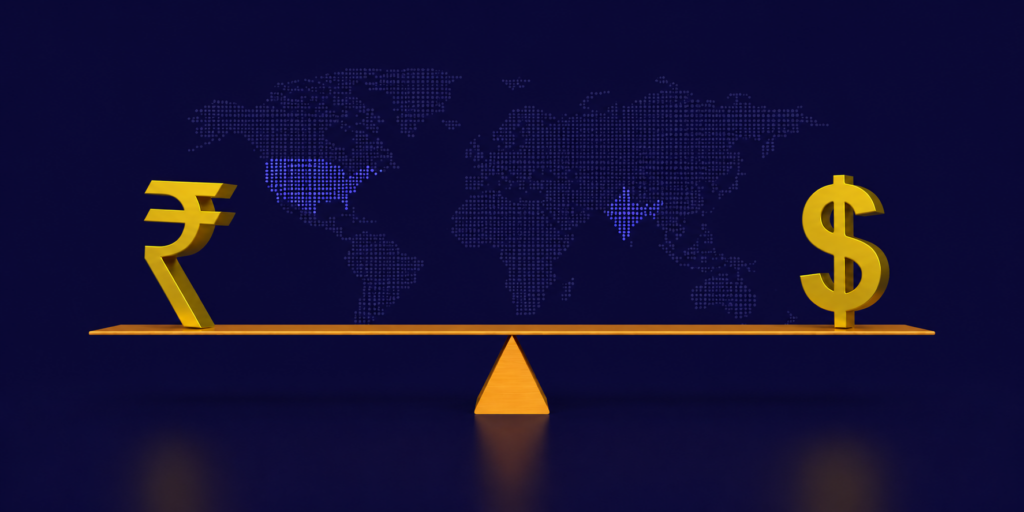
Over the past decade, the Indian rupee has steadily depreciated against the U.S. dollar.
Around 2015, the exchange rate was close to ₹65 per dollar. By 2026, it crossed the ₹95 range.
At first glance, that movement may not appear dramatic.
But over long periods, gradual depreciation compounds.
A decline of roughly 30% over ten years effectively adds an additional layer of return for Indian investors holding dollar-denominated assets.
This is one reason global investing can produce outcomes that look very different once converted back into rupee terms.
A ₹1 Lakh Comparison Looks Different After Currency Adjustment
Consider a simple example.
If ₹1 lakh had been invested in the Nasdaq 100 around ten years ago, the investment would have benefited from two separate drivers:
- appreciation in the underlying index
- appreciation of the U.S. dollar relative to the rupee
Meanwhile, a similar investment in Indian equities would have depended almost entirely on local market returns.
The result is that long-term U.S. investments often show a noticeable difference once adjusted for currency movement.
This does not mean U.S. markets always outperform India.
It means currency acts as an additional return layer that investors cannot ignore.
Currency Can Quietly Amplify Compounding
One of the most important aspects of currency movement is that it compounds gradually over time.
A small annual depreciation may not feel significant in a single year. But over longer periods, the cumulative effect becomes meaningful.
This creates what can be described as an invisible amplifier.
If a U.S. investment generates strong equity returns while the dollar also strengthens against the rupee, the combined effect can substantially improve outcomes for Indian investors.
That is especially relevant in long-term investing, where compounding matters more than short-term fluctuations.
The Nasdaq Example Explains the Difference Clearly
Technology-focused U.S. indices provide a useful illustration of this effect.
The Nasdaq 100 has benefited from strong earnings growth, innovation cycles, and global technology leadership over the past decade.
But for Indian investors, returns were amplified further because the underlying gains were earned in dollars.
This combination created a dual engine:
- equity appreciation
- currency appreciation
Together, they produced significantly stronger INR-adjusted returns compared to looking at index performance alone.
This is why many global portfolios behave differently once currency conversion is included.
Currency Does Not Always Move in One Direction
It is important to understand that currency impact is not guaranteed.
There are periods when the rupee stabilises or even strengthens temporarily against the dollar. During those phases, currency contribution to returns becomes smaller.
This happened briefly during certain periods over the last decade.
However, long-term structural trends still matter.
Historically, the rupee has gradually depreciated against the dollar over extended periods due to inflation differentials, trade balances, and capital flows.
That long-term trend is what shapes outcomes for global investors.
Global Investing Is Not Just About Geography
Many investors think diversification only means investing across countries.
In reality, currency diversification is equally important.
Holding assets denominated in different currencies helps reduce dependence on a single economy or monetary system.
For Indian investors, U.S. exposure provides:
- access to global companies
- exposure to the world’s reserve currency
- diversification beyond domestic market cycles
This becomes especially relevant during periods of local volatility or inflation pressure.
Currency Also Changes How Risk Feels
Another overlooked aspect of global investing is how currency affects investor psychology.
When the rupee weakens sharply, dollar-denominated assets often appear stronger in INR terms even during volatile market periods.
This can help stabilise portfolio outcomes during certain economic conditions.
At the same time, currency movement can also introduce short-term volatility. Investors need to recognise that global investing involves both market risk and exchange rate risk.
That is why long-term horizons matter.
Currency effects become more meaningful over the years rather than months.
Why Indian Investors Are Paying More Attention to the Dollar
The conversation around global investing in India has changed significantly over the past few years.
Earlier, U.S. investing was mostly viewed as a way to access technology companies.
Today, investors increasingly recognise that currency itself is part of the investment thesis.
The dollar is not simply a conversion tool.
It is an asset exposure.
That distinction is changing how portfolios are being constructed.
Turning Currency Awareness Into Better Portfolio Decisions
Understanding currency impact is useful only if investors incorporate it into their strategy.
That does not mean trying to predict short-term exchange rate movements. Currency forecasting is extremely difficult even for professionals.
Instead, it means recognising that:
- Global investing has multiple return drivers
- Currency diversification can improve portfolio resilience
- long-term outcomes depend on both asset performance and exchange rates
Platforms like Appreciate help investors access U.S. stocks and ETFs more easily, allowing Indian investors to participate in global markets while understanding how currency shapes long-term returns.
Conclusion
Currency is often treated as an afterthought in investing.
In reality, it can significantly influence long-term outcomes.
For Indian investors, exposure to the U.S. dollar has historically added an important layer of return alongside equity performance. Over time, this compounding effect becomes difficult to ignore.
That does not make global investing risk-free.
But it does highlight why looking only at headline stock returns can miss part of the picture.
Because in global investing, what matters is not just how markets perform.
It is also the currency in which those returns are earned.
Disclaimer: Investments in securities markets are subject to market risks. Read all related documents carefully before investing. The securities and examples mentioned above are only for illustration and are not recommendations.