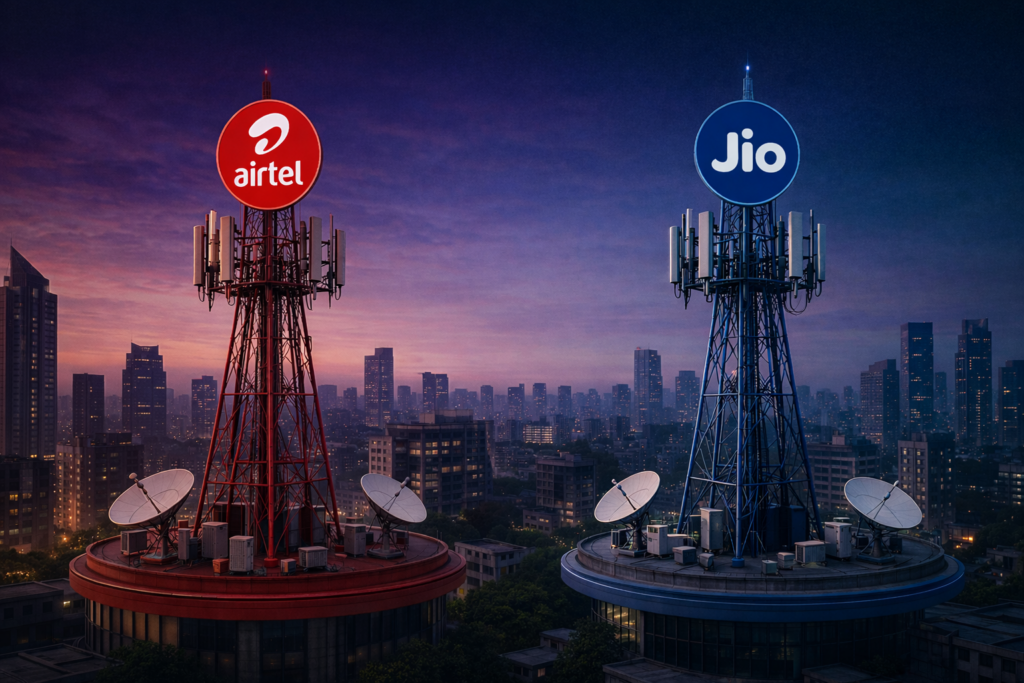
India’s telecom sector has transformed from a fragmented, price-driven market into a consolidated, capital-intensive duopoly dominated by two giants: Reliance Jio and Bharti Airtel. Over the past decade, the competitive dynamics between these two companies have reshaped pricing, profitability, and the broader structure of the industry.
The debate around Jio vs Airtel is no longer limited to consumers asking “airtel or jio which is better.” It has evolved into a deeper financial question: which company has the stronger long-term business model, better monetisation strategy, and superior capital efficiency?
This article takes a finance-led deep dive into Jio vs Airtel, analysing market share, revenue, ARPU (average revenue per user), network quality, and long-term investment implications.
The Indian telecom market has undergone three distinct phases: hyper-competition, disruption, and consolidation.
India’s Telecom Industry: From Price Wars to Profit Focus
The entry of Reliance Jio in 2016 triggered one of the most aggressive price wars in global telecom history. Free voice calls and ultra-low data tariffs forced incumbents to slash prices, leading to industry-wide financial stress.
Over time, weaker players exited or consolidated, leaving a triopoly dominated by Jio, Airtel, and Vodafone Idea. Today, Jio and Airtel together control the majority of the market, with a combined dominance exceeding 70% in subscriber share and even higher in revenue terms.
The industry has now shifted from subscriber growth to ARPU expansion and profitability, marking a critical structural transition.
Jio vs Airtel Market Share: Scale vs Value
Market share is the most visible metric in the Jio vs Airtel debate.
Reliance Jio leads the Indian telecom market with approximately 40–41% subscriber market share, while Bharti Airtel holds around 33–34%.
In absolute terms, Jio has a significantly larger subscriber base, crossing 500 million users, compared to Airtel’s ~460 million.
This difference reflects Jio’s strategy of rapid scale expansion through aggressive pricing and mass-market penetration.
However, market share alone does not capture economic value.
Airtel has consistently focused on premiumisation, targeting higher-paying customers and improving user quality rather than chasing volume alone. This distinction is crucial when analysing profitability.
Revenue and Profitability: Airtel’s Edge in Monetisation
While Jio dominates in scale, Airtel leads in monetisation.
In Q3 FY26, Airtel reported India revenue of approximately ₹39,226 crore, slightly ahead of Jio’s ₹37,262 crore.
This is notable because Airtel generates higher revenue despite having fewer subscribers.
The key driver behind this is ARPU.
Airtel’s ARPU stands at around ₹259, compared to Jio’s ~₹213–214.
This gap highlights a fundamental strategic difference:
- Jio = volume-driven growth
- Airtel = value-driven growth
Higher ARPU directly translates into better margins, stronger cash flows, and greater ability to invest in network infrastructure.
From an investor perspective, this makes Airtel structurally more profitable per user.
ARPU (Average Revenue Per User) is arguably the single most important metric in telecom analysis.
ARPU: The Most Critical Metric in Telecom
Telecom is a high fixed-cost business. Once infrastructure is built, incremental revenue flows directly into margins. This makes ARPU growth a key driver of profitability.
Airtel has consistently led the industry in ARPU due to:
- Higher share of postpaid users
- Faster migration to 4G/5G plans
- Premium customer positioning
Jio, on the other hand, has historically focused on expanding its user base, which has kept ARPU lower but supported scale.
However, the gap is narrowing as Jio gradually increases tariffs and monetises its base more effectively.
The entire sector is now entering a tariff hike cycle, with expectations of 10–20% price increases in 2026.
This shift is expected to benefit both players, but especially Airtel, given its premium positioning.
Network Quality: Jio vs Airtel Network Quality Debate
From a consumer perspective, one of the most searched queries remains “jio vs airtel network quality.”
Both companies have invested heavily in 4G and 5G infrastructure, but their approaches differ.
Jio built a greenfield, all-IP network, allowing it to scale rapidly with lower incremental costs. This has enabled faster rollout of services, particularly in rural and semi-urban areas.
Airtel, in contrast, upgraded its existing infrastructure, focusing on network efficiency and quality of service.
In recent years, Airtel has gained a reputation for:
- Better call quality
- More stable connectivity in urban areas
- Strong enterprise-grade network
Meanwhile, Jio continues to dominate in:
- Data consumption
- Coverage breadth
- Rapid 5G rollout
Both operators have added hundreds of millions of 5G users since launch, indicating strong adoption across the market.
The gap in network quality is increasingly narrowing as both players continue aggressive capex.
Subscriber Growth: Jio’s Dominance in Scale Expansion
When it comes to subscriber additions, Jio continues to lead.
The company has consistently added more users than Airtel, with strong traction in rural and lower-income segments.
This reinforces Jio’s position as the largest telecom operator in India by user base.
However, Airtel has shown strength in active user quality, often maintaining a higher proportion of active subscribers.
This difference matters because:
- Not all subscribers generate equal revenue
- Active users contribute significantly more to ARPU
From a financial perspective, subscriber quality is often more important than sheer numbers.
Capital Expenditure and 5G Strategy
Telecom is a capital-intensive industry, and both companies are investing heavily in 5G.
Jio has taken a more aggressive approach, aiming for rapid nationwide rollout. Its integration with Reliance Industries’ digital ecosystem—including cloud, apps, and AI—positions it as a broader technology platform.
Airtel, on the other hand, has adopted a more disciplined capital allocation strategy, focusing on returns rather than rapid expansion.
This difference reflects their broader philosophies:
- Jio: ecosystem-driven growth
- Airtel: return-on-capital-focused growth
Over time, the ability to generate returns on invested capital (ROIC) will be a key differentiator.
Balance Sheet and Financial Strength
From a financial standpoint, Airtel has significantly improved its balance sheet in recent years.
The company has reduced debt, improved cash flows, and strengthened its capital structure. This has allowed it to invest in network upgrades without compromising financial stability.
Jio benefits from the backing of Reliance Industries, which provides access to capital and strategic flexibility.
Additionally, Jio has attracted global investors such as Meta and Google, strengthening its financial position and long-term growth prospects.
Both companies are financially strong, but Airtel’s independent balance sheet improvement is noteworthy from an investor standpoint.
Stock Market Perspective: Airtel vs Jio (Reliance)
For investors, the comparison becomes slightly more complex.
- Airtel is a pure-play telecom company listed independently
- Jio operates under Reliance Industries, which includes energy, retail, and digital businesses
This means investing in Jio indirectly involves exposure to Reliance’s broader business portfolio.
In 2025, Airtel delivered stronger stock returns compared to Reliance Industries, reflecting improving profitability and ARPU expansion.
However, Jio’s potential IPO could unlock significant standalone value in the future.
Airtel or Jio Which is Better? (Investor Lens)
The question “airtel or jio which is better” depends on the lens you apply.
From a consumer perspective:
- Jio offers better pricing and wider reach
- Airtel offers better service quality and premium experience
From a financial perspective:
- Jio leads in scale and growth
- Airtel leads in profitability and monetisation
From an investment perspective:
- Airtel offers direct exposure to telecom profitability
- Reliance (Jio) offers diversified exposure with telecom as a key driver
Future Outlook: Where the Industry is Heading
The telecom sector is entering a new phase defined by:
- Tariff hikes
- ARPU expansion
- 5G monetisation
- Data consumption growth
Both Jio and Airtel are expected to benefit from these trends.
However, the competitive intensity is likely to remain high, especially as Vodafone Idea attempts a turnaround.
The long-term winner will likely be the company that:
- Sustains ARPU growth
- Maintains capital discipline
- Expands into adjacent digital ecosystems
What This Means for Investors
The Jio vs Airtel debate ultimately reflects a broader investment theme: scale vs efficiency.
Jio represents scale, ecosystem expansion, and long-term digital dominance. Airtel represents efficiency, profitability, and disciplined growth.
For investors, the optimal approach is not necessarily choosing one over the other, but understanding how both fit within a diversified portfolio.
Platforms like Appreciate enable investors to go beyond domestic telecom exposure and access global telecom and technology leaders via US ETFs, balancing local opportunities with global innovation.
This combination allows investors to participate in both India’s digital growth story and global tech trends.
FAQ
Jio vs Airtel, which is better?
Jio is better for pricing and scale, while Airtel is better for network quality and ARPU-driven profitability.
What is Jio’s market share in India?
Jio holds around 40–41% of the telecom market, making it the largest operator in India.
Airtel or Jio, which is better for network quality?
Airtel is often considered better for network stability and call quality, especially in urban areas.
Why is Airtel’s ARPU higher than Jio’s?
Airtel focuses on premium customers and postpaid plans, leading to higher revenue per user.
Is Jio growing faster than Airtel?
Yes, Jio is adding subscribers faster, but Airtel is improving profitability more efficiently.
Conclusion
The rivalry between Bharti Airtel and Reliance Jio defines India’s telecom sector.
Jio transformed the market through scale and disruption. Airtel adapted and emerged stronger through premiumisation and financial discipline.
As the industry moves into a phase of profitability and consolidation, both companies are well-positioned but for different reasons.
Understanding this distinction is key. Because in telecom, the real question is not just who has more users, but who creates more value per user.
Disclaimer: Investments in securities markets are subject to market risks. Read all the related documents carefully before investing. The securities quoted are exemplary and are not recommended.