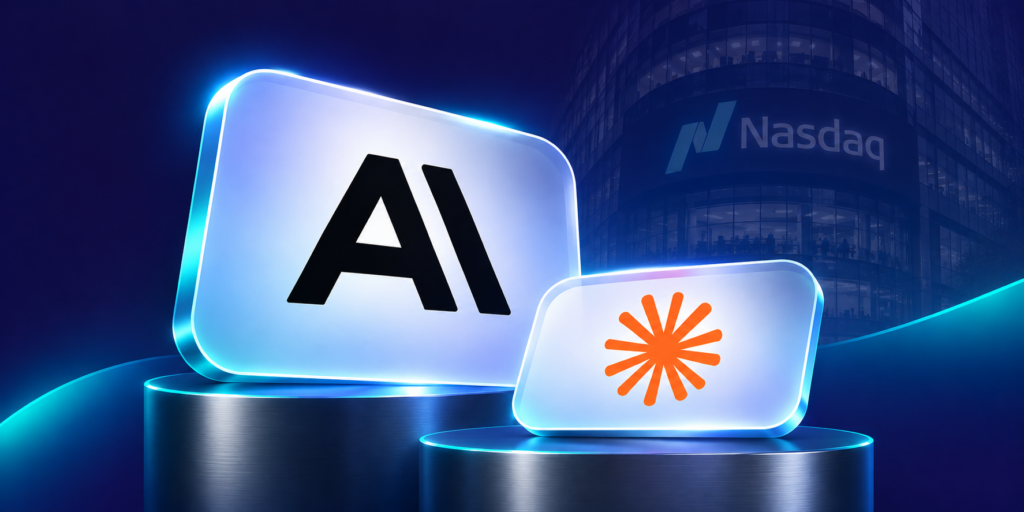
Anthropic’s first day on the Nasdaq was meant to be a celebration. The Claude maker became the world’s first publicly traded frontier AI company, pricing its IPO at $83 and opening at $111.50, about 34% higher. It raised $81.3 billion through the offering and a further $26 billion in private placement, for a total transaction value of $107.3 billion. At the peak, its valuation approached $2 trillion.
By the closing bell, the mood had cooled. The stock ended the day at $97.17, a gain of about 17% on the IPO price and a market value of roughly $1.75 trillion. By any ordinary standard that is a strong debut, but it fell well short of what the opening minutes had promised. And the rest of the market did not join the party.
A record listing, a worsening sell-off
The broader AI trade kept sliding. Asian equities headed for their worst week since March 2020, with the MSCI Asia-Pacific index excluding Japan down about 7% over the week and on course for a sixth straight losing session. Japan’s Nikkei fell more than 4% on the day, and South Korea’s KOSPI dropped nearly 5%. In the US, both the S&P 500 and the Nasdaq Composite had already lost more than 2% in a single session, and futures pointed lower again.
Analysts read this as a verdict on sentiment rather than on Anthropic itself. The listing, in their view, wasn’t enough to ease the wider worry about where the AI trade and equities are headed. Several pressures were working at once. Investors are uneasy about the sheer scale of spending on AI and the rising debt companies are taking on to fund it. Jensen Huang’s exit from Nvidia unsettled a stock that sits at the centre of the AI story. Opposition to data centres has grown following the Democrats’ midterm victory. Expectations of further US interest rate hikes have added to the strain.
The safety question the IPO put in the spotlight
Anthropic’s listing also revived an old tension. The company was founded by former OpenAI employees who wanted to build AI with a stronger emphasis on safety, and it has been among the most outspoken firms about the technology’s dangers. Its pre-IPO filing devoted 93 pages to risk factors, including the possibility of catastrophic or existential harm from advanced AI.
Now it answers to public shareholders who want growth. CEO Dario Amodei has acknowledged that tension, describing the company’s approach as deliberately slower than what it could technically achieve and promising to pace training and deployment until it is confident systems remain under human control. Critics are not fully convinced. A September resignation by one of its researchers, who accused leading labs of gambling with lives, and an independent report suggesting Anthropic is developing models roughly twice as fast as a year ago, have kept the debate alive.
Wealth is part of the story too. The Amodei siblings’ fortunes rose from about $14 billion each to roughly $22.7 billion and $22.8 billion on listing day, according to Forbes, and the founders have pledged to donate 80% of their equity, though the pledge is voluntary. As a public benefit corporation, Anthropic has a legal duty to weigh public good alongside shareholder returns, and the market will now test how that works in practice.
Why the first-day pop is a poor guide
For investors, the most useful lesson is about how little a debut-day move reveals. Subho Moulik, Founder and CEO of Appreciate, notes that the average US IPO gains around 19% on its first day, which puts Anthropic’s 17% close to normal. He is clear that this is a historical average and not a forecast for any single company. He also points to SpaceX, which gained 19% on its debut and slipped back close to its IPO price within five weeks.
Longer-run data supports that caution. Research from Jefferies covering more than two decades of IPOs finds that companies valued at $10 billion or more at listing average a first-week gain of about 26.5%, but only around 3.5% over the following twelve months.
Supply, funding and index demand
Several mechanical factors will shape the stock in the coming weeks. According to the prospectus, up to 316 million shares held by directors, officers and employees can be sold from day one, with more released in stages as lock-ups expire. Fresh supply can cap rallies, especially if early holders choose to lock in profits.
There is also a funding effect. Nigel Green of deVere Group has argued that every dollar in a deal this size has to come from somewhere, and that investors are selling other tech stocks, bonds, cash funds and private holdings to pay for their allocations. If that continues for several weeks, it could keep pressure on other technology shares and add to the sell-off.
On the supportive side, index inclusion could bring fresh demand. Under the Nasdaq-100’s fast-entry rules, a large new listing can qualify after as few as 15 trading days, and some reports point to an addition on or before December 21. Eligibility does not guarantee inclusion, and the weighting would matter as much as the headline.
What Indian investors should do with this
Indian residents can buy Anthropic shares after listing through international brokerages or India-based platforms that route investments under the Liberalised Remittance Scheme. The practical question is not whether access exists but how to use it. Viram Shah of Vested has suggested there is no need to deploy an entire allocation on day one, and that building a position gradually can help manage the volatility that tends to follow big listings.
A sensible approach starts with the basics. Decide how much of your overseas allocation you are willing to commit to a single, richly valued, newly listed stock. Stagger purchases rather than buying in one go. Watch lock-up expiries and index announcements as scheduled events that can move the price. And keep in mind that a falling market can pull down even strong companies regardless of their fundamentals.
The test is still ahead
Anthropic has done what few companies have: it listed at a valuation above $1.5 trillion, raised a record amount, and closed its first day comfortably above its offer price. The harder part begins now. It has to turn rapid growth into sustained revenue, justify an enormous valuation, manage a flood of new supply, and show that its safety commitments can coexist with shareholder expectations, all in a market that is currently pulling back from AI.
The debut was a milestone. Whether it becomes a good investment will be decided over the coming months, not in the first few minutes of trading.
Disclaimer: Investments in securities markets are subject to market risks. Read all related documents carefully before investing. The securities and examples mentioned above are only for illustration and are not recommendations.