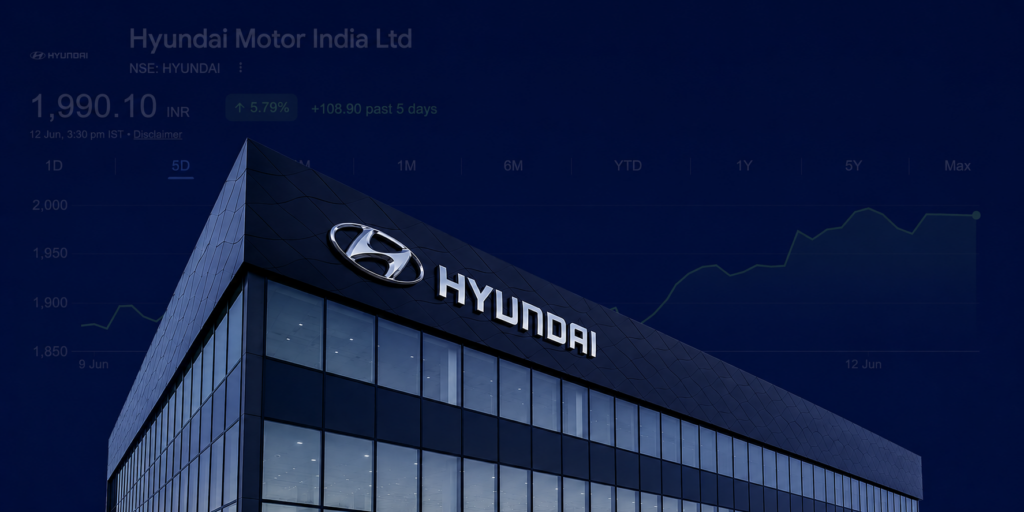
Shares of Hyundai Motor India Limited (HMIL) rose approximately 2% on June 10, 2026, after the company filed a detailed operational update with stock exchanges confirming that a fire-related production disruption at its Chennai Plant 1 was contained, temporary, and on a defined recovery timeline.
The filing, made under Regulation 30 of the SEBI LODR Regulations, disclosed that a fire at the manufacturing facility of Mobis India Limited — HMIL’s key Tier-1 supplier of automotive modules and assemblies — had caused a temporary disruption to production at Chennai Plant 1. The disruption is confined to that facility. Pune and Chennai Plant 2 continue to operate with minimal impact.
The company’s regulatory communication was precise on two recovery dates. Chennai Plant 1 is expected to regain its production pace by June 15, 2026, with all production operations projected to return to normal by June 22, 2026. HMIL stated it is sourcing automotive components from alternate locations to mitigate the impact — a standard supplier diversification response for a company with the scale and procurement relationships that India’s second-largest passenger vehicle manufacturer maintains.
The market reaction reflected relief rather than exuberance. A 2% gain on a stock that has been navigating margin pressure, a profit decline, two successive price hikes, and a broader auto sector derating is a calibrated response to a well-handled crisis communication — one that gave investors three things they needed: a defined scope (Chennai Plant 1 only), a defined timeline (June 22), and a retail sales assurance.
The Mobis India Fire and What It Disrupted
Mobis India Limited is the Indian subsidiary of Hyundai Mobis — the Korean parts manufacturing and after-sales services arm of the Hyundai Motor Group — and functions as HMIL’s primary supplier for assembled front-end modules, cockpit systems, chassis modules, and related sub-assemblies. The nature of these components — integrated assemblies rather than individual parts — means that a supply interruption at Mobis translates almost immediately into a production stoppage at the OEM, because these modules are delivered on a just-in-time basis and cannot be easily substituted at short notice from alternative sources.
The fire at Mobis India’s facility is the proximate cause of the Chennai Plant 1 disruption. HMIL’s filing stated it is still assessing the overall operational impact of the Mobis incident and that it expects most of the production losses to be recovered during the next quarter — Q1 FY27 (the April–June 2026 period), with the recovery extending into the first weeks of July where necessary.
The inventory assurance is the most market-relevant element of the filing. HMIL stated it does not expect any noteworthy impact on retail sales in June 2026 since it has adequate inventory in its network. This is not a generic reassurance — it is a specific claim about pipeline stock that protects retail throughput from the dealership channel even as plant output is temporarily constrained. The separation between wholesale production (which is affected) and retail delivery (which is buffered by inventory) is the structural reason the stock reacted with a gain rather than a loss.
The Financial Context: A Company Navigating Margin and Cost Pressures
The Chennai fire update arrives at a moment when Hyundai Motor India’s financial profile reflects a company that delivered volume growth in FY26 but faced measurable earnings pressure from cost headwinds it has only partially offset.
HMIL reported FY26 consolidated revenue of ₹7,07,633 million, up 2.3% year-on-year, with PAT of ₹54,315 million — representing a 3.7% decline from FY25. EBITDA margin for the full year contracted by approximately 70 basis points to 12.2%, attributed to commodity price volatility — particularly aluminium and steel cost pressure driven by the West Asia energy supply disruption — and logistics cost increases from higher freight rates on international shipping routes. The full-year result was within the company’s guided EBITDA margin range of 11% to 14%, but at the lower end of the band.
The board recommended a final dividend of ₹21 per equity share for FY26, subject to shareholder approval at the upcoming AGM.
Despite the annual profit compression, the volume trajectory has been strong. Hyundai Motor India reported a 4.15% increase in total sales for May 2026, selling 61,137 units during the month as against 58,701 units sold in the same period last year. Domestic sales increased by 9.07% to 47,837 units, while exports declined by 10.38% to 13,300 units. In the first two months of FY27, HMIL witnessed domestic sales rise by 13% to 99,739 units, compared to 88,235 units in the same period of FY26, according to MD and CEO Tarun Garg. April had been a milestone month: HMIL recorded highest-ever April domestic sales of 51,902 units, up 17% year-on-year.
The export weakness in May — a 10.38% decline — reflects supply chain challenges on international routes and the ongoing disruption to shipping logistics from the Strait of Hormuz closure. HMIL’s exports are concentrated toward the Middle East and Latin America, both of which are experiencing freight and logistics disruption in varying degrees.
Two Price Hikes in Two Months: A Margin Defence Strategy
The Chennai update exists in the context of an aggressive pricing strategy that HMIL has been executing since April 2026 to arrest the margin compression that characterised FY26.
Effective June 1, 2026, HMIL announced a strategic price revision of up to ₹12,800 across its vehicle portfolio. This followed a 1% weighted-average price increase implemented in May 2026 — meaning the company has raised prices in two consecutive months. The June revision is more significant in scope: the ₹12,800 cap applies across specific high-margin model-variant combinations, with the practical effect concentrated in mid-to-premium SUV derivatives where commodity cost recovery is most critical.
Hyundai’s decision to implement another price hike just a month after the May revision indicates that the West Asia crisis and associated logistics and commodity costs are weighing heavier than initially projected. The company maintains its FY27 guidance of 11% to 14% EBITDA margins — the same range as FY26 — with management having guided for 8–10% domestic and export volume growth alongside two new SUV launches: a second-generation SUV in the existing lineup and a localised compact electric vehicle.
The pricing strategy reflects a deliberate choice: protect margins through price increases rather than volume cuts, relying on the brand strength and product mix concentration — where SUV-led models including the Creta, Venue, and Alcazar account for the majority of domestic revenue — to sustain demand even at elevated price points. The competitive risk is that Maruti Suzuki, Tata Motors, and Kia India may absorb rather than match cost increases in certain segments, creating a price-gap that could affect HMIL’s market share in volume-sensitive compact SUV categories.
What Analysts Are Saying: Overweight and Above-Market Targets
The broader analyst community’s view on HMIL heading into the Chennai update was constructive, with multiple houses maintaining above-market ratings. JPMorgan maintained an Overweight rating on Hyundai Motor India with a target price of ₹2,135 as of May 27, 2026. Morgan Stanley maintained Overweight with a revised target of ₹2,114 (cut from a prior higher level following the FY26 results). Nomura maintained Buy at ₹2,407. CLSA held Outperform at ₹2,290.
The spread between the most bullish (Nomura at ₹2,407) and the most conservative targets is narrow, suggesting institutional consensus that HMIL’s FY27 volume growth guidance and margin recovery path — supported by the two new SUV launches and the Pune capacity expansion to 11.4 lakh units by 2030 — are achievable. The capex commitment of approximately ₹7,500 crore for FY27 reflects continued investment in manufacturing capacity rather than defensive retrenchment.
The investor conference scheduled for June 12, 2026, organised by Investec in Chennai, will be the next opportunity for management to address questions about the Mobis fire’s financial quantification, the alternate supplier sourcing cost, and the timeline for returning Chennai Plant 1 to full capacity. The conference, per HMIL’s regulatory filing, will cover only publicly available information — consistent with SEBI LODR requirements. The Mobis assessment, once complete, will be disclosed through a separate exchange filing.
The Operational Pattern: How Indian Manufacturers Handle Supplier Incidents
The market’s 2% positive reaction to the June 10 regulatory update reflects an investment community that has learned to read supply chain disruption communications carefully. The key variables that determine whether a manufacturing disruption announcement triggers a stock decline or an investor relief rally are: confinement (is it one plant or the whole network?), timeline (days or months?), and retail insulation (is customer delivery affected?).
HMIL’s June 10 filing addressed all three cleanly. The disruption is confined to Chennai Plant 1. The full recovery timeline is June 22 — twelve days from the date of disclosure. And retail sales in June are protected by adequate inventory. For a company that operates a 47,837-unit monthly domestic sales volume, “adequate inventory” implies channel stock of typically three to six weeks — enough to bridge the production gap without customer-visible delays.
The production loss, once the Mobis assessment is complete, will likely be quantified in units lost per day at Chennai Plant 1 and expressed as a percentage of monthly capacity. Given that the disruption appears to have begun in early June and recovery is expected by June 22, the absolute production loss — even at 100% downtime at Plant 1 during the period — would represent a fraction of a month’s domestic sales volume, easily absorbed by the inventory buffer HMIL has confirmed exists in its network.
Disclaimer: Investments in securities markets are subject to market risks. Read all the related documents carefully before investing. The securities quoted are exemplary and are not recommendatory.