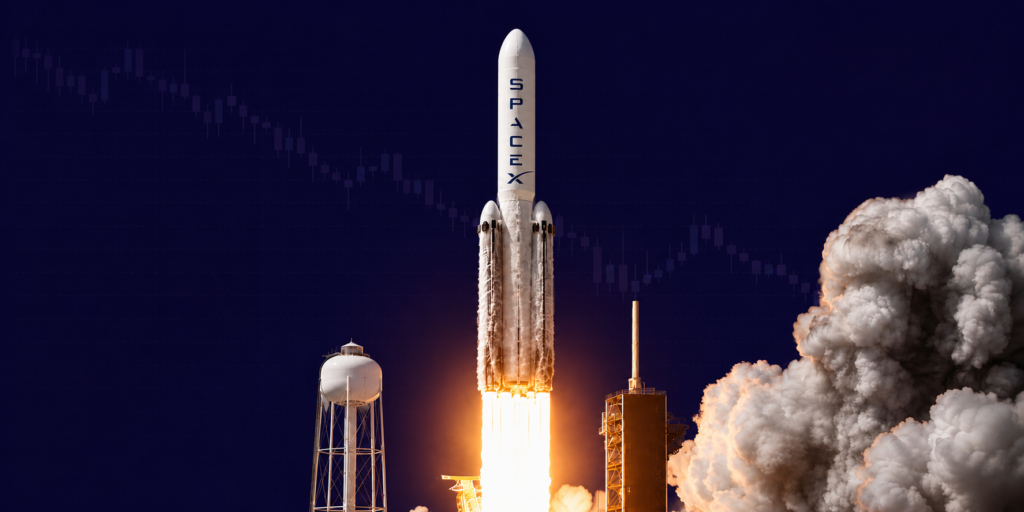
In the span of ten trading days, SpaceX went from the most celebrated stock market debut in history to one of the most dramatic post-IPO corrections Wall Street has seen in years. The question investors are now asking is simple: is this a buying opportunity, or the beginning of a longer reckoning?
From Record High to $600 Billion Wipeout
SpaceX listed on Nasdaq on June 12, 2026, raising $75 billion at $135 per share — the largest initial public offering ever recorded. By June 15, underwriters had exercised the greenshoe overallotment option, lifting total proceeds to $85.7 billion. In the days that followed, retail and institutional investors piled in, driving shares to an intraday peak of $225.64 on June 16 — a 67% surge from the IPO price — and briefly vaulting SpaceX past Amazon and Microsoft to become the fourth-most-valuable publicly traded company on Earth, with a market capitalization approaching $2.6 trillion.
Then came the reversal.
Shares fell 5% on Wednesday, June 18, followed by a 3.6% drop on Thursday. By Monday, June 22, the stock closed down 16.4% — its worst single session since going public — at $154.60. On Tuesday, June 23, shares extended their losses, briefly dipping to $146.88, falling below the $150 opening price from debut day. In total, the three-session selloff erased more than $600 billion from SpaceX’s peak market value. Measured from the intraday high, the cumulative decline exceeded $920 billion.
SPCX was simultaneously the top loser on US markets, according to Yahoo Finance data — and the most actively traded stock.
What Triggered the Selloff?
Three forces converged to drive the decline.
The bond filing. On Monday morning, SpaceX confirmed its first-ever public bond sale, a $20 billion offering. The company disclosed it would use proceeds to repay an outstanding bridge loan secured in February 2026 when it acquired xAI from Elon Musk. The initial market reaction was sharp: investors read the capital raise as a distress signal rather than routine refinancing — especially given SpaceX’s disclosed long-term debt of $29.1 billion as of March 31. The sell-off that followed was severe enough that SpaceX briefly had a lower market capitalization than it carried the morning of its IPO.
The bond market, however, told a different story. The offering attracted $89 billion in orders — a 3.5x oversubscription — and all three major credit agencies assigned investment-grade ratings: Moody’s at Baa1, Fitch at BBB+, and S&P Global at BBB. Far from signaling financial stress, the demand reflected institutional-level confidence in SpaceX’s long-term solvency. The company also disclosed a cash balance of $100.8 billion as of the offering date, further undermining the “cash crunch” narrative.
The broader tech selloff. SpaceX’s decline did not occur in a vacuum. Tech stocks were broadly under pressure, with analysts pointing to a more challenging interest-rate environment. Fed Chair Kevin Warsh’s hawkish signals added pressure on rate-sensitive growth stocks. Alphabet shed 2.1%, Nvidia fell 2.7%, Tesla dropped 2.7%, and Apple declined 0.9% in pre-market trading Tuesday, representing a combined market value erosion of roughly $331 billion across the group if losses held.
The float problem. Perhaps the most underappreciated factor is structural. SpaceX listed with just 4.2% of its total shares available to the public — the smallest float relative to total shares for any mega-cap debut in US history. A 30% retail allocation, the highest on record, amplified every move. Vanda Research data shows individual investors purchased $369.8 million of SPCX in the first three trading sessions — four times the $88.2 million they put into Nvidia over an equivalent post-listing window. That same thin float that powered the explosive rally is now accelerating the decline.
The Lockup Calendar: The Real Risk Ahead
Analysts at 22V Research have flagged the lockup schedule as the primary structural risk for investors holding SPCX through the summer. The timeline is more compressed — and more consequential — than a standard 180-day restriction period.
A 10% insider share unlock is triggered if SPCX closes at 30% or more above its $135 IPO price, a threshold of $175.50. A 20% unlock follows SpaceX’s first post-IPO earnings report, expected in early to mid-August. Two additional 7% tranches are set for approximately August 21 and September 10. 22V Research strategist Jeff Jacobson estimated that insiders could sell as much as 44% of total SpaceX shares by early September — expanding the current 4.2% public float by roughly 900%.
The precedent from comparable IPOs is not encouraging. Meta and Saudi Aramco both experienced drawdowns of 30% to 50% within their first six months as lockup windows expired.
Valuation: Where Analysts Stand
The debate over SpaceX’s intrinsic value is unusually wide — a 400% spread between the lowest and highest analyst targets.
On the bull side, Oppenheimer carried a $310 price target as of June 2026, and Arete Research analyst Andrew Beale holds the highest target on the Street at $401. The consensus across eight analysts sits at $221.20, suggesting roughly 39% upside from $154.60. Goldman Sachs projects SpaceX’s AI segment revenue rising from $15.6 billion in 2026 to $34.5 billion in 2027, with a moonshot figure of $322 billion by 2030.
On the bear side, NYU finance professor Aswath Damodaran estimates SpaceX’s equity at approximately $1.3 trillion, or around $103 per share, based on analysis of the company’s S-1. Morningstar places its fundamental fair value at $63 per share – 59% below Monday’s close. The company reported a net loss of $4.28 billion in Q1 2026 alone, trades at roughly 104.7x price-to-sales, and carries an accumulated deficit of $41.3 billion.
Wall Street projects full-year 2026 losses of $0.89 per share, shrinking to $0.24 per share in fiscal 2027 — still not a profitable company. Gary Black of The Future Fund summarized the valuation risk bluntly, arguing the stock has “no room for error” at a multiple of 175 times fiscal 2026 estimated enterprise value-to-EBITDA.
What the Stabilization Signals
By Tuesday, June 24, the story had begun to shift. SpaceX’s bond deal drew $89 billion in institutional demand — among the largest investment-grade order books in US corporate history — and shares partially recovered, rising more than 3% intraday. The $89 billion in bond demand stands in sharp contrast to the equity selloff, suggesting the institutional market views SpaceX as creditworthy even as equity markets price in near-term uncertainty.
Crucially, the proceeds from the bond offering will settle on June 26 and will be used to fully retire the bridge loan due in September 2027. With that liability removed, SpaceX’s remaining debt is spread across five maturities between 2031 and 2056. The bridge loan cliff — one of the more concrete bear arguments — effectively disappears after this week.
The Bottom Line
SpaceX’s post-IPO correction is a textbook case of what happens when extraordinary demand meets extraordinary supply constraints. The float structure that sent shares to $225 in four trading sessions is the same mechanism pulling them down now — and the lockup calendar suggests more supply is coming.
The bond deal, paradoxically, may end up being the stabilizing event. Its $89 billion demand proved SpaceX can access capital markets at scale, debunking the liquidity panic that triggered Monday’s 16.4% drop. The bridge loan risk is being retired. And with shares now sitting nearly 40% below the consensus analyst target, the risk-reward calculus looks different than it did two weeks ago.
What has not changed: SpaceX remains loss-making, its valuation multiples far exceed any comparable public company, and between August and September, the supply of available shares is set to increase dramatically. For investors without a high tolerance for volatility, that calendar — not the headlines — may be the more important variable to watch.
Disclaimer: Investments in securities markets are subject to market risks. Read all the related documents carefully before investing. The securities quoted are exemplary and are not recommended.