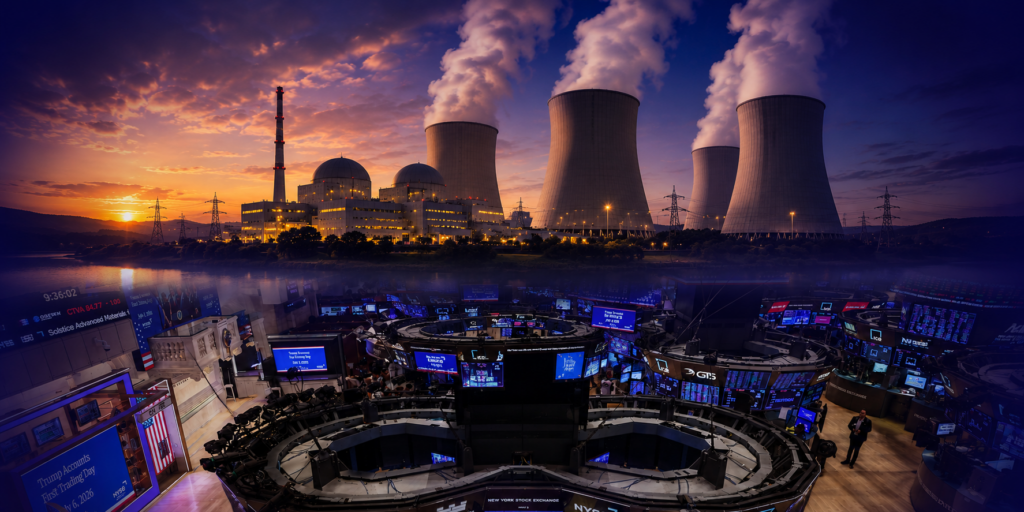
On July 7, 2026, Standard Nuclear, Inc. filed its amended S-1/A registration statement with the US Securities and Exchange Commission, targeting an initial public offering of 18.25 million Class A shares at a price range of $18 to $21 per share on the New York Stock Exchange under the ticker symbol STDN. At the top of the range, the offering would raise $383.25 million in gross proceeds; at the bottom, approximately $328 million. The target market capitalisation at $21 per share is $3.55 billion. Bank of America Securities, Goldman Sachs, Barclays, UBS Investment Bank, Evercore ISI, RBC Capital Markets, William Blair, and Stifel are the underwriters.
The company is headquartered in Oak Ridge, Tennessee — the city whose Manhattan Project-era research infrastructure gave rise to much of the foundational science of nuclear energy in the United States. That geographical choice is not incidental: Oak Ridge is home to Oak Ridge National Laboratory, the Department of Energy’s nuclear research campus, and a dense ecosystem of nuclear engineering talent and regulatory expertise that makes it the natural base for a company attempting to industrialise an advanced nuclear fuel type at national scale.
What Standard Nuclear Actually Makes
The product at the centre of Standard Nuclear’s business is TRISO — Tristructural Isotropic — fuel. TRISO fuel is one of the most technically sophisticated fuels in the nuclear industry. Each unit is a poppyseed-sized sphere: a kernel of highly enriched uranium surrounded by multiple concentric protective coatings, including layers of carbon buffer, inner pyrolytic carbon, silicon carbide, and outer pyrolytic carbon. These layered ceramic coatings are specifically engineered to encapsulate radioactive fission products even at extreme temperatures — conditions that would cause conventional nuclear fuel pellets to fail and release radioactivity.
The uranium used is High-Assay Low-Enriched Uranium, or HALEU — uranium enriched to between 10% and 20% uranium-235, materially above the 3–5% enrichment used in conventional light-water reactor fuel but below the 90%+ enrichment threshold of weapons-grade material. HALEU is the specific fuel type required by the new generation of advanced nuclear reactors — including High-Temperature Gas-Cooled Reactors, Fluoride Salt-Cooled Reactors, and various categories of microreactors — that represent the architecture of what the nuclear industry and US government policy framework describe as the advanced nuclear fleet.
Standard Nuclear describes itself as America’s only independent manufacturer of TRISO fuel — a claim consistent with the acknowledged concentration of advanced nuclear fuel manufacturing capability in a very small number of US-based entities, all of which are either government-affiliated or large established defence contractors rather than independent commercial suppliers. The company positions itself as reactor-agnostic: rather than being tied to supplying fuel to one specific reactor design or one specific commercial partner, it aims to be the domestic independent supply source for any advanced reactor that requires TRISO fuel, regardless of developer.
Beyond TRISO, Standard Nuclear also produces Radioisotope Power Systems (RPS) — devices that generate electrical power from the heat produced by radioactive decay of plutonium-238 or other radioisotopes. RPS systems are the power source for deep-space missions (including the Curiosity and Perseverance Mars rovers and the Voyager probes), lunar surface operations, and remote terrestrial applications where solar power and conventional batteries are impractical. This is a distinct, highly specialised business line with demand principally from NASA, the Department of Defense, and national security applications — a set of counterparties that prioritise reliability and national security supply chain independence above price.
The Policy and Market Backdrop Driving the IPO
Standard Nuclear has timed its IPO at the intersection of two converging demand curves, both of which are unambiguously real.
The first is the Trump administration’s stated ambition to quadruple US nuclear power capacity by 2050 — from approximately 100 gigawatts of installed capacity today to 400 gigawatts within 25 years. This target, if pursued with anything approaching the regulatory and infrastructure support implied, would represent the largest expansion of nuclear generating capacity in American history, requiring a commensurate expansion of domestic nuclear fuel manufacturing capacity. US law and national security policy already tilt procurement of nuclear fuel for government and military applications toward domestically produced supplies, and recent legislative action has further reinforced barriers to Russian and Chinese enriched uranium imports.
The second is AI data centre power demand. Every major technology company building or operating large-scale AI infrastructure has disclosed that electricity availability — stable, continuous, high-density power — is one of the primary constraints on AI capacity deployment. Nuclear power, uniquely among zero-carbon electricity generation technologies, provides baseload power that operates continuously regardless of weather conditions, making it structurally preferable to solar and wind for data centre applications that require 24/7 power availability. Amazon, Google, Microsoft, and others have all announced or are pursuing nuclear power purchase agreements or direct investments in advanced nuclear reactor developers specifically to secure long-term power supply for AI data centres. US News and World Report’s summary of the market context was precise: “Energy-related IPOs are also benefiting as the Trump administration pushes to quadruple US nuclear power capacity by 2050 to meet growing electricity demand from AI-driven data centers.”
The Specific Risk Profile: What the S-1 Actually Discloses
Standard Nuclear’s S-1 is the document that separates the compelling macro thesis from the specific company-level risk, and investors who are evaluating STDN as an investment rather than a thematic bet need to spend time on both sections of that document.
The most critical disclosure is temporal: the company was incorporated on July 15, 2024 — less than two years before its IPO filing. It had an accumulated deficit of $79.9 million as of March 31, 2026, and has had no large-scale commercial fuel sales to date. The company is not yet in full commercial production. This is a pre-revenue, pre-production IPO for a company with an almost uniquely long and capital-intensive path from its current state to commercial-scale fuel manufacturing.
The company’s facility plan illustrates that path. The operating Oak Ridge SN-0 facility is a demonstration and pilot production line, not a commercial-scale plant. Two near-term sister facilities — SN-TN and SN-ID — are expected to come online in the second half of 2026, subject to Department of Energy approvals and readiness reviews; those qualifiers are significant given the DOE’s historically variable timeline on nuclear facility approvals. A fourth facility, the Richland SN-F, is a joint venture with Framatome — the French nuclear technology company — representing a longer-horizon capacity expansion. A fifth, longer-term facility, SN-TN20, would represent the company’s first genuinely commercial-scale production. The distance between the SN-0 pilot line and SN-TN20 production is where most of the $383 million in IPO proceeds will need to be deployed — and where the execution risk is concentrated.
The governance structure adds a concentration-of-control dimension that public market investors in technology and energy IPOs have become familiar with but should still note explicitly: Founder and Executive Chairman Thomas Hendrix retains approximately 59.5% of total voting power through a dual-class share structure, making STDN a controlled company in the NYSE’s own classification. Voting control at 59.5% means public shareholders have limited ability to influence strategic decisions or management changes, regardless of economic majority. This structure is neither unusual nor inherently problematic in early-stage companies where founders’ long-term vision is material to the investment thesis — but it is a governance constraint that investors should incorporate into their assessment.
Standard Nuclear’s relationship with the Department of Energy provides both an asset and a dependency that is worth understanding clearly. The company was the first recipient of the DOE’s Fuel Line Pilot Program and operates under a DOE Other Transaction Agreement — a streamlined contracting mechanism the DOE has used to accelerate deployment of advanced nuclear technologies. This relationship provides access to DOE facilities, technical expertise, and potentially future fuel purchase agreements, but it also means that a material change in DOE priorities, funding levels, or political support for advanced nuclear could directly affect the company’s business model before it reaches commercial self-sufficiency.
The Investment Case: Three Questions to Resolve
Investors evaluating Standard Nuclear’s IPO as a potential position should resolve three questions before committing capital, and none of them is answerable from the existing S-1.
The first is fuel supply timeline: when does SN-TN and SN-ID come online, what does DOE approval actually look like in practice for TRISO production facilities at commercial scale, and what is the realistic timeline from those facilities’ commissioning to a recurring commercial revenue stream? Green Stocks Research’s analysis of the S-1 identified “a path to commercial TRISO production by 2026–2027 and scaling toward $200 million in revenue by 2028” as the company’s own projected trajectory — but this is a prospectus-disclosed projection, not an audited forward commitment, and the DOE approval qualifier on second-half 2026 readiness for SN-TN and SN-ID introduces uncertainty about the front end of that timeline.
The second is competitive positioning: the claim that Standard Nuclear is “America’s only independent manufacturer of TRISO fuel” is a meaningful technical fact, but independent status in this market does not automatically equate to commercial advantage. Centrus Energy, BWX Technologies, and X-Energy — the latter backed by Amazon — all have exposure to advanced nuclear fuel supply chains. The distinction between “independent” and “affiliated” in nuclear fuel supply is relevant to certain government procurement contexts but less determinative for commercial reactor developers choosing their fuel suppliers, who care primarily about reliability, quality certification, price, and supply certainty.
The third is valuation calibration: $3.55 billion for a company incorporated 23 months ago with no commercial production, an accumulated deficit of $79.9 million, and a revenue timeline that requires successful DOE approvals and facility commissioning over the next 18 to 30 months is a valuation that is entirely a function of thematic premium. The AI-nuclear power demand thesis is real; the Trump administration’s nuclear quadrupling ambition is a stated policy goal; the US government’s interest in domestic TRISO supply for national security applications is documented. But none of these factors creates a direct bridge from the current operational state to a $3.55 billion enterprise value without considerable execution across multiple regulatory and commercial milestones.
The Right Comparison: Stage, Not Sector
The most useful framing for Standard Nuclear’s IPO is not to compare it to established nuclear utilities or even to the uranium enrichment companies that trade on public markets. The right comparison class is early-stage, mission-critical technology companies that have secured government programme participation — the DOE relationship, the Fuel Line Pilot Program status, the Other Transaction Agreement — as a platform for commercial scaling, and are using the public markets to fund the facility build-out required to convert that programme participation into recurring commercial revenue.
In that class, the investment case is not trivially wrong: the addressable market is real and structurally growing, the company has genuine technical differentiation and a government endorsement that most competitors in the same space would struggle to replicate quickly, and the management team’s relationships in the Oak Ridge nuclear complex provide a specific form of institutional access that new entrants cannot easily acquire. Thomas Hendrix’s background and the company’s DOE programme positioning are meaningful commercial assets in a procurement environment where the buyer is the US government.
What remains genuinely uncertain — and what the $383 million IPO is in part trying to fund the answer to — is whether TRISO fuel can be manufactured at commercial scale, on the company’s projected timeline, at the cost structure that makes the SN-TN and SN-ID facilities economically viable before another capital raise is needed. For investors who believe the answer to that question is yes and are willing to hold through the facility approval and commissioning process, STDN at $18 to $21 per share may be an appropriate early-stage position. For investors who require demonstrated revenue before establishing a position in a capital-intensive, regulatory-dependent manufacturing business, the IPO is too early in the company’s journey.
Disclaimer: Investments in securities markets are subject to market risks. Read all related documents carefully before investing. The securities and examples mentioned above are only for illustration and are not recommendations.