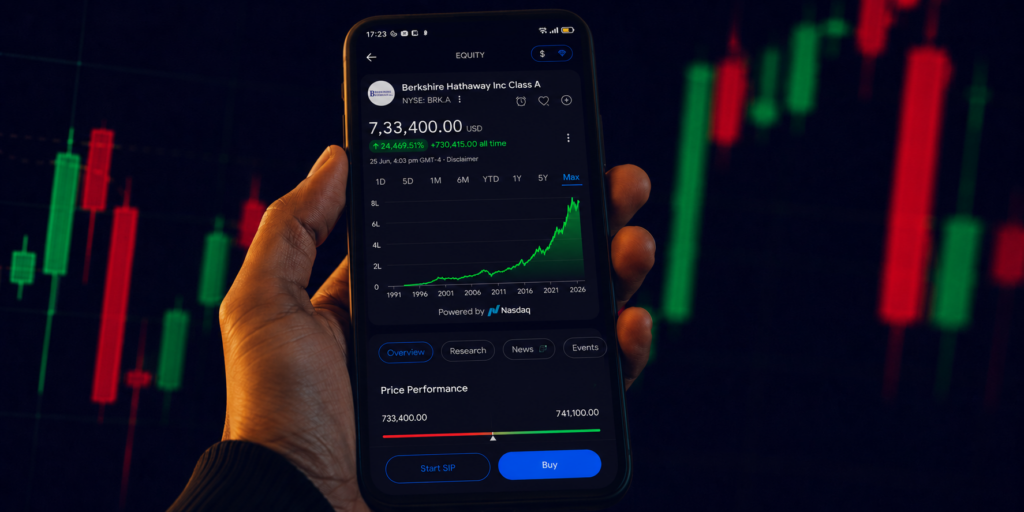
Berkshire Hathaway has spent much of the past year as a quiet underperformer — trailing the S&P 500 by a wide margin while Wall Street chased artificial intelligence and mega-cap tech. But something has shifted in recent weeks. As the broader market grows increasingly expensive and a new CEO starts writing his own chapter, BRK.B is drawing fresh attention from investors who want quality at a reasonable price.
Here is what the numbers say, and why it matters.
A New CEO, A New Pace of Dealmaking
The most important change at Berkshire in 2026 is not a balance sheet line — it is leadership. Greg Abel officially took the reins from Warren Buffett on January 1, 2026, and he has wasted no time proving he can deploy capital decisively.
In the span of just a few weeks, Abel closed the $9.7 billion acquisition of OxyChem — Occidental Petroleum’s chemicals arm — made a $1.8 billion strategic investment in Japanese insurer Tokio Marine, and then announced a $6.8 billion all-cash takeover of homebuilder Taylor Morrison. He followed that with a $10 billion equity stake in Alphabet. Four moves, roughly $28 billion deployed, in under six months.
Buffett himself appeared bullish on his successor’s instincts. “Greg did that faster than I could have done it, smoother than I could have done it,” Buffett told CNBC in June.
The Taylor Morrison acquisition is particularly telling about how Abel intends to run the conglomerate. Rather than taking a partial stake in a publicly listed homebuilder, he chose to privatize one entirely — a pattern also visible in the OxyChem deal. Abel seems less interested in minority equity exposure and more inclined toward full ownership of businesses with durable cash flows. That signals a meaningful shift in capital allocation philosophy from his predecessor.
The Financials: Steady, Not Spectacular
Berkshire’s Q1 2026 results — the first quarterly report under Abel — told a story of solid operational strength rather than dramatic acceleration.
Operating earnings came in at $11.35 billion, up nearly 18% from $9.64 billion in the same quarter a year earlier. Revenue rose 4.4% year over year to $93.6 billion, while net income attributable to shareholders more than doubled, climbing to $10.1 billion from $4.6 billion in Q1 2025.
The insurance segment continued to be a key earnings engine. Insurance underwriting contributed $1.72 billion — a 28% jump year over year — driven by disciplined risk selection across Berkshire’s sprawling insurance operations. BNSF, the railroad business, added $1.38 billion. Berkshire Hathaway Energy contributed $1.11 billion.
Not everything was clean. GEICO, the company’s flagship auto insurer, reported a 34% decline in earnings — a notable soft spot in an otherwise strong quarter. The result came in slightly below analyst expectations of $11.56 billion, per FactSet.
But the headline that matters most to long-term investors is the cash position: as of March 31, 2026, Berkshire’s cash and short-term investments had swelled to a record $397 billion, up from $373 billion at the end of 2025. That war chest isn’t just a balance sheet curiosity. In a high-rate environment, it is generating meaningful returns. Shareholders’ equity stood at $729.4 billion at quarter-end.
The Valuation Case: Cheap Relative to the Market
Here is where the investment argument gets interesting.
The S&P 500 currently trades at roughly 32 times forward earnings, with the Shiller CAPE ratio sitting above 41 — a level historically associated with stretched valuations. Berkshire, by contrast, trades at approximately 1.45 times book value, close to its 10-year historical average.
On a price-to-earnings basis, BRK.B’s trailing P/E has declined to around 14, below its 12-month average of roughly 15.4. The stock’s 52-week range runs from $455.19 to $516.85. As of June 24, it is trading near $494 — comfortably in the middle of that band, with Wall Street’s consensus price target sitting at approximately $520.
The 10-year total return for BRK.B stands at 237%, and the 20-year figure is 674%. Over two decades, the stock has compounded at roughly 10.7% annually. For context, BRK.B’s 5-year price CAGR is approximately 10%. These are not venture-capital-style returns, but they are highly consistent, with notably low volatility — the stock’s beta is just 0.14.
The Underperformance Gap: A Risk or an Opportunity?
Over the past 12 months, BRK.B has returned roughly 0%, while the S&P 500 has gained around 22%. That gap is significant, and it has frustrated some shareholders. The primary explanation is structural: Berkshire has minimal exposure to artificial intelligence, which has been the dominant driver of the broader market’s ascent.
That same dynamic, however, is what makes the relative valuation case compelling to contrarians. The S&P 500’s gains are heavily concentrated — the ten largest index constituents account for nearly 40% of its total weight. Berkshire, by contrast, generates cash from insurance, energy, rail, manufacturing, and consumer businesses. Its float — the pool of premium money held before claims are paid — stood at $176.9 billion as of March 31, 2026, a structural advantage that few competitors can replicate.
The next earnings report is scheduled for August 3, 2026. That release, Abel’s second as CEO, will offer the first real read on whether the Taylor Morrison and Alphabet investments are performing to expectations.
What Investors Are Watching
Three variables dominate the near-term narrative.
Capital deployment. With nearly $400 billion on the balance sheet, investors want to see Abel continue to put cash to work at attractive prices. Each acquisition announcement has been met with a positive market response, suggesting shareholders are rewarding activity over patience.
Insurance profitability. The 28% jump in underwriting earnings in Q1 was encouraging, but GEICO’s 34% earnings decline is a margin risk that deserves monitoring. Auto insurance pricing and loss trends will be a key watch item through the rest of 2026.
Leadership continuity. Abel is writing a new playbook, but Berkshire’s culture of decentralized management and long-term ownership remains intact. How he balances operational intervention — as he hinted at with Taylor Morrison’s integration into Clayton Homes — against Berkshire’s tradition of leaving acquired companies alone will define his early tenure.
The Bottom Line
Berkshire Hathaway is not a stock that rewards impatient investors. It does not pay a dividend. Its management moves deliberately. And it will almost certainly trail the S&P 500 in any year defined by a narrow, technology-driven rally.
But the combination of a record cash position, resilient operating earnings, a new CEO demonstrating clear deal-making ability, and a valuation meaningfully below the broader market makes BRK.B one of the more defensible large-cap positions available to investors today — particularly those who believe the current market is priced for a level of perfection that markets rarely sustain.
At $494 a share, the market is not pricing in a lot of optimism. That, in itself, might be the most compelling reason to pay attention.
Disclaimer: Investments in securities markets are subject to market risks. Read all the related documents carefully before investing. The securities quoted are exemplary and are not recommendatory.