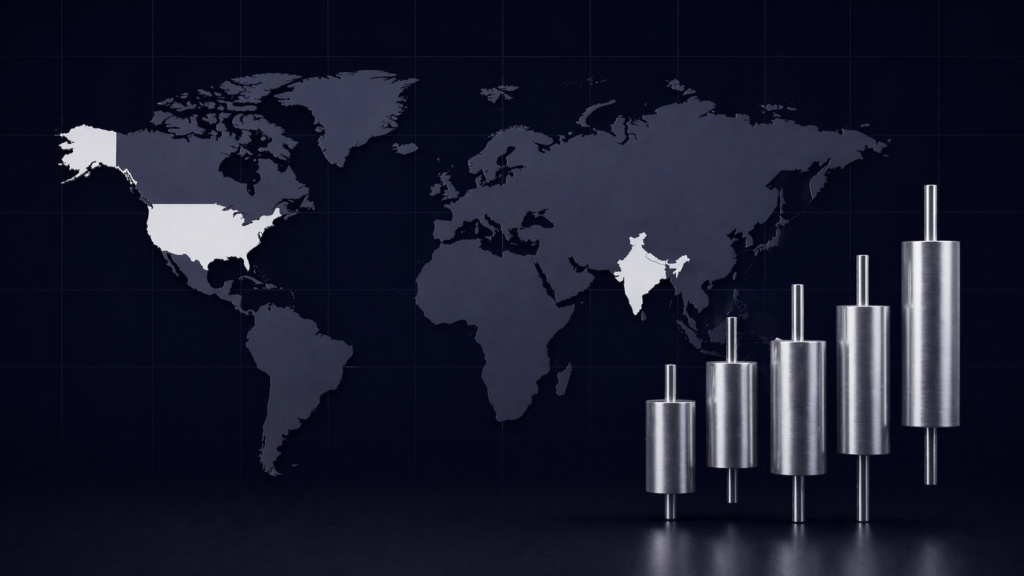
If you step back and look at the global economy today, two markets stand out for very different reasons.
India is growing fast. The U.S. is growing steadily.
At first glance, faster growth may seem more attractive. But in investing, consistency often matters just as much as speed. That is where the comparison becomes more interesting.
For investors exploring global opportunities through platforms like Appreciate, the question is not about choosing one over the other. It is about understanding how these two economies complement each other.
Because in many ways, India and the U.S. represent two different engines of the same global cycle.
Growth Versus Stability Is Not a Trade-Off Anymore
India continues to post strong growth numbers. Recent data shows GDP expansion well above most major economies, supported by domestic demand, infrastructure spending, and a growing services sector.
The U.S., on the other hand, is expanding at a more moderate pace. But what it lacks in speed, it makes up for in consistency.
Growth in the U.S. is broad-based. It is supported by corporate earnings, productivity improvements, and sustained consumer demand. This creates a more stable economic environment.
The difference is important.
India represents momentum. The U.S. represents durability.
For investors, this means the choice is no longer about growth versus stability. It is about how to balance both within a portfolio.
Inflation and Policy Are Moving in Sync but at Different Stages
Both economies are now seeing inflation stabilize after a period of volatility.
In India, inflation has cooled significantly, moving closer to policy targets. In the U.S., inflation has also moderated and is approaching levels that allow for more predictable policy decisions.
However, the stage of the cycle differs.
The U.S. appears closer to a policy pivot, with interest rates stabilizing and the possibility of easing becoming more visible. India, while stable, is still navigating its own cycle of growth and inflation balance.
This creates an important dynamic.
A more predictable policy environment in the U.S. supports valuations and long term investment flows. In India, policy continues to support growth through infrastructure and domestic demand.
Both are positive, but they operate differently.
Markets Reflect the Difference in Economic Structure
Equity markets often translate macro trends into investor outcomes.
Over the past year, both Indian and U.S. markets have delivered positive returns. However, the drivers behind those returns are not the same.
In India, performance has been supported by domestic themes such as financial services, manufacturing, and consumption.
In the U.S., returns have been driven more by earnings strength, productivity gains, and continued investment in areas such as technology and energy.
Corporate earnings data reinforces this difference.
A higher proportion of U.S. companies are exceeding expectations, reflecting stronger profitability and operational efficiency. This consistency contributes to sustained market performance.
The takeaway is clear.
India reflects optimism. The U.S. converts that into consistent earnings-driven returns.
Capital Flows Continue to Favor Stability
Global capital tends to move toward markets that offer both opportunity and reliability.
While India continues to attract steady investment, the U.S. remains the primary destination for global capital flows. The scale, depth, and predictability of U.S. markets make them a preferred allocation for large investors.
This does not diminish India’s importance.
Instead, it highlights a complementary relationship.
India offers growth potential. The U.S. offers a stable platform for deploying large amounts of capital.
For investors, this distinction matters because capital flows often influence long-term market performance.
Understanding Where Each Economy Stands in the Cycle
Every economy moves through cycles, and positioning within that cycle affects investment outcomes.
India is currently in a phase of consolidation following a period of rapid growth. This is a natural progression, allowing the economy to stabilize and prepare for the next phase of expansion.
The U.S. appears to be in a later stage of its cycle, but one that continues to extend through productivity gains and innovation. Investment in areas such as artificial intelligence and energy transition is helping sustain growth.
This creates a balanced global backdrop.
One economy is consolidating and building momentum. The other is extending growth through efficiency and scale.
Together, they reduce overall volatility in the global system.
Why Diversifying Across Both Markets Matters
For investors, the most important takeaway is not which economy is better. It is how they work together.
India and the U.S. offer exposure to different drivers of growth.
India provides access to domestic expansion, infrastructure development, and consumption driven growth. The U.S. offers exposure to global innovation, corporate earnings strength, and mature capital markets.
By combining both, investors can reduce concentration risk and participate in multiple growth themes.
This approach also helps manage uncertainty.
If one market slows, the other may continue to perform, creating a more balanced portfolio outcome.
Turning Global Insight Into Portfolio Strategy
Understanding these dynamics is valuable, but execution is what ultimately matters.
Access to global markets allows investors to translate macro insights into real portfolio decisions. This includes allocating across sectors, geographies, and asset classes based on where opportunities are emerging.
Platforms like Appreciate make this process more accessible by enabling investment in U.S. stocks and ETFs alongside domestic exposure.
This creates flexibility.
Investors can adjust their portfolios as cycles evolve, rather than remaining tied to a single market or theme.
In a world where growth is increasingly interconnected, this flexibility becomes a key advantage.
Conclusion
India and the U.S. are not competing stories. They are complementary ones.
India brings momentum, driven by domestic demand and expansion. The U.S. brings consistency, supported by earnings, productivity, and scale.
Together, they form a balanced foundation for global investing.
For investors, the opportunity lies in recognizing how these two economies fit together and positioning accordingly.
Because in today’s market, the most effective strategy is not choosing one engine over the other. It is understanding how both drive the journey forward.
Disclaimer: Investments in securities markets are subject to market risks. Read all related documents carefully before investing. The securities and examples mentioned above are only for illustration and are not recommendations.