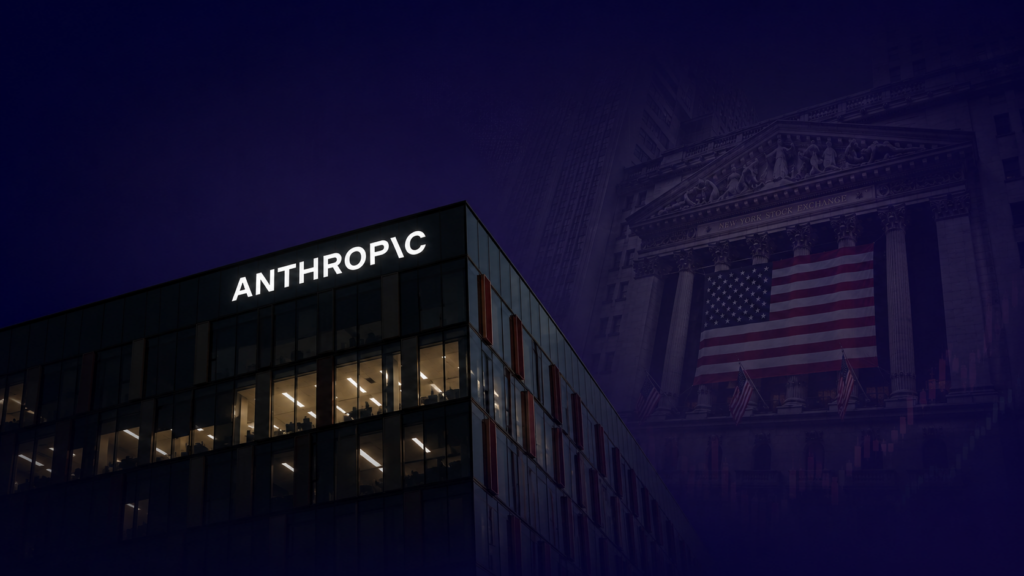
On June 1, 2026, Anthropic quietly submitted a draft registration statement to the US Securities and Exchange Commission, setting in motion what could be one of the largest technology public offerings in Wall Street history. The filing is confidential — a standard pre-IPO mechanism that allows the SEC to review disclosures privately before a company faces public scrutiny — and Anthropic has been careful to say only that it “gives us the option to go public after the SEC completes its review.” No firm pricing date. No share count. No listing price.
But the intent is unmistakable. And the timing is everything.
The Race with OpenAI Is On
The Anthropic IPO filing arrived just four days after the company closed a $65 billion Series H funding round — led by Altimeter Capital, Dragoneer, Greenoaks, and Sequoia Capital — at a post-money valuation of $965 billion. That round had itself made news, because it pushed Anthropic’s private market valuation past OpenAI’s $852 billion mark for the first time, a symbolic inversion in an industry rivalry that has defined the AI landscape since 2023.
OpenAI is preparing its own confidential SEC filing, targeting a Q4 2026 listing window. Executives there have reportedly expressed concern about being beaten to the public markets. Goldman Sachs, JPMorgan Chase, and Morgan Stanley are in consideration for lead underwriting roles on both deals. The fall 2026 IPO window — which already includes SpaceX’s submitted paperwork — could produce more than $200 billion in new public market value from three companies alone, a concentration of debut capital without precedent in modern markets.
Anthropic, targeting an October 2026 listing on Nasdaq, appears to be aiming for a debut market capitalisation above $1 trillion. If markets cooperate, that would immediately place it among the top 15 most valuable listed companies in the United States on its first trading day.
A Revenue Trajectory That Has No Comparable Precedent
To understand why markets are paying attention, consider the revenue growth curve. Anthropic’s annualised revenue run rate stood at $87 million in January 2024. By December 2024, it had crossed $1 billion. By the end of 2025, it reached $9 billion. Then the acceleration became near-vertical: $14 billion in February 2026, $19 billion in March, $30 billion in April, and $47 billion by early May 2026 — the figure disclosed in connection with the Series H raise.
The company has told investors it expects revenue to exceed $50 billion by the end of July 2026, representing roughly an 80-fold increase in annualised revenue over two years. For Q2 2026 alone, Anthropic projects $10.9 billion in revenue — more than double Q1’s $4.8 billion, and more than its entire 2025 annual revenue in a single quarter. According to the Wall Street Journal, Q2 2026 is expected to be the company’s first-ever profitable quarter, with operating profit projected at approximately $559 million — a thin 5% margin, but a psychologically significant milestone ahead of a public listing.
No B2B software company has scaled this fast. Not Slack. Not Zoom. Not Snowflake.
The Enterprise Engine Driving the Numbers
Anthropic’s growth story is fundamentally an enterprise story. Roughly 80% of its revenue comes from business customers — a sharp contrast with OpenAI, where consumer subscriptions represent a larger share of the mix. Enterprise contracts, by their nature, are stickier: harder to cancel, more likely to expand, and less sensitive to individual pricing decisions than consumer plans.
The depth of that enterprise penetration is striking. As of April 2026, more than 1,000 businesses were spending over $1 million annually with Anthropic — a number that doubled in under two months. The cohort spending more than $100,000 a year had grown roughly sevenfold in the prior twelve months. The company now serves over 300,000 business customers in total, up from fewer than 1,000 two years ago. In April 2026, Anthropic surpassed OpenAI in business adoption for the first time, according to Ramp’s AI Index, which tracks spending data across 50,000 companies. Anthropic’s enterprise adoption reached 34.4% of tracked businesses; OpenAI’s fell to 32.3%.
The engine behind much of this growth is Claude Code, the company’s agentic AI coding tool launched publicly in mid-2025. Claude Code hit $1 billion in annualised revenue within six months of launch — and by February 2026 was already generating over $2.5 billion. Enterprise clients including Netflix, Spotify, KPMG, L’Oréal, and Salesforce are among its users. More than half of all enterprise spending on Anthropic’s products now flows through Claude Code. The product has driven a commercial transformation at the company itself: as of late May 2026, Anthropic had 72 open sales roles and 67 in research — a telling ratio for a company that markets itself as safety-first.
Claude is also the only frontier AI model available simultaneously across all three major cloud platforms: AWS Bedrock, Google Cloud Vertex AI, and Microsoft Azure Foundry. Amazon, which has committed to investing up to $25 billion in Anthropic, has secured dedicated compute capacity for training and deploying Claude models. Google and Broadcom have signed a separate agreement to supply multiple gigawatts of next-generation TPU capacity from 2027.
The Risk No One Is Ignoring
Here is the inconvenient timing: Anthropic filed for its IPO on the same day that a wave of data on enterprise AI spending anxiety landed in the market.
Within hours of the filing, OpenAI CEO Sam Altman told CNBC that corporate concern over AI costs is “the most fair criticism of AI so far.” A Bain survey of nearly 1,000 companies showed that after investing in AI, 40% of those surveyed reported cost savings below 10% — in the survey’s own phrasing, “the value didn’t arrive.” An early Anthropic investor told Axios that companies are “waking up to how much they’re spending on Claude,” calling it a risk worth monitoring. An AI consultant cited by the same report described a CFO client who had accidentally spent $500 million on Claude in a single month.
The structural exposure is real. Companies are Anthropic’s biggest customers. If they reduce AI budgets — through a combination of sticker shock, unmet ROI expectations, or a rotation toward cheaper open-source models — that weakens the revenue base that justifies a near-trillion-dollar valuation. The risk of switching to cheaper alternatives has been described by analysts in the field as potentially existential.
There is also an accounting nuance worth noting. Anthropic reports revenue from cloud resellers — AWS, Google, Microsoft — on a gross basis, counting total end-customer spend as revenue and booking partner payouts as cost. This inflates headline revenue figures relative to peers who report on a net basis. The full S-1, when it becomes public, will need to resolve this clearly for institutional investors to anchor precise valuation models.
The Governance Wildcard
Anthropic’s corporate structure adds a dimension unusual in the IPO landscape. The company is incorporated as a Public Benefit Corporation and maintains a Long-Term Benefit Trust designed to ensure its safety mission takes precedence over short-term shareholder pressure. This is not window-dressing: in April 2026, Anthropic withheld its most advanced model — Claude Mythos Preview — from public release over cybersecurity concerns, even as the competitive pressure to ship was intense. The company simultaneously established a cybersecurity partnership with Amazon, Apple, and Microsoft to use Mythos to identify software vulnerabilities before public deployment.
This governance posture has not been without friction. CEO Dario Amodei’s safety-focused public stance has reportedly generated tension with the Trump administration. For public market investors, the PBC structure and LTBT raise a genuine question: in a shareholder dispute over strategic direction, who ultimately prevails?
What Public Market Investors Will Need to See
A confidential S-1 is not an IPO. It opens a regulatory review window. The actual decision to list will hinge on market conditions, the SEC’s timeline, and whether Anthropic’s audited financials hold up under a standard of scrutiny considerably more exacting than private capital has demanded.
The key questions are straightforward. Can the $559 million Q2 operating profit be sustained and grown, or is it a timing artefact of the revenue ramp outpacing cost additions that are still being onboarded? How does the gross-versus-net revenue accounting affect true margin profiles? What is the company’s path to a margin structure that justifies a near-trillion-dollar valuation at steady state?
For now, the market appears willing to bet that the AI infrastructure buildout is still in its first innings, that Anthropic’s enterprise moat is durable, and that a company growing at 80x in two years deserves the benefit of the doubt on near-term cost questions. Whether that conviction survives the full scrutiny of a public S-1 will determine whether the October 2026 listing window becomes a landmark moment in technology history — or a stress test of how far AI optimism can stretch.
Disclaimer: Investments in securities markets are subject to market risks. Read all the related documents carefully before investing. The securities quoted are exemplary and are not recommended