At COMPUTEX 2026 on June 2, Nvidia CEO Jensen Huang turned to Marvell CEO Matt Murphy on stage and delivered one of the most consequential lines in recent semiconductor history: “The next trillion-dollar company, ladies and gentlemen.”
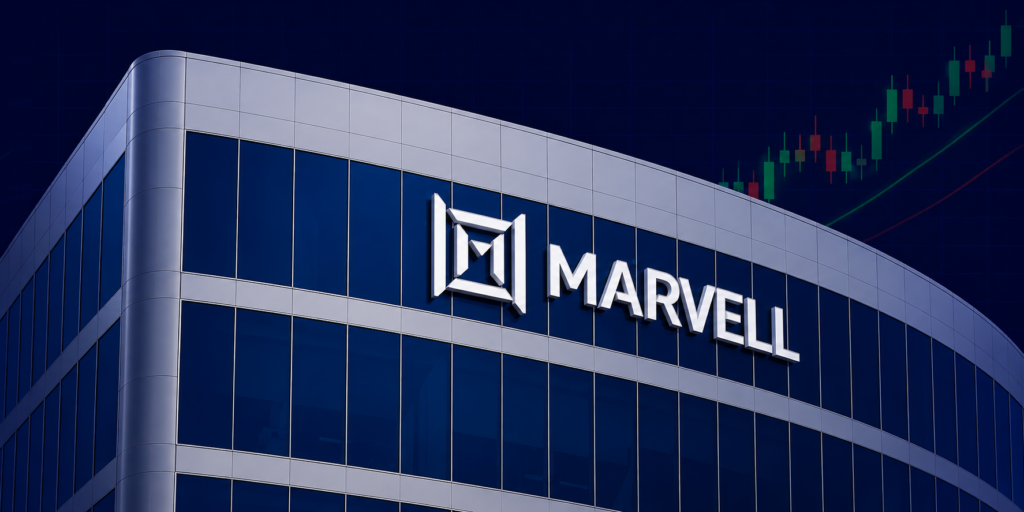
The market reacted before the keynote had even concluded. Marvell Technology (NASDAQ: MRVL) shares surged 25–30% almost immediately, adding tens of billions of dollars in market capitalisation in a matter of hours. By the time the US market opened on June 3, MRVL had extended those gains, with the stock trading between $294 and $333.50 intraday — up more than 32% from its pre-Computex levels. Volume reached 59.4 million shares, approximately 40% above the 30-day average of 42.51 million, as institutional investors rushed to establish or expand positions.
To understand why a single statement from a competitor’s CEO could produce this magnitude of move, you have to understand what Marvell actually is — and what Jensen Huang was signalling about the next phase of AI infrastructure buildout.
The Connectivity Thesis: Why This Isn’t Just a Compliment
Huang’s endorsement was not social media flattery. It was a thesis about where AI infrastructure spending is going next — and it is one that Marvell CEO Matt Murphy had been building the analytical case for throughout his own Computex keynote.
“For the past several years, AI has created new demands on the infrastructure and we’ve seen the industry solve one major bottleneck after another,” Murphy told the audience. “First it was compute, and the industry needed dramatically more compute to enable AI, and Nvidia did an incredible job and became the first $5 trillion company. Next is the memory bottleneck. Larger models required enormous amounts of memory and bandwidth, and the memory companies are scaling aggressively now to match demand. Just recently, we’ve seen three new trillion-dollar companies emerge. The bottleneck is shifting again; now it’s connectivity that has redefined the limits of the infrastructure.”
Murphy’s framing recast the AI investment narrative around a sequential bottleneck model that the chip industry has long understood: you solve for compute, you solve for memory, and then you solve for the bandwidth and latency constraints that stop those components from operating as a coordinated system at scale. Marvell, Murphy argued, is “the undisputed connectivity leader” — and Huang’s on-stage presence was the endorsement that transformed that claim from a CEO’s self-assessment into an NVIDIA-validated investment thesis.
Huang’s specific language was precise: “When you take a computing problem and you disaggregate it into a lot of parts and you distribute it across the entire data centre, what’s necessary is connectivity. That’s the reason why Marvell is so essential.”
For investors who had watched Nvidia become the world’s first $5 trillion company on the back of GPU demand, Huang’s positioning of Marvell as the infrastructure layer that makes those GPUs function together at scale was a direct signal about where the next capital cycle in AI was heading.
The Technology Behind the Thesis
The structural underpinning of Marvell’s position is silicon photonics — the replacement of copper-based electrical interconnects with optical data transmission using light rather than electrons. Marvell CEO Murphy characterised the copper-to-photonics transition as one of the most consequential shifts in data centre architecture in a decade, predicting it would broadly complete within ten years and reshape how AI data centres are physically built.
Silicon photonics matters for AI because the fundamental constraint of large-scale AI training and inference is not the raw compute of individual chips, but the speed at which those chips can share data with each other. As AI models grow more complex and are distributed across thousands of accelerators — GPUs, TPUs, and custom XPUs — the interconnect layer becomes the binding constraint on system performance. Copper interconnects are approaching their physical bandwidth limits at the speeds modern AI workloads require. Optical interconnects running at 1.6 terabits per second and above are the engineering path through that bottleneck.
Marvell’s claim to leadership in this space rests on three capabilities that the company has assembled through a combination of organic development and strategic acquisition. Its custom ASIC business designs application-specific integrated circuits for hyperscalers — most publicly, Amazon’s Trainium and Inferentia AI chips (which Marvell manufactures exclusively) and Google’s TPUs. Its optical digital signal processor (DSP) technology, which provides 1.6 Tbps capability, is one of the highest-performing in the industry. And its silicon photonics capability, dramatically expanded by the December 2025 acquisition of Celestial AI for $3.25 billion and the subsequent April 2026 acquisition of Polariton Technologies, has positioned the company as the only player simultaneously covering custom ASIC design, high-speed optical DSP, silicon photonics, and CXL switching — what Simply Wall St analysts described as “a full-stack moat no single competitor replicates today.”
Additionally, Marvell’s 102.4 Tbps AI data centre switch represents a world-first in networking speed, providing the switching layer that connects AI accelerators at the scale required by modern hyperscaler deployments.
The Nvidia Investment: More Than a Vote of Confidence
Huang’s Computex endorsement was not the first signal Nvidia had given about its conviction in Marvell. On March 31, 2026, Nvidia announced a $2 billion strategic investment in Marvell through its NVLink Fusion platform — a rack-scale architecture for semi-custom AI infrastructure. The NVLink Fusion partnership is not a routine component supply deal; it embeds Marvell’s silicon photonics and custom XPU capabilities directly into Nvidia’s AI factory ecosystem.
The practical implication is significant: hyperscalers building Nvidia-powered AI factories are now getting Marvell’s connectivity layer as part of the integrated architecture. This is the difference between Marvell winning individual chip contracts and Marvell being architected into the standard platform that the world’s largest cloud providers use to build AI infrastructure. The former creates revenue visibility; the latter creates switching costs and structural share.
The $2 billion investment itself — at Marvell’s then-prevailing price — gave Nvidia meaningful equity exposure to the company’s AI connectivity revenue ramp, aligning incentives between the two companies in a way that has not existed before. Nvidia as a shareholder is a qualitatively different relationship than Nvidia as a customer.
The Financial Reality: Record Revenue, but a Long Road to a Trillion
The excitement surrounding Marvell is grounded in genuine financial momentum, though investors should calibrate the valuation implications carefully.
For fiscal Q1 FY2027 (the quarter ended May 3, 2026), Marvell reported record quarterly net revenue of $2.418 billion — up 28% year-on-year — with a non-GAAP gross margin of 58.9% and non-GAAP EPS of $0.80. Operating cash flow hit a record $638.8 million for the quarter. Data centre revenue now represents approximately 75% of Marvell’s total business, up from 50% just two years earlier — a structural shift that tracks the company’s pivot from a diversified chip maker to a focused AI infrastructure supplier. For full fiscal year FY2026, Marvell reported annual revenue of approximately $8.2 billion.
At the June 3 trading price around $309, Marvell’s market capitalisation stood at approximately $270 billion — a long journey from the trillion-dollar milestone that Huang’s comments invoke. A $1 trillion market cap for MRVL would require the stock to reach approximately $1,140 per share, representing roughly a 270% gain from its June 3 price. MarketWise analyst Tom Yeung, who had outlined a $147 justified value for the stock in February 2026, updated his target to $400 following the Computex remarks, with a longer-range target of $650–700. That range represents analyst confidence in accelerating AI connectivity spend — but also a market that, at $309, has already priced in substantial forward execution.
The stock trades at a price-to-earnings ratio of 99.37x based on current earnings — a multiple that reflects AI infrastructure excitement rather than current profitability, and that requires sustained high-growth delivery to be sustained. Year-to-date in 2026, MRVL is up approximately 130%.
The Competitive Landscape: Broadcom’s Shadow and the Custom Silicon Race
The trillion-dollar comparison becomes more meaningful when set against Broadcom — Marvell’s closest rival in custom AI silicon and AI networking, and a company that Marvell CEO Murphy pointedly referenced in his bottleneck narrative. Broadcom currently commands approximately 60–70% market share in the custom ASIC segment and has a market capitalisation above $2 trillion. Marvell trades at roughly a third of Broadcom’s price-to-sales multiple.
The gap between the two reflects both scale — Broadcom’s total AI revenue reached $10.8 billion in a single quarter, compared to Marvell’s $2.4 billion quarterly total revenue — and the maturity of customer relationships. Broadcom has multi-year, multi-billion dollar XPU commitments from Google, Meta, OpenAI, and Anthropic. Marvell’s Amazon Trainium relationship is substantial and growing, but narrower in current hyperscaler diversification.
However, the NVLink Fusion architecture — which is Nvidia’s, not Broadcom’s — is a potential equaliser. If the AI infrastructure buildout increasingly runs through Nvidia’s rack-scale platform, Marvell’s position within that platform gives it access to Nvidia’s entire hyperscaler customer base in a way that traditional bilateral custom silicon contracts do not. That is the long-range option value embedded in the current stock price.
The Risk That Does Not Disappear With the Enthusiasm
The bear case on Marvell is straightforward and should be stated clearly. At a $270 billion market cap trading at 99x earnings, the stock requires flawless execution across multiple simultaneous technology bets: that silicon photonics displaces copper as rapidly as Murphy predicts; that the NVLink Fusion integration deepens rather than remains superficial; that the Celestial AI acquisition integrates successfully and begins contributing revenue as guided in FY2028’s second half; and that Amazon’s Trainium ramp continues accelerating without design pivots that could reduce Marvell’s manufacturing exclusivity.
Each of these is plausible. None of them is guaranteed. And a 32% move driven by six words from a competitor’s CEO — rather than a disclosed new contract or a quarterly earnings beat — is, almost by definition, vulnerable to profit-taking as the initial momentum fades and investors return to first-principles analysis.
The fundamental question is not whether Huang is right that connectivity is AI’s next bottleneck. He almost certainly is. The question is whether Marvell’s $270 billion valuation appropriately prices the timeline, probability, and competitive intensity of capturing that opportunity — or whether the endorsement has borrowed from future returns that will materialise more slowly than the stock’s single-day reaction implied.
Disclaimer: Investments in securities markets are subject to market risks. Read all the related documents carefully before investing. The securities quoted are exemplary and are not recommendatory.