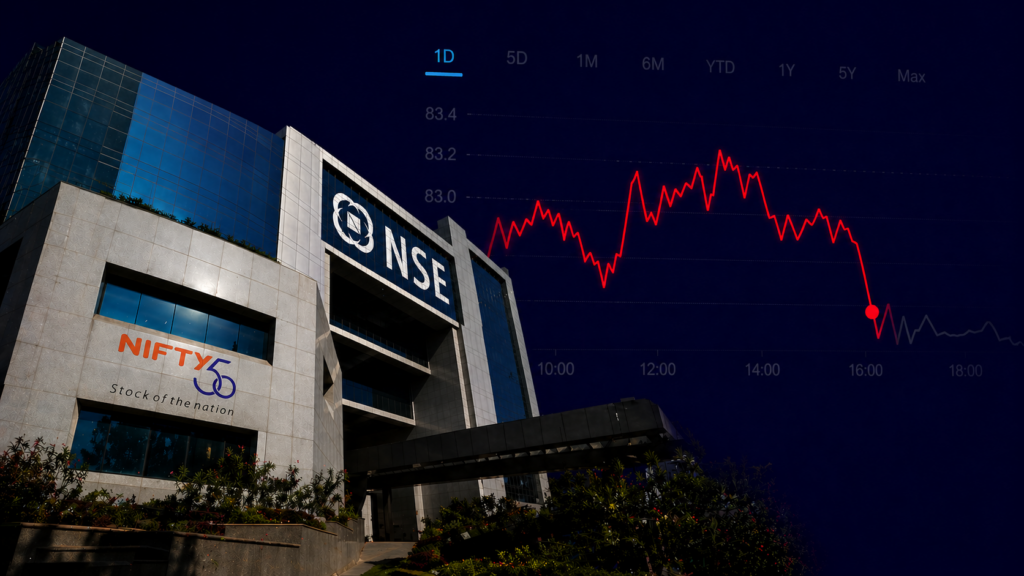
If you opened your portfolio today and saw red across the board, you are not alone. The Nifty has slipped, and investors are once again asking the same urgent questions. Why is Nifty down today. Why is the Indian stock market falling today. And is this just a temporary dip or something deeper.
Market corrections are rarely driven by a single factor. They are usually the result of multiple pressures building at the same time. Global cues, domestic triggers, interest rates, and investor sentiment all come together to shape market direction.
In this blog, we break down the real reasons behind the latest Nifty fall, what it means for investors, and how to approach such volatility with clarity and discipline.
For investors who want to go beyond India and reduce concentration risk, platforms like Appreciate are making global diversification easier. But before that, it is important to understand what is driving today’s fall.
Why Nifty Down Today
The most immediate answer to why Nifty is down today lies in a combination of global and domestic triggers.
Global markets have been under pressure due to rising interest rates and inflation concerns in the U.S. When U.S. bond yields rise, global investors tend to shift capital from equities to safer fixed income assets. This creates selling pressure in emerging markets like India.
At the same time, foreign institutional investors have been net sellers in recent sessions. When large global funds pull money out, markets react quickly. Even strong domestic participation cannot fully offset heavy FII selling in the short term.
Domestically, the market had rallied significantly over the past months. Valuations in several sectors had stretched beyond historical averages. This made the market vulnerable to correction.
So, when multiple triggers aligned, the fall accelerated.
Market Crash Reasons Explained
To understand why the share market is falling today, it is important to break the situation into clear drivers.
Rising Interest Rates
Higher interest rates reduce liquidity in the system. When borrowing becomes expensive, both consumers and companies slow down spending. This impacts corporate earnings expectations.
For equities, this is a double hit. Lower growth expectations and higher discount rates reduce valuations.
Global Uncertainty
Geopolitical tensions, energy price fluctuations, and slowing global growth continue to create uncertainty. Investors prefer safer assets during uncertain times.
This shift away from risk assets often leads to equity market declines.
FII Selling Pressure
Foreign investors play a major role in Indian markets. When they sell, the impact is immediate and visible.
Recent sessions have seen consistent outflows, adding to the downward pressure on Nifty.
Profit Booking
Markets do not move in a straight line. After a strong rally, investors lock in profits.
This selling is not always negative. It is part of a healthy market cycle. But when combined with other factors, it can lead to sharp declines.
Sector-Wise Impact on the Market
Not all sectors fall equally during a correction. Some sectors are more sensitive to global factors, while others are driven by domestic demand.
| Sector | Impact Today | Reason |
|---|---|---|
| IT | High decline | U.S. slowdown concerns |
| Banking | Moderate decline | Rate sensitivity |
| FMCG | Stable | Defensive demand |
| Metal | Sharp fall | Global commodity weakness |
| Pharma | Mixed | Export driven |
IT stocks often fall when global growth concerns rise. Banking stocks react to interest rate changes. Metals are heavily linked to global demand cycles.
Defensive sectors like FMCG tend to hold up better during market corrections.
Why the Indian Stock Market Is Falling Today Beyond Headlines
The headline explanation is often simple, but the underlying reality is more layered.
One important factor is liquidity tightening. Over the past few years, global markets benefited from excess liquidity. As central banks withdraw this liquidity, asset prices adjust.
Another factor is earnings expectations. When companies fail to meet high expectations, markets react quickly.
There is also a psychological component. When markets start falling, fear spreads faster than fundamentals change. Retail investors panic, leading to further selling.
This creates a feedback loop where falling prices trigger more selling.
Is This a Market Crash or a Correction
It is important to distinguish between a crash and a correction.
A crash is sudden, sharp, and driven by systemic risk. A correction is a gradual adjustment after a period of excess.
Current market conditions suggest a correction rather than a crash.
The economy remains stable. Corporate earnings are growing. Domestic demand is intact.
What we are seeing is a recalibration of valuations, not a breakdown of fundamentals.
What Should Investors Do Now
The biggest mistake investors make during market falls is reacting emotionally.
Instead of asking why the share market is falling today, the better question is how to respond.
Long term investors should focus on fundamentals. Corrections often create better entry points for quality stocks.
Short term traders need to manage risk carefully. Volatility increases during such phases, making timing more difficult.
Diversification also becomes critical. Concentrating only on domestic equities can increase risk during corrections.
This is where global investing becomes relevant.
Start Investing with Daily SIP at Just ₹11 with Appreciate
If you’re looking to diversify your portfolio with international mutual funds, Appreciate offers an easy way to get started. With Daily SIP at just ₹11 a day, you can begin investing in top mutual funds without committing large amounts upfront. This allows you to take advantage of market growth, diversify your investments, and build wealth over time all while keeping your investments manageable. Start small, invest regularly, and watch your wealth grow with the power of Daily SIP through Appreciate.
US ETFs also provide exposure to global leaders across technology, healthcare, and consumer sectors. With Appreciate, investors can access these opportunities easily and reduce dependence on a single market.
Key Indicators to Watch Going Forward
Understanding what happens next is just as important as understanding why Nifty is down today.
There are a few key indicators investors should track.
Bond yields are one of the most important signals. If yields continue to rise, equity markets may remain under pressure.
FII flows will also play a crucial role. Sustained outflows can keep markets volatile.
Corporate earnings will determine whether valuations are justified. Strong earnings can stabilize markets even during global uncertainty.
Finally, global macro trends such as inflation and central bank policy will shape market direction over the next few quarters.
Why Market Falls Can Be Opportunities
Market declines often feel uncomfortable, but they also create opportunities.
Historically, some of the best investment returns have come from buying during periods of fear.
When prices fall, future return potential improves.
However, this requires patience and discipline. Not every falling stock is a good investment. The focus should be on quality businesses with strong fundamentals.
FAQ
Why Nifty down today
Nifty is down today due to a combination of global uncertainty, rising interest rates, FII selling, and profit booking after a strong rally.
Why is the Indian stock market falling today
The Indian stock market is falling today because of global market weakness, liquidity tightening, and valuation corrections in key sectors.
What are the main market crash reasons
The main market crash reasons include rising interest rates, global economic slowdown, geopolitical tensions, and heavy institutional selling.
Why share market fall today suddenly
The share market can fall suddenly when multiple negative triggers align, such as global cues, policy changes, and investor sentiment shifts.
Is this a good time to invest
Market corrections can provide good entry points for long term investors, but decisions should be based on fundamentals and risk tolerance.
Will the market recover soon
Market recovery depends on global conditions, earnings growth, and liquidity trends. Corrections are usually temporary in a long term growth market.
Conclusion
The recent decline in Nifty is not driven by a single event but by a combination of global and domestic factors.
Rising interest rates, FII outflows, and profit booking have come together to create short term pressure.
However, the broader economic story remains intact. India continues to be one of the fastest growing major economies, supported by strong domestic demand and structural reforms.
For investors, the focus should shift from short term volatility to long term opportunity.
Understanding why Nifty is falling today is important. Acting on that understanding with discipline is what ultimately builds wealth.
Disclaimer
Investments in securities markets are subject to market risks. Read all the related documents carefully before investing. The securities quoted are exemplary and are not recommendatory.