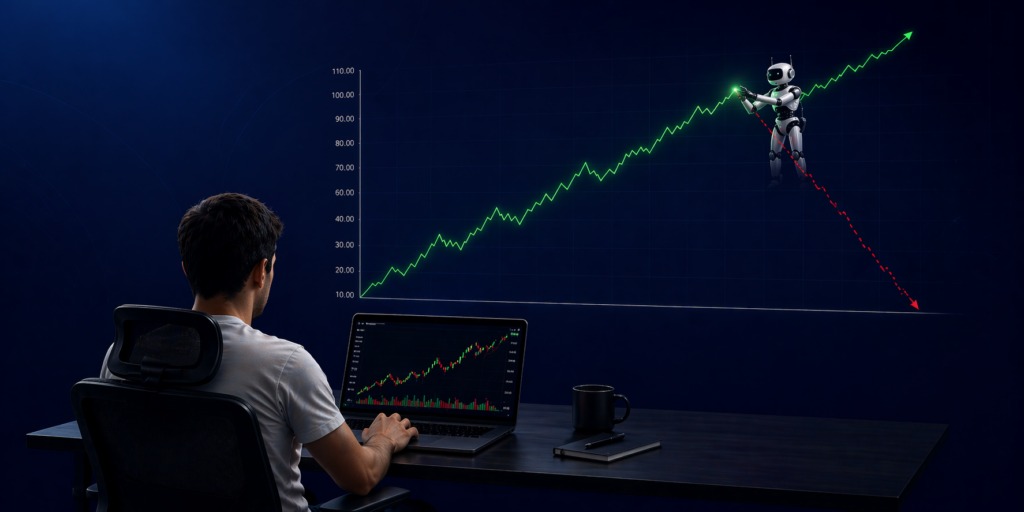
Financial markets operate at a speed that often exceeds human processing limits. To stay competitive, many participants now turn to advanced technology to filter noise and find value. AI for trading stocks involves using computer programs to perform tasks that typically require human intelligence, such as pattern recognition and logical reasoning. This shift is changing how individuals interact with the National Stock Exchange (NSE) and the Bombay Stock Exchange (BSE).
The primary goal of using these technologies is to remove emotional bias from the investment process. Fear and greed often lead to poor choices, but algorithms follow strict logic. By processing millions of data points in seconds, AI stock trading helps identify opportunities that might be invisible to the naked eye. This leads to a more disciplined approach to wealth management in an increasingly complex environment.
These factors are not mere benefits anymore but necessities in order to participate in the contemporary market. Be it an individual investor in a small town or a big institution, the technology being employed for scanning the market is constantly evolving. The comprehension of such technology is the first step towards making effective use of it under the Indian regulatory environment, established by SEBI.
Key Takeaway
- AI trading software processes vast amounts of data to find patterns and trends.
- Machine learning allows systems to improve their accuracy over time without manual updates.s
- Risk management improves through automated stop-loss orders and portfolio balancing.
- AI tools for trading help reduce human errors caused by fatigue or emotion
The Role of AI in Modern Trading
Traditional trading often relied on manual technical analysis and gut feeling. Technical analysis is the study of historical market data, including price and volume, to predict future price movements. Today, the sheer volume of data from global news, social media, and financial reports makes manual analysis difficult. AI addresses this by acting as a high-speed filter.
Speed is a significant issue in today’s markets. For instance, when a firm releases its quarterly figures, there will be a reaction from its share price in just milliseconds. A human being cannot process the information contained in the document and place an order in such a small time period. However, an AI-driven stock trading system in India can do this automatically.
Accuracy is just as important. If you make even the slightest mistake when making a calculation by hand, there is a chance that you could suffer a huge financial setback. Trading AI software works off of established mathematical principles, meaning that each transaction will adhere to certain standards.
What Techniques AI Uses in Stock Trading
Modern systems use several specialised methods to analyse the markets. The most common is Machine Learning (ML). Machine Learning is a branch of AI that allows a system to learn from data and improve its performance without being explicitly programmed. For instance, an ML model might notice that a certain stock price usually rises after a specific interest rate announcement by the Reserve Bank of India (RBI).
Natural Language Processing (NLP) is another critical tool. This refers to the capacity of a computer program to comprehend language as it is used by humans. The NLP in finance analyses news reports, speeches made by central banks, and even those made by CEOs, to determine the “mood” of the market. This is how Sentiment Analysis comes into play.
Predictive Analytics uses historical data and statistical algorithms to identify the likelihood of future outcomes. By looking at years of NSE data, these systems can forecast potential price ranges for a security. While no system can predict the future with 100% certainty, these tools provide a statistical edge that helps in making more calculated decisions.
How AI Analyses Market Trends
Real-time data processing is the foundation of trading using AI. The system continuously monitors “Level 2” data, which shows the full range of buy and sell orders in the market. By analysing the order book, the AI can see where large institutional buyers are placing their bids. This helps small investors avoid being on the wrong side of a massive price move.
Analysing past market trends is equally vital. The AI system doesn’t simply consider the current price; it considers whether that trend was followed by past market movements. If there were a pattern that had caused a market collapse years ago, in 2008 or 2020, it would alert us to the current risky trend.
Anticipating market movements involves looking for “alpha.” Alpha is a term used to describe an investment strategy’s ability to beat the market return. By identifying tiny inefficiencies in how stocks are priced across different exchanges, AI tools for trading can capture small profits that add up over time. This process is often called arbitrage, which is the simultaneous purchase and sale of the same asset in different markets to profit from tiny price differences.
Why AI is Essential for Risk Management in Trading
Managing risk is often more important than chasing returns. AI helps by performing constant Risk Assessment on a portfolio. A portfolio is a collection of financial investments like stocks, bonds, and mutual funds. The system can calculate the “Value at Risk” (VaR), which estimates how much money a trader might lose in a set time frame under normal market conditions.
Portfolio Diversification is another area where AI shines. Diversification is the practice of spreading investments across different assets to reduce risk. Instead of just picking five stocks, an AI can analyse the correlation between hundreds of assets. Correlation is a statistic that measures the degree to which two securities move in relation to each other. AI ensures that your assets are truly different so that they do not all fall in value at the same time.
Stress Testing involves simulating extreme market events to see how a portfolio would react. For example, a trader can ask the AI, “What happens if the price of oil rises by 20% tomorrow?” The system will then run thousands of simulations to show potential losses. This allows traders to adjust their positions before a real crisis hits.
Where AI Tools Are Used in Trading Platforms
Most modern investors use these technologies without even realising it. Automated Trading Systems are now common on many Indian brokerage platforms. These systems allow users to set specific rules, such as “buy stock X if it falls 5% below its 50-day average.” Once the condition is met, the trade happens automatically.
AI-powered trading bots and trading algorithms, with the help of AI, you can go one step ahead and make decisions on the basis of market volatility. They do not work on a set of static rules but change along with the volatility level in the market. Volatility is the level of variation in the prices of a particular stock.
Portfolio Management Tools use AI to help with “rebalancing.” Rebalancing is the process of realigning the weightings of a portfolio of assets. If one stock in your portfolio grows too large, it might make your overall risk too high. AI monitors this daily and suggests small trades to keep your risk levels exactly where you want them.
Popular AI Tools for Trading
When looking for AI trading tools, investors find a variety of options. Some platforms focus on “screeners,” which are tools that filter the thousands of stocks on the NSE and BSE based on specific criteria like P/E ratio or dividend yield. A P/E ratio, or Price-to-Earnings ratio, is a tool used to value a company by comparing its share price to its per-share earnings.
Other tools focus on “backtesting.” Backtesting is the process of testing a trading strategy on historical data to see how it would have performed in the past. High-quality AI trading software allows you to run years of data in minutes to see if your idea is actually profitable before you risk any real ₹ (Indian Rupee) on the live market.
Many fintech applications in India are adopting AI technology to offer “smart portfolios.” The portfolio is a collection of shares pre-selected by the AI according to your risk tolerance level. As of February 2026, such applications have gained more popularity among young investors who value data-based advice over the conventional “tips” given by unknown sources.
The Future of AI in Trading
The next phase of this technology will likely involve even deeper integration of generative AI. This could allow traders to talk to their trading platform in plain English, asking complex questions like, “Which sectors in the Indian market are most undervalued compared to their 5-year growth?” The system would then generate a full report and a suggested plan of action.
We may also see advancements in “quantum computing” combined with AI. Quantum computing is a type of computing that can perform certain calculations much faster than regular computers. This would allow for even more complex market simulations, potentially making the markets even more efficient.
Nevertheless, the human factor will remain. As the machine deals with data and execution, human beings will set the targets and moral limits. The interplay between man and machine in the stock market will continue, bringing the system within reach of everybody, irrespective of their geographical location or social status.
Conclusion
The integration of artificial intelligence into the financial world is not just a trend but a fundamental change in how markets function. By providing superior speed, removing emotional bias, and offering deep analytical insights, AI for trading stocks is making the investment process more scientific. It allows traders to focus on strategy while the software handles the heavy lifting of data processing.
As these technologies become more affordable and available to ordinary people from all walks of life in India, the difference between large institutions and individuals will start to become less apparent. Knowledge and understanding still stand as the most important tools that any investor can have in their arsenal.
FAQs on AI for Trading Stocks
AI enhances trading tactics by analysing complicated trends within past information that might escape the attention of a human being. It is capable of testing various versions of the tactic using backtesting until it finds the most statistically probable version. Additionally, it eliminates any possibility of emotional involvement in the transaction process.
Though AI works much better when it comes to analysis and trading, it is not able to substitute humans in making decisions and maintaining ethics. Humans are required to define global strategies, taking into account political situations, and controlling the AI system. Therefore, it should be treated as a valuable help to traders.
The most useful software programs would be the ones which are available within reputable Indian online trading platforms. Seek out applications called “automated screeners” or “smart portfolios” which assist in choosing stocks using data analysis. Remember that one should begin with simpler tools and seek guidance from financial experts before using bots.
Security is a major focus for SEBI and trading platforms. Most AI systems use high-level encryption and multi-factor authentication to protect data. However, users should always practice good digital hygiene by using strong passwords and avoiding public Wi-Fi when accessing their trading accounts.
The main risks include “technical glitches” where the software may malfunction or “overfitting.” Overfitting happens when a strategy is so perfectly tuned to past data that it fails to work in the real, changing market. There is also the risk of market crashes if too many AI systems react to the same signal at the same time.
Disclaimer: Investments in securities markets are subject to market risks. Read all the related documents carefully before investing. The securities quoted are exemplary and are not recommended.