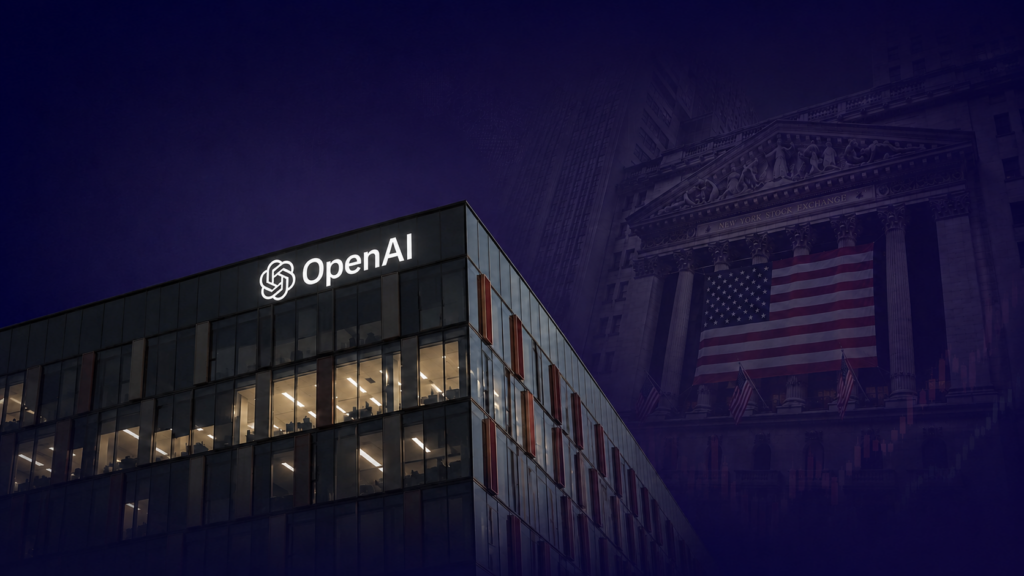
On June 8, 2026, OpenAI announced that it had submitted a confidential draft registration statement to the US Securities and Exchange Commission — the first formal step toward a public listing that CEO Sam Altman is reported to favour completing before Thanksgiving 2026, with September as his preferred debut window. Goldman Sachs, Morgan Stanley, and JPMorgan Chase are leading the process.
The company’s public statement on the filing was disarmingly candid about the decision to announce rather than wait to be exposed. “We expect it to leak, so we’re just announcing it,” the company said. “We have not decided on timing yet; it may be a while because there are things we want to do that are likely easier as a private company.” A second statement clarified that the filing “gives us the option to go public sooner if that ends up being best.”
The deliberate hedging in that language is not uncertainty for its own sake. It is a legally precise framing: a confidential S-1 is not a commitment to list. It opens a private channel with the SEC for regulatory review — typically 60 to 90 days of back-and-forth on financial disclosures, risk factors, and governance disclosures — while keeping OpenAI’s actual financials, margin structure, and compute cost details out of the public domain until approximately 15 days before any investor roadshow. That timeline places a September listing at the outer edge of plausible, and makes Q4 2026 — somewhere between Labour Day and Thanksgiving, as Altman’s advisers have framed the window — the realistic target.
The $852 Billion Baseline — and the $1 Trillion Target
OpenAI’s most recent confirmed private market valuation is $852 billion, established on March 31, 2026, when the company closed the largest private funding round in history — $122 billion — from a syndicate that included Amazon, Nvidia, SoftBank, Altimeter, Appaloosa, ARK Invest, Sequoia Capital, and Thrive Capital, among others. More than $3 billion of that total came through individual investors via banking channels — a deliberate democratisation of access that now positions OpenAI for a broad retail shareholder base from the first day of trading.
The IPO itself is being shaped around a valuation target of up to $1 trillion, according to CNBC and the Wall Street Journal — implying that the public markets will be asked to pay a meaningful premium over the March private round price. The precedent from Anthropic’s filing one week earlier is directly relevant: Anthropic filed at a $965 billion valuation, above OpenAI’s $852 billion mark. Investment bankers have advised both companies, per the Wall Street Journal, that an early mover advantage is operationally significant — the first to list will define how institutional investors categorise and price the frontier AI sector, and will access the enormous pool of capital seeking an entry point into the space before the second company’s S-1 is even public.
The Financial Reality That the S-1 Will Have to Resolve
OpenAI’s financial profile, while not yet publicly disclosed in audited detail, has been characterised by consistent reporting across multiple sources. The company earns approximately $2 billion per month in revenue — an annualised rate of approximately $24 billion. Against that, it spends approximately $1.22 for every dollar it earns: compute costs for running inference and training models, data centre infrastructure under the Stargate joint venture, employee compensation, and research expenditure combine to produce a cash burn of approximately $14 billion annually. The gap between revenue and spending is being bridged by the $122 billion raised in March and an $11 billion Microsoft partnership structure under which Microsoft continues to provide Azure compute while receiving a revenue share from OpenAI’s commercial operations.
The revenue multiple at which OpenAI is being marketed to public market investors — implied at 34 to 40 times annual revenue at the $852 billion to $1 trillion valuation range — is an extraordinary figure, even in an era of premium AI company valuations. Broadcom, which delivered $22.19 billion in quarterly revenue in Q2 FY2026 and has $5.51 billion in net new ARR, trades at a fraction of that revenue multiple. The OpenAI multiple is justifiable only if investors believe two things simultaneously: that the $24 billion annualised revenue run rate is genuinely growing toward the hundreds of billions, and that the current $14 billion annual cash burn will compress meaningfully as revenue scales and compute costs decline through efficiency improvements and proprietary chip development.
The public S-1, when it lands, will need to answer four questions that private market investors were able to defer but that SEC-registered shareholders cannot. First: what does OpenAI’s contractual revenue concentration look like — specifically, how much of its revenue depends on Microsoft’s continued partnership structure and on the API access contracts with enterprise customers? Second: what are the precise terms of the revenue share arrangement with Microsoft post-renegotiation, and how does it change at different revenue thresholds? Third: what is the cost trajectory for training and inference as newer models (GPT-5 and beyond) require more compute, and how does that interact with any proprietary chip development programme? Fourth: what is the status of CFO Sarah Friar’s “public-company discipline” preparation, and has the company built the internal controls, financial reporting infrastructure, and investor relations function that an NYSE or Nasdaq listing requires?
The Musk Lawsuit: The Legal Overhang That Was Just Cleared
The June 8 filing came two days after a jury dismissed Elon Musk’s lawsuit against OpenAI on statute of limitations grounds — a legal resolution that CNBC noted directly as providing timing clarity for the IPO process. Musk had sued OpenAI in 2024, alleging that its conversion from a non-profit to a for-profit company violated the terms of his original donation and founding agreements. The lawsuit had created real uncertainty about the governance and corporate structure questions that any S-1 would need to disclose — and its dismissal removed the most significant single legal overhang in the path to a public listing.
The conversion itself — from the original non-profit founded in 2015 to a Public Benefit Corporation, finalised in late 2025 — was itself a multi-year negotiation with California’s Attorney General and various stakeholders, including a separate settlement with Musk’s own legal challenge. The PBC structure that emerged preserves OpenAI’s stated safety mission and charitable commitments while allowing equity-based compensation, external shareholders, and the capital markets access that the IPO represents.
Sam Altman’s Third Phase and the Governance Paradox
In a blog post published on June 8, 2026, the same day as the filing announcement, Altman framed the IPO in the context of what he described as OpenAI’s “third phase.” The first phase, he wrote, was research toward artificial general intelligence. The second was becoming a product company as people learned to use its tools. The third is the current phase: “The economy is beginning to reshape around AI,” he wrote. “The central question now is how to make advanced AI abundant, affordable, safe, useful, and easy enough for every person and organisation to benefit from it.”
The framing is compelling as a mission statement. As an investor document, it defers rather than resolves a governance question that most analyst notes have raised but not centred: Sam Altman currently holds no confirmed equity stake in OpenAI. An analysis of the leaked March 2026 capitalisation table showed his position as “None/Pending.” Every major technology IPO in recent history has had a founding CEO with significant ownership — the alignment of incentives between the CEO and public shareholders is one of the foundational assumptions of the IPO governance structure. If Altman receives a formal equity grant before the S-1 goes public — which is the most likely outcome — both the size of that grant and the dilutive effect on existing shareholders will be closely scrutinised.
The non-profit structure that preceded the PBC conversion also means that the original charitable mission remains legally embedded in the corporate documents. In Anthropic’s analogous case — a Public Benefit Corporation with a Long-Term Benefit Trust — investors accepted that the non-commercial mission takes precedence over short-term shareholder interests under the terms of the corporate charter. OpenAI’s specific PBC terms, and how they interact with standard fiduciary duties to shareholders, will be among the most-examined sections of the eventual public S-1.
The Competitive Race That Is Reshaping the Valuation
Emarketer analyst Nate Elliott’s characterisation of OpenAI’s filing moment as “precarious” captures something important. The company that launched ChatGPT in 2022 and was effectively synonymous with generative AI for its first two years is now contending with a materially more competitive landscape. Sacra’s April 2026 developer market share analysis showed OpenAI’s API market share declining from approximately 60% to 51% year-on-year, with Anthropic’s Claude Code taking meaningful share in the enterprise AI coding segment. Google’s Gemini Ultra and Meta’s open-source Llama 3 models have created alternatives that compress pricing power in the consumer and enterprise segments simultaneously.
The implication for public market investors is straightforward: the $852 billion valuation is built on the assumption that OpenAI retains leadership in foundation models as the AI generation matures. That assumption requires OpenAI to outperform not just Anthropic — its most direct rival — but also Google, which has the advantage of vertical integration from chips (TPUs) through data centres to distribution (Search, Android, Workspace) — and Meta, whose open-source model releases have established a free baseline that makes OpenAI’s commercial API pricing harder to defend against enterprise customers who have the technical sophistication to self-host Llama equivalents.
OpenAI’s most durable competitive assets are, in order: the ChatGPT consumer brand (which still commands 55–60% of the global AI chatbot market by user engagement); the Microsoft commercial distribution agreement that embeds OpenAI models into Copilot across Office 365, GitHub, and Azure; the Sora video generation product, which has no direct open-source equivalent; and the institutional knowledge from training GPT-4o and its successors on volumes of reinforcement learning from human feedback (RLHF) data that newer entrants have not yet accumulated at scale. Whether any of these moats are durable enough to justify a trillion-dollar valuation in a world where Anthropic has overtaken OpenAI in private market price and enterprise adoption will be the central question investors ask during the roadshow.
The Three-Company Window: What the AI IPO Season Looks Like
The OpenAI filing places three of the most valuable private companies in history in various stages of the public listing process simultaneously. SpaceX is pricing on June 11 at $135 per share for a $1.77 trillion market cap. Anthropic filed its confidential S-1 on June 1 at a $965 billion valuation and is targeting an October 2026 listing. OpenAI filed June 8 at an $852 billion valuation and is targeting Q4 2026 — with September as the preferred window, though SEC timing makes that optimistic.
Investment bankers who advised on all three deals — Goldman Sachs and Morgan Stanley are the common thread across SpaceX’s underwriting, Anthropic’s filing, and OpenAI’s process — have made the first-mover argument to all three clients: the company that lands first in the public market establishes the AI sector valuation floor that subsequent listings are priced against. SpaceX wins that race by virtue of a June 12 listing date. Between Anthropic and OpenAI, the race is closer. Anthropic’s earlier filing and October target puts it in front unless OpenAI can compress its SEC review cycle to enable a September debut — which would require a clean filing with minimal SEC comment letters and a rapid roadshow.
For investors watching the AI IPO season: the combined implied public market value of these three companies, if all list at or near their targeted valuations, would approach $4 trillion — approximately equivalent to the current market capitalisation of Apple, and more than the annual GDP of Germany. Whether the public market can absorb that supply at those prices will determine the terms on which the AI infrastructure investment story is publicly priced for the next decade.
Disclaimer: Investments in securities markets are subject to market risks. Read all the related documents carefully before investing. The securities quoted are exemplary and are not recommendatory.