At 8:30 AM Eastern Time on Friday, June 5, 2026, the Bureau of Labor Statistics released the May nonfarm payrolls report. The US economy had added 172,000 jobs in the month — more than double the Wall Street consensus forecast of 85,000, and above the revised April figure of 115,000. The unemployment rate held steady at 4.3%, exactly as expected. Annual wage growth came in at 3.4%, in line with estimates. It was, from the labour market’s perspective, an unambiguously strong reading.
For gold and silver, it was devastating.
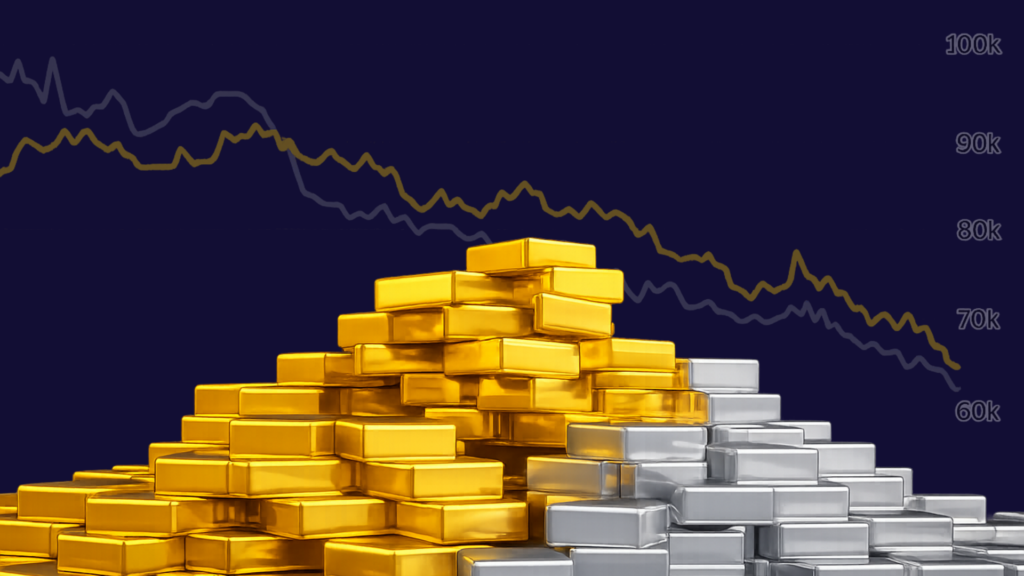
Spot gold fell $146.50 on the day, or 3.27%, settling at $4,339.61 per troy ounce — its lowest level since March 27, 2026, and a pullback of nearly 8% from its peak earlier in the year. Silver was hit harder, dropping $5.26 or 7.17% to close at $68.57 per troy ounce, its lowest price since late March. The US Dollar Index surged to 99.726, its highest level since April 9. US 10-year Treasury yields climbed above 4.50% alongside German Bund yields crossing 3.00% — both hitting two-week highs. By June 7, gold had settled at approximately $4,336.78 per troy ounce — down 8.04% over the preceding month despite remaining 30.40% above its level a year earlier.
In India, the domestic impact compounded. As of June 7, 2026, the price of 24-karat gold stood at ₹15,273 per gram, or approximately ₹1,52,730 per 10 grams — down sharply from its peak earlier in the year but still reflecting a level more than 30% above year-ago prices in rupee terms. The five-day decline in domestic gold prices that the Aaj Tak source covers is a direct translation of the global spot market correction into rupee prices, modulated by the rupee’s own trajectory against the dollar.
The Mechanism: Why Good Economic News Is Bad for Gold
The inverse relationship between strong economic data and gold prices is among the most consistent dynamics in modern financial markets, yet it remains counterintuitive to many investors — particularly those who think of gold primarily as an inflation hedge.
Gold produces no income. It pays no dividend, no coupon, no interest. Its entire value as a financial asset rests on one proposition: that holding it preserves wealth better than holding cash or cash-like instruments in a given environment. When interest rates are high or rising, the opportunity cost of holding gold — what you forego by owning the metal instead of a Treasury bond or money market fund — rises. When rate cut expectations are strong, that opportunity cost falls, and gold becomes more attractive relative to yield-generating alternatives.
The May jobs report rewired market expectations on that single dimension. Before the release, futures markets had been pricing in some probability of Federal Reserve rate reductions at upcoming FOMC meetings. After 172,000 payrolls — double consensus — those expectations collapsed. The CME FedWatch Tool showed the probability of the Fed keeping rates unchanged at 3.50–3.75% in June at 99.4%, essentially eliminating any near-term easing scenario. More consequentially, pre-report discussions had already included a 42% market-priced probability of a rate hike by December 2026, according to Bart Melek of TD Securities — and the stronger-than-expected payrolls number reinforced that trajectory. Melek had stated directly in the days before the report that “higher inflation expectations, associated with negative supply shocks, have pushed yields across the curve higher, kept the USD firm, and prompted markets to begin pricing in a Fed hike in late 2026.”
This is the critical context. Gold had already been under upward pressure from an unusual combination of forces: the West Asia energy supply disruption following Operation Epic Fury and the Strait of Hormuz closure on February 28, 2026, which generated both safe-haven demand and inflation expectations. Central bank accumulation — 244 tonnes in Q1 2026 alone, representing continued sovereign buying by emerging market central banks — had provided a structural floor. Physical investment demand for gold bars reached 397.7 tonnes in Q1 2026, up 20% quarter-on-quarter and 50% year-on-year, even as jewellery demand globally contracted 24% from Q4 2025 levels, with India down 18% and China down 32%. The metal was, in short, being held up by geopolitical and central bank dynamics even as the rate and dollar environment was turning against it.
The May jobs report was the data point that resolved this tension sharply in favour of the dollar and rates — and the magnitude of the payroll beat meant the repricing was rapid and severe.
The Five-Day Decline Anatomy
The gold and silver correction did not begin on June 5. It had been building across the preceding week as pre-report employment signals came in stronger than expected.
On June 3, ADP reported 122,000 private sector jobs added in May — the strongest reading since January 2025 — which was the first significant warning that Friday’s official payroll number might exceed consensus. Gold, which had been trading near $4,454, held near $4,450 in immediate response to the ADP data before softening toward $4,450. By June 4, the JOLTS job openings data also exceeded forecasts, and gold slipped further to around $4,481 before recovering partially. Futures markets had already repriced meaningful rate hike risk into the forward curve.
Then came the June 5 official payroll release, and the full correction occurred in a single session. The $146.50 intraday drop in gold represented its largest single-day move in more than three months. Silver’s 7.17% single-session decline reflected its dual nature as both a monetary metal and an industrial commodity — the dollar strengthening is bearish on both counts, and at times of sharp risk repricing, silver’s higher volatility relative to gold produces amplified moves in both directions.
By the close of the week, gold had erased effectively all of its 2026 year-to-date gains in nominal terms, placing it roughly where it had traded at the start of January — even as its one-year gain of 30.40% remained historically strong. BullionVault’s market report noted that gold fell to its weakest price since end-winter and that the MSCI World Index posted its worst weekly drop since late March.
What the Rate Hike Probability Means
The pricing of a potential Federal Reserve rate hike by December 2026 is the most significant shift embedded in the post-NFP repricing — and it deserves emphasis because it represents a qualitative change in the policy outlook, not merely a delay in cuts.
The current Fed funds rate of 3.50–3.75% is already materially below the peak of the previous tightening cycle. The Federal Reserve has now held rates unchanged for two consecutive MPC meetings, following an aggressive cutting cycle through 2025 that brought rates from 6.5% in February 2025 to 5.25% in December 2025 to further cuts through early 2026. With US inflation running at approximately 3.8% as of the most recent readings — well above the 2% target — and the labour market demonstrating resilience against all expectations for softening, the logical next FOMC question has shifted from “when do we cut again?” to “might we need to hike?”
That repricing has two direct implications for precious metals. First, real interest rates — the nominal rate minus inflation — are already positive and would rise further if the Fed tightened. Positive and rising real rates are structurally bearish for gold, because they represent a genuine return on dollar-denominated cash and bonds that gold cannot match. Second, a Fed rate hike would strengthen the dollar against virtually every other currency, making gold more expensive in non-dollar terms and reducing demand from gold’s largest physical buyers: India, China, and the Middle East.
Adding to the complexity is the inaugural FOMC meeting of Federal Reserve Chair Kevin Warsh, scheduled for June 16–17. Warsh’s policy orientation — whether he leans hawkish in response to the labour market strength or dovish in deference to global financial stability concerns raised by the West Asia energy disruption — is not yet established in the market’s understanding. As GoldSilver.com noted in its June 3 analysis: “The fact that this is a new chair’s first press conference adds a layer of uncertainty that the market would otherwise not price at this stage of the cycle. Traders who might otherwise position aggressively around a known Fed Chair’s likely messaging are operating with less conviction.”
Why Gold Has Not Collapsed Further: The Structural Demand Floor
Despite the severity of Friday’s correction, there are four structural factors that have prevented a deeper or more sustained decline and that form the basis for the medium-term constructive view maintained by analysts including Commerzbank — which adjusted its year-end gold target to $4,800 per troy ounce.
Central bank buying is the most important. Sovereigns across the emerging market world — China, Poland, India, Turkey, and others — have been systematically increasing gold’s share of their reserves as protection against dollar-denominated asset risk, an explicit response to the freezing of Russia’s overseas reserves in 2022. In Q1 2026 alone, central banks globally purchased 244 tonnes. This accumulation is not price-sensitive in the conventional sense: it continues regardless of short-term rate dynamics because it serves a reserve diversification objective that interest rate levels do not change.
Geopolitical safe-haven demand persists. The Strait of Hormuz closure has not been resolved. The uncertainty around the US-Iran confrontation, the broader West Asia security situation, and the potential for further supply disruptions provides a floor under gold that rate movements alone cannot fully remove. When the energy supply risk abates — through a diplomatic resolution or a gradual rerouting of supply — that component of the gold premium will deflate. Until it does, it suppresses the downside.
Physical investment demand for gold bars reached its highest level in years in Q1 2026 — a 50% year-on-year increase — reflecting individual investors globally treating gold as a strategic portfolio allocation rather than a trading position. This demand is longer-horizon and less reactive to single data points than futures market positioning.
Finally, the gold-to-silver ratio has widened sharply, with silver falling more than gold on the June 5 session. This divergence typically eventually self-corrects — either through silver recovering faster when sentiment improves, or through gold declining to match silver’s relative weakness. Investors who monitor relative value within the precious metals complex will note that silver at $68.57 against gold at $4,339.61 represents a gold-silver ratio of approximately 63:1 — at the lower end of its recent range, implying that silver’s industrial component (demand from solar panels, electronics, and electric vehicles) continues to provide support even when monetary demand contracts.
What Comes Next: The June Calendar
Three data releases will determine whether the June 5 correction deepens or reverses in the near term.
May CPI data, released Tuesday June 10, is the most immediate. If inflation prints above expectations — particularly in the energy and shelter components — it would deliver a “double shock” of hot employment and rising prices that would firmly close the door on any near-term rate cut and potentially advance market pricing on a December hike. A below-consensus CPI print would provide partial offset.
The University of Michigan June consumer sentiment and inflation expectations survey follows shortly after, providing a real-time read on whether households are beginning to anchor higher inflation expectations — the most operationally significant input for the Fed’s medium-term policy calculus.
The June 16–17 FOMC decision and Warsh’s inaugural press conference will then set the policy tone for the remainder of the year. LiteFinance’s June 2026 forecast range — $4,186 to $4,933 for the month — reflects the wide band of outcomes that these inputs could produce. The base case, per Commerzbank’s $4,800 year-end target, implies recovery from current levels. The bear scenario, contingent on a confirmed rate hike trajectory and a sustained dollar rally, extends toward $3,816 by year-end.
For Indian investors, an additional variable applies: the rupee. At approximately ₹95 to the dollar following recent partial recovery from ₹96.965 lows, domestic gold prices incorporate both the global spot movement and the rupee’s own trajectory. A weaker rupee partially offsets global gold price declines for Indian holders — meaning that domestic MCX prices fall less than international spot prices when the dollar strengthens — while a stronger rupee amplifies the downside. The June 5 correction in domestic gold prices was moderated by the rupee’s own movement on that day, which is why the Indian decline was proportionally smaller than the 3.27% global spot fall.
Disclaimer: Investments in securities markets are subject to market risks. Read all the related documents carefully before investing. The securities quoted are exemplary and are not recommendatory.