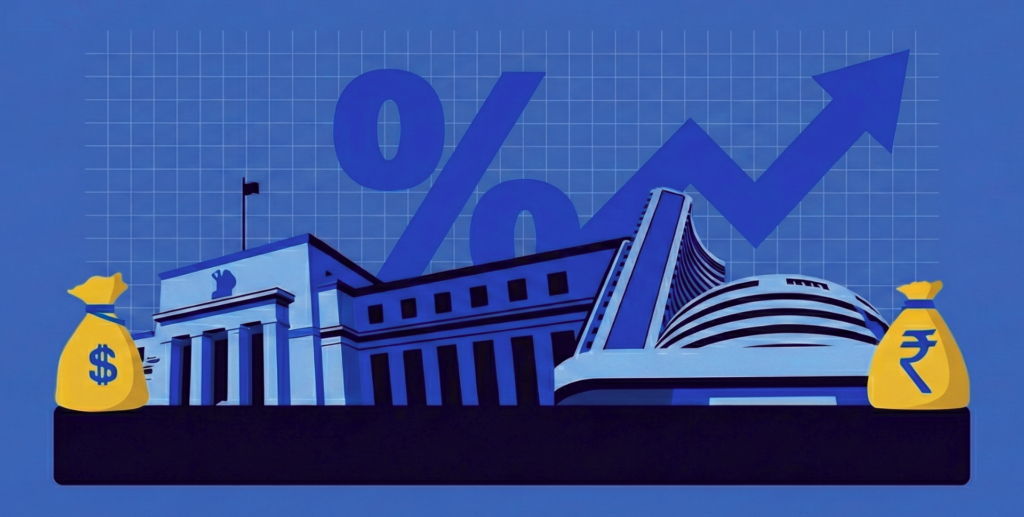
The US Fed rate may seem like a distant line on a Washington policy chart, but its influence reaches Indian markets within minutes. In a globalized financial system anchored by the U.S. dollar, shifts in the U.S. Federal Reserve rates often dictate risk appetite, currency movements, and capital flows into emerging markets such as India. Understanding how this mechanism works is essential for investors navigating a world where domestic fundamentals meet powerful global forces.
Why the Fed’s Decisions Matter for India
The current U.S. Fed interest rate serves as the world’s benchmark cost of capital. When the Fed rate in the USA rises, yields on U.S. Treasuries climb, drawing capital away from emerging markets. This pattern was visible in 2022–2023, when the Federal Reserve lifted rates from near zero to above 5 percent, triggering more than ₹1.2 trillion in foreign investor outflows from Indian equities as the dollar strengthened.
The value of the rupee also moves with the Fed. A rising Fed rate typically strengthens the dollar index, pushing the rupee weaker as seen when it crossed ₹83 per USD in 2023. A weaker rupee raises India’s import bill, pressures companies dependent on foreign inputs, and raises inflationary risks for the economy.
When markets anticipate lower rates or an outright U.S. Fed rate cut, risk appetite tends to swing back toward emerging markets. Lower U.S. yields narrow the India–U.S. rate differential, making Indian equities more attractive and supporting FPI inflows. This is why investors closely monitor every Fed statement and press conference: in practice, the “US Fed rate cut impact on Indian stock market” often appears before any policy change even occurs.
How Rate Changes Affect Different Sectors
The US Federal Reserve rates influence Indian sectors in different ways. Rate-sensitive segments such as banks, NBFCs, real estate, and autos usually respond first to shifts in global bond yields. A softer U.S. Fed rate stabilizes yields, supports credit growth, and lifts banking-sector outlooks. When volatility in global interest rates subsides, banks benefit from improved treasury income and better loan visibility.
Export-oriented companies react differently. A stronger dollar during Fed tightening boosts margins for IT service providers such as TCS, Infosys, and Wipro because their revenues are dollar-denominated. When the Fed signals easing, the dollar typically softens, which can compress margins even if global demand remains steady.
Commodities and cyclicals, metals, energy,and capital goods move with global growth expectations shaped by U.S. monetary policy. Higher interest rates usually suppress commodity prices by slowing growth forecasts. If the Fed cuts rates, commodity-linked sectors often rally as industrial demand expectations rise. For investors looking to invest in US stocks from India, understanding how Fed policy impacts global sectors can help identify opportunities across U.S. equities and ETFs.
Why Investors Track Fed Guidance So Closely
Most Indian market swings linked to the Fed occur not on policy days, but on communication days. The Fed’s dot plot, balance-sheet commentary, and forward guidance hold enormous influence over FPI positioning. A single hawkish line in a press conference can spark selling across emerging markets; a dovish surprise can send Indian indices to fresh highs.
In late 2023, for example, a more restrictive tone from the Fed triggered widespread Asian currency weakness and a rapid pullback in India’s IT index. Conversely, renewed expectations of rate cuts in 2024–2025 helped push the Nifty and Sensex toward record levels as FPIs returned to Indian markets.
The bond market is equally sensitive. India’s benchmark yields fall when U.S. yields decline, easing borrowing costs for corporations and the government. This dynamic is especially relevant as India enters global sovereign bond indices, which directly link foreign inflows to the trajectory of U.S. rates.
Conclusion
Whether tightening or easing, the U.S. Fed rate has become an embedded part of India’s market calculus. A higher Fed rate strengthens the dollar, draws capital toward U.S. assets, and pressures emerging-market currencies and equities. A lower rate improves global liquidity, lifts risk appetite, and supports inflows into India. While domestic growth remains India’s strongest long-term driver, the US Federal Reserve rates shape the financial conditions that determine how quickly and how smoothly that growth gets priced into markets.
Disclaimer: Investments in securities markets are subject to market risks. Read all the related documents carefully before investing.