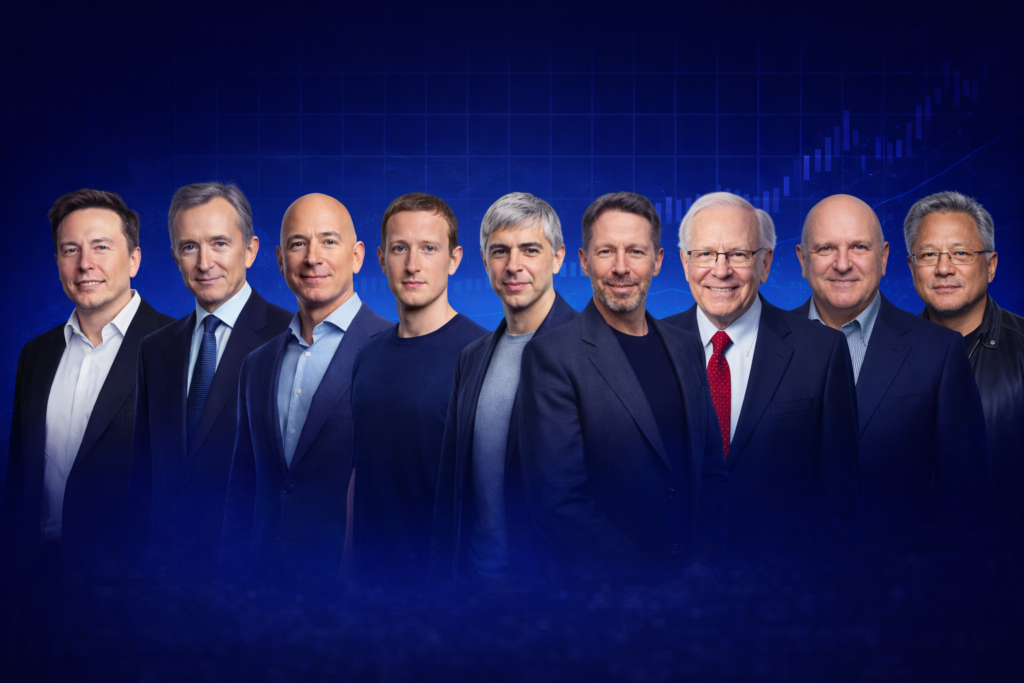
The list of top 10 richest person in the world in 2026 shows how quickly wealth can shift at the very top. Market movements, ownership in global businesses and the rise of new industries have reshaped rankings over the past year, as seen in milestones like Walmart’s trillion-dollar market cap.
This article looks at the top 10 richest people in the world in 2026, breaking down their net worth, the industries behind their wealth and the key factors that pushed them to the top.
Based on August 2026 data, the top ten richest people in the world are:
- Elon Musk
- Larry Page
- Jeff Bezos
- Sergey Brin
- Michael Dell
- Mark Zuckerberg
- Larry Ellison
- Jensen Huang
- Steve Ballmer
- Warren Buffett
Note: Net worth figures can fluctuate rapidly based on stock market performance
Key Takeaways
- Elon Musk is the richest person in the world in 2026, with an estimated net worth of $853.3 billion as of August 11, 2026.
- Larry Page, Jeff Bezos and Sergey Brin follow Musk, with technology and AI playing a major role in their wealth.
- Michael Dell ranks fifth, with an estimated net worth of $250.8 billion, driven by his stake in Dell Technologies and growing demand for AI infrastructure.
- Technology, AI, cloud computing and advanced manufacturing continue to be major drivers of wealth creation among the world’s richest individuals.
Criteria for Ranking the Richest People
There’s no single number that defines billionaire wealth. Rankings are shaped by how assets are valued, how markets behave and how much real influence a business holds over time.
Net Worth Evaluation Methods
Ranking the richest people in the world starts with a basic calculation: total assets minus total liabilities. Assets usually include:
- Shares in publicly listed companies
- Stakes in private businesses
- Cash, real estate and other disclosed investments
Public company holdings are valued using market prices, while private assets are estimated using comparable company valuations and financial disclosures. Since many billionaires hold large portions of their wealth in businesses they founded, rankings can change quickly when markets move.
Economic and Market Influences
Global markets play a major role in shaping billionaire rankings. A rise or fall in stock prices, currency movements, or changes in interest rates can shift net worth figures within weeks.
Economic slowdowns, sector-specific booms and investor sentiment also influence how companies are valued. This means that even if a business performs well operationally, market conditions can still impact where its founder ranks among the world’s billionaires.
Innovation and Impact
Sustained wealth rarely comes from static businesses. The richest individuals usually sit behind companies that continue to evolve and stay relevant at scale. Innovation supports long-term valuations, while real-world impact helps maintain investor confidence.
Profiles of the Top 10 Richest People in 2026
Below is a list of the top 10 richest people in the world as of August, 2026:
1. Elon Musk
- Industry: Automotive, Aerospace, Artificial Intelligence
- Net Worth: Approximately $853.3 billion (as of August 11th 2026)
- Primary Sources of Wealth: Tesla, SpaceX, xAI, X
Elon Musk entered 2026 as the clear outlier among the world’s billionaires. Elon Musk net worth surged by an estimated $244 billion in a single month, driven largely by a sharp rise in SpaceX’s private valuation and the restoration of his Tesla stock options.
2. Larry Page
- Industry: Technology
- Net Worth: $292.3 billion (as of August 11th 2026)
- Primary Source of Wealth: Alphabet
Larry Page is one of Alphabet’s largest shareholders. While Alphabet’s stock declined modestly toward the end of 2025, Page’s long-term ownership keeps him firmly near the top.
He is also reportedly backing new AI-led manufacturing ventures, which reflect continued exposure to future-facing technology.
3. Jeff Bezos
- Industry: E-commerce, Cloud Computing
- Net Worth: Between $283.8 billion and $267 billion (as of August 11th 2026)
- Primary Source of Wealth: Amazon
Bezos remains Amazon’s largest individual shareholder. Alongside Amazon Web Services, his private investments in space and AI-driven manufacturing support his position among the world’s richest individuals.
4. Sergey Brin
- Industry: Technology
- Net Worth: $269.6 billion (as of August 11th 2026)
- Primary Source of Wealth: Alphabet
Brin returned to a more active role in Alphabet’s AI strategy during 2025. His wealth fluctuated with Alphabet’s share price, but his controlling stake keeps him solidly in the top five.
5. Michael Dell
- Industry: Technology
- Net Worth: $250.8 billion (as of August 11th 2026)
- Primary Source of Wealth: Dell Technologies
Dell’s net worth has surged significantly, driven by the growing demand for enterprise AI hardware. As the company dominates the manufacturing of high-performance servers configured for next-generation AI processors, his concentrated 40% equity stake has established him firmly among the top five wealthiest people globally
6. Mark Zuckerberg
- Industry: Social Media, Digital Platforms
- Net Worth: $204.2 billion (as of August 11th 2026)
- Primary Source of Wealth: Meta
Zuckerberg’s net worth grew modestly as Meta stabilised its advertising business and continued investing in AI and platform monetisation. His long-term ownership remains one of the primary drivers of his wealth.
7. Larry Ellison
- Industry: Enterprise Software, Cloud Infrastructure
- Net Worth: $192.2 billion (as of August 11th 2026)
- Primary Source of Wealth: Oracle
Ellison’s wealth is tied closely to Oracle’s cloud and AI infrastructure push. Although Oracle shares corrected after a sharp rally, Ellison continues to benefit from enterprise demand for large-scale data and computing systems.
8. Jensen Huang
- Industry: Semiconductors, AI Computing
- Net Worth:$187.9 billion (as of August 11th 2026)
- Primary Source of Wealth: Nvidia
Huang is the biggest beneficiary of the AI computing boom. NVIDIA’s dominance in GPUs pushed the company to record valuations, firmly placing Huang in the global top ten.
9. Steve Ballmer
- Industry: Technology, Sports Ownership
- Net Worth: $155 billion (as of August 11th 2026)
- Primary Source of Wealth: Microsoft
Ballmer’s wealth is driven by his decision to hold Microsoft shares after stepping down as CEO. His ownership of the Los Angeles Clippers adds diversification but is still secondary to his tech exposure.
10. Warren Buffett
- Industry: Investments, Insurance
- Net Worth: $150.2 billion (as of August 11th 2026)
- Primary Source of Wealth: Berkshire Hathaway
Buffett’s wealth dropped a little due to market movements, but Berkshire’s diversified holdings continue to generate steady value. Even after decades, long-term equity ownership is the core of his fortune.
| Rank | Name | Net Worth (USD) | Primary Industry | Main Source |
| 1 | Elon Musk | $853.3 billion | EV, Space, AI | Tesla, SpaceX |
| 2 | Larry Page | $ 292.3 billion | Technology | Alphabet |
| 3 | Jeff Bezos | $ 283.8 billion | E-commerce, Cloud | Amazon |
| 4 | Sergey Brin | $269.6 billion | Technology | Alphabet |
| 5 | Michael Dell | $250.8 billion | Technology | Dell Technologies |
| 6 | Mark Zuckerberg | $204.2 billion | Social Media | Meta |
| 7 | Larry Ellison | $192.2 billion | Software, Cloud | Oracle |
| 8 | Jensen Huang | $187.9 billion | Semiconductors | Nvidia |
| 9 | Steve Ballmer | $155 billion | Technology | Microsoft |
| 10 | Warren Buffett | $150.2 billion | Investments | Berkshire Hathaway |
Emerging Trends among the Wealthiest
While individual fortunes differ, clear patterns are visible across the world’s billionaires:
Technology and Digital Transformation
Technology remains the strongest driver of billionaire wealth, especially among companies often grouped as FAANG stocks. Software platforms, cloud services, AI-led products and digital marketplaces dominate the current rankings.
Ownership in technology businesses offers:
- Global reach
- Scalable revenue models
- Long-term growth visibility
Sustainable and Ethical Investments
A growing number of wealthy individuals are directing capital toward clean energy, electric mobility and responsible business models.
While returns remain the main focus, these sectors are drawing interest due to policy support, long-term demand and large-scale infrastructure needs.
Influence of Cryptocurrencies and Blockchain
Digital assets and blockchain-based businesses have created new paths to wealth, especially for early participants.
Although volatility remains high, companies building exchanges, payment rails and core blockchain infrastructure have produced significant gains, bringing new names into the billionaire list.
Factors Affecting Wealth Creation in 2026
A mix of structural changes and external forces drives wealth creation in 2026:
- Technological Disruptions and Innovations: Companies that adopt automation, artificial intelligence and advanced computing gain cost advantages and scale faster than traditional players.
- Global Economic Shifts: Changes in global growth patterns influence where wealth is created. Interest rates, inflation trends, trade policies and currency movements affect corporate earnings and investor confidence.
- Regulatory Changes and Their Impacts: Government policies can either support or restrict wealth creation. Regulations on data use, competition, taxation, and environmental standards directly affect company valuations.
US ETF – “US ETFs (Exchange Traded Funds) offer a great opportunity for investors looking to diversify their portfolio with international exposure. With Appreciate, you can now access these ETFs easily, benefiting from the growth of US-based companies. Investing in US ETFs can be a strategic way to tap into global markets, adding stability and potential growth to your investment strategy.
For investors looking to invest in US stocks from India, US ETFs offer a simple and diversified way to access leading global companies.
Conclusion
The world’s richest individuals in 2026 share a common thread: long-term ownership in businesses that scale globally and stay relevant.
Technology, finance and investment-led models continue to dominate the rankings, supported by favourable market conditions and strong demand.
Looking ahead, future billionaires are likely to emerge from sectors tied to artificial intelligence, advanced manufacturing, clean energy and global financial infrastructure.
FAQs on Richest People in World
As of 2026, Elon Musk is widely regarded as the world’s richest person. His wealth comes largely from Tesla, SpaceX and his AI venture xAI. Net worth figures move frequently because a large part of his wealth is linked to publicly traded shares.
Other names that consistently appear near the top include Larry Page, Jeff Bezos and Sergey Brin.
Net worth is calculated using a simple formula:
Net Worth = Total Assets – Total Liabilities
Assets include shares in public companies, stakes in private businesses, real estate, cash and known investments. Liabilities include loans and other financial obligations.
In 2026, Finance and Investments remains the industry with the highest number of billionaires. This includes hedge fund managers, private equity leaders and large-scale investors.
Technology continues to add new billionaires at a faster pace than most other sectors. Manufacturing and fashion retail also contribute a steady number of high-net-worth individuals.
Technology plays a central role in modern wealth creation. Most of the top 10 richest people built their fortunes by owning and scaling global tech companies such as Amazon, Meta and Alphabet.
These businesses benefit from:
Global reach
High margins
Strong long-term demand
Yes, the billionaire list has seen fresh names. One standout is Jensen Huang, co-founder and CEO of Nvidia. Rising demand for AI computing and chips has sharply increased his wealth and placed him among the world’s richest individuals in 2026. Another is Michael Dell, Chairman and CEO of Dell Technologies who secured the 5th position among the world’s richest people.
Elon Musk is the richest man in the world in 2026, with an estimated net worth of $853.3 billion as of August 11, 2026. His wealth primarily comes from his stakes in Tesla, SpaceX and xAI. However, his net worth can fluctuate significantly as the value of his business holdings and investments changes.
Disclaimer: Investments in securities markets are subject to market risks. Read all the related documents carefully before investing. The securities quoted are exemplary and are not recommendatory.