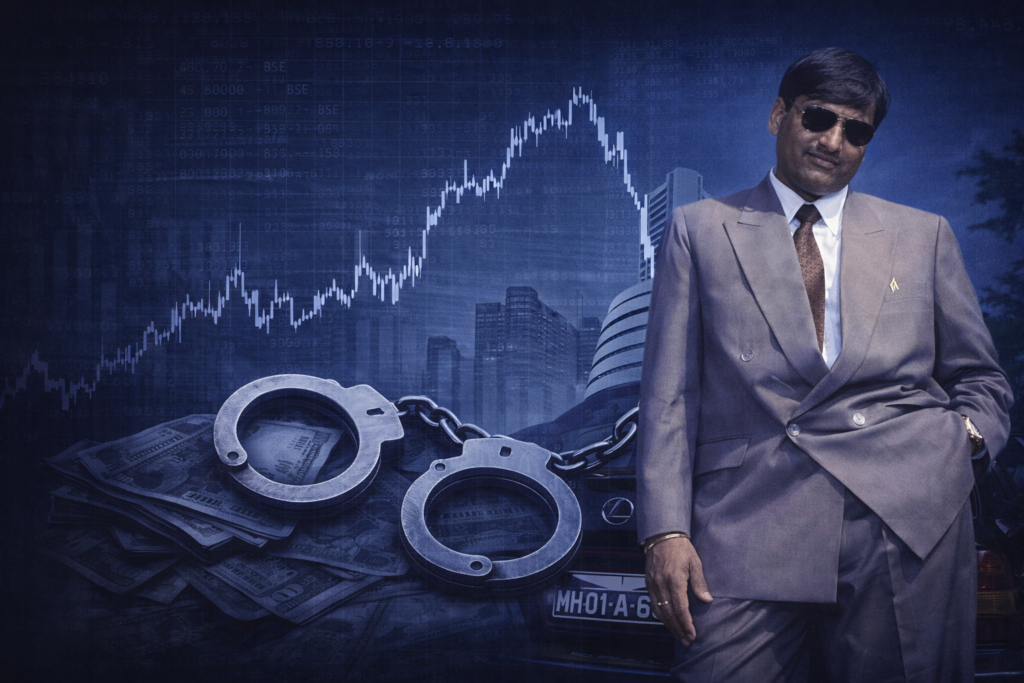
In April 1992, the Bombay Stock Exchange Sensex was riding an extraordinary wave — up nearly 4,000% from its level just a few years earlier. Retail investors were pouring their savings into stocks. Optimism was everywhere. And at the very centre of this euphoria stood one man: Harshad Mehta, a stockbroker from a modest Gujarati family who had somehow convinced the entire market that a new era of Indian capitalism had arrived
It was all built on a lie — and one of the most sophisticated financial frauds the country had ever seen. The Harshad Mehta scam didn’t just cost investors their money. It rewrote the rulebook for India’s stock markets, banking system, and financial regulation in ways that still echo today. Decades later, the story of Scam 1992 continues to fascinate, disturb, and educate anyone who takes the stock market seriously.
If you’re an investor — whether you’re tracking Indian equities or watching the US stock market — understanding what happened in 1992 isn’t just history. It’s a masterclass in how markets can be manipulated, how systemic failures compound each other, and why regulation matters more than most people think.
Who Is Harshad Mehta? From Small-Town Ambition to Dalal Street Royalty
To understand the scam, you first have to understand the man. Harshad Shantilal Mehta was born on July 29, 1954, in a small town in Gujarat. His family had modest means, and after completing his education, Mehta made his way to Bombay — as Mumbai was then known — chasing bigger dreams.
He worked a string of unrelated jobs: selling hosiery, distributing diamonds, working as a dispatch clerk. But Mehta’s real passion was the stock market. He started as a sub-broker in the early 1980s, working the floors of the Bombay Stock Exchange (BSE), learning the game from the ground up. He was sharp, charismatic, and had an exceptional ability to read market sentiment.
By the late 1980s, Mehta had established his own brokerage firm — GrowMore Research and Asset Management — and built a substantial following among investors. He developed a valuation approach he called the “replacement cost theory,” arguing that stocks should be priced based on what it would cost to build an equivalent business today, not just on current earnings. It sounded intellectual. It drew crowds. And it made him extraordinarily influential.
At his peak, Harshad Mehta’s net worth was estimated at over ₹2,000–3,000 crore — a staggering figure in early 1990s India. He owned a 15,000-square-foot apartment in Worli, a fleet of luxury cars including a Lexus (one of very few in India at the time), and threw parties that made the pages of gossip columns. He was Dalal Street royalty. The press called him the “Amitabh Bachchan of the Stock Market.”
Harshad Mehta — Quick Facts
| Full Name | Harshad Shantilal Mehta |
| Born | July 29, 1954 — Rajkot, Gujarat |
| Died | December 31, 2001 — Thane, Maharashtra |
| Nickname | “Big Bull” of Dalal Street |
| Peak Net Worth (est.) | ₹2,000–3,000 crore (early 1990s) |
| Firm | GrowMore Research and Asset Management |
| Key Scam Period | 1991–1992 |
| Total Scam Amount | ~₹4,025 crore (≈ ₹24,000+ crore in today’s value) |
Harshad Mehta Net Worth: How Much Was He Actually Worth?
The question of Harshad Mehta’s net worth is one of the most searched topics about the man — and the answer is complicated. At the height of his influence in 1991–1992, Harshad Mehta’s net worth was estimated at ₹2,000 to ₹3,000 crore, an almost incomprehensible figure in early 1990s India.
| 💰 Harshad Mehta Net Worth — Key Numbers Peak estimated net worth: ₹2,000–3,000 crore (1991–92) | Total funds diverted from banking system: ~₹4,025 crore | Equivalent today: ₹24,000+ crore | Investor wealth destroyed in market crash: ~₹1 lakh crore |
But here’s the crucial distinction: how much of Harshad Mehta’s net worth was legitimately earned, and how much was built on fraud?
The honest answer is that a significant portion of his apparent wealth was the product of a financial house of cards. Mehta had diverted approximately ₹4,025 crore from the interbank securities market into stock market speculation. The assets he flaunted — the luxury apartment, the cars, the lifestyle — were funded, directly or indirectly, by money that belonged to India’s banking system and, ultimately, to ordinary depositors and taxpayers.
When the scam unravelled in April 1992, Harshad Mehta’s net worth effectively went to zero. Assets were seized, bank claims piled up, and legal proceedings consumed the next decade of his life. By the time of his death on December 31, 2001, he was fighting over 600 pending court cases with no empire left to speak of.
The lesson is instructive for investors: visible wealth is not the same as real wealth. A stock portfolio built on manipulation is not wealth — it’s a ticking clock.
The Perfect Storm: India’s Economy in 1991
The timing of the Harshad Mehta scam was not accidental. India in 1991 was in the middle of its most consequential economic transformation since independence. Facing a severe balance of payments crisis — the country had foreign exchange reserves sufficient for just two weeks of imports — the government of Prime Minister Narasimha Rao, guided by Finance Minister Dr. Manmohan Singh, launched sweeping liberalization reforms.
Tariff barriers came down. Licensing restrictions were eased. Foreign investment began flowing in. And Indian companies, suddenly exposed to global competition but also global opportunity, saw their valuations surge. The Sensex, which stood at around 1,100 in early 1991, was climbing toward 4,500 by April 1992.
For Mehta, this was the ideal backdrop. Investor sentiment was bullish, regulation was light, the banking system was complex and opaque, and the stock market was genuinely exciting. He found his opportunity in the gaps between the banking system and the securities market — gaps that regulators hadn’t thought to close because no one had imagined anyone would try to exploit them at this scale.
How the Harshad Mehta Scam Actually Worked
The mechanics of the Harshad Mehta scam are deceptively complex but can be broken down into a few key steps. At its core, Mehta exploited the interbank securities market to illegally funnel money into stocks.
Step 1: The Ready Forward (RF) Deal System
Banks in India were required to maintain a certain proportion of their deposits in government securities under RBI rules. To manage short-term liquidity needs, banks traded these securities with each other through a mechanism called “Ready Forward” deals — essentially short-term repo agreements where one bank sold securities to another with an agreement to buy them back at a slightly higher price.
Brokers like Mehta were supposed to simply facilitate these trades — connecting buyer and seller. But Mehta saw something more: if he could get control of the funds even briefly during the transaction, he could use that money for his own purposes.
Step 2: Exploiting Bank Receipts (BRs)
Instead of physically transferring securities (which would have been logistically complex), banks issued Bank Receipts — essentially IOUs saying that the securities existed and would be delivered. Mehta, operating as a trusted intermediary, managed to get certain banks to issue BRs against securities that didn’t actually exist. These fake BRs were then presented to other banks as legitimate collateral, unlocking real cash.
Two smaller banks — the Bank of Karad and the Metropolitan Co-operative Bank — were central to issuing these fraudulent instruments. Their officials either colluded with Mehta or failed catastrophically in their oversight duties.
Step 3: Pumping the Stock Market
With access to enormous sums of bank money — estimates place the Harshad Mehta scam amount at approximately ₹4,025 crore at the time, equivalent to over ₹24,000 crore in today’s purchasing power — Mehta channelled these funds into select stocks. His most famous target was ACC (Associated Cement Company), whose share price he drove from approximately ₹200 to nearly ₹9,000 in a matter of months.
The mechanism was self-reinforcing. As Mehta bought heavily, prices rose. Rising prices attracted retail investors chasing returns. More buying pushed prices higher. Mehta used overvalued stocks as collateral to borrow more money, which was used to buy more stocks — a classic pyramid that could only survive as long as prices kept climbing.
Step 4: The Unravelling
The scheme collapsed when the State Bank of India discovered a significant shortfall in its government securities portfolio — securities that should have existed but didn’t. An internal investigation led to Mehta’s connections. On April 23, 1992, journalist Sucheta Dalal published a front-page article in The Times of India exposing the fraud. The market immediately began to crumble. The Sensex crashed from 4,467 points in April 1992 to 2,529 points by August — a fall of more than 43% in under four months.
The Harshad Mehta Scam Amount: Understanding the True Scale
Numbers associated with the scam vary depending on the source and what’s being counted. The most widely cited figure for the Harshad Mehta scam amount is approximately ₹4,025 crore — the estimated value of funds diverted from the banking system. In today’s terms, adjusted for inflation, this translates to over ₹24,000 crore.
But the total destruction was far larger. When the market crashed, investor wealth worth roughly ₹1 lakh crore evaporated. Thousands of retail investors who had trusted the bull market — many of them first-time market participants drawn in by Mehta’s public persona — lost their savings. Small cooperative banks that had issued fraudulent BRs were left insolvent. Pension funds, insurance companies, and public sector banks had to account for massive losses on their securities portfolios.
Harshad Mehta’s net worth, once estimated at thousands of crores, was wiped out by the investigations, asset seizures, and legal proceedings that followed. He was arrested in November 1992, slapped with 23 criminal charges and 70 civil suits. Though he was convicted in only four of these cases before his death on December 31, 2001, the proceedings consumed the last decade of his life.
The Aftermath: How Scam 1992 Remade India’s Financial System
If the Harshad Mehta scam had one unintended positive consequence, it was this: it forced India to build the financial regulatory infrastructure it should have had all along. The reforms that followed fundamentally transformed how Indian markets operate.
1. SEBI Gets Real Power: The Securities and Exchange Board of India had existed since 1988 but had limited authority. The scandal was the catalyst for SEBI receiving full statutory power through the SEBI Act of 1992, giving it the teeth to investigate fraud, penalize wrongdoers, and regulate market intermediaries. Today, SEBI is one of Asia’s most respected capital market regulators.
2. Demat and Electronic Trading: Physical share certificates were a key vulnerability. The scam accelerated India’s transition to dematerialized (demat) accounts and electronic trading through the National Securities Depository Limited (NSDL), established in 1996. This made share ownership transparent and nearly impossible to fake.
3. Banking Oversight Reform: The RBI introduced far stricter rules governing interbank transactions, eliminated the use of broker intermediaries in government securities deals, and mandated better internal audit and compliance systems for banks. The Subsidiary General Ledger (SGL) system was introduced to track government securities holdings electronically.
4. Birth of NSE: The Bombay Stock Exchange’s opacity had been part of the problem. The National Stock Exchange (NSE) was established in 1992 partly as a response to the BSE’s governance failures, introducing screen-based, anonymous trading that removed the scope for informal manipulation between brokers.
5. Investor Protection: Frameworks for investor grievance redressal and mandatory disclosures by listed companies were strengthened, laying the groundwork for the more mature equity culture that developed through the 2000s and 2010s.
Scam 1992: The Harshad Mehta Story — Why the Web Series Struck a Nerve
Nearly three decades after the events, Scam 1992: The Harshad Mehta Story arrived on a popular streaming platform in October 2020 and became a cultural phenomenon almost overnight. Directed by Hansal Mehta and starring Pratik Gandhi in a career-defining portrayal of Harshad Mehta, the series became one of the highest-rated Indian web shows ever made.
Based on the book The Scam, co-authored by journalist Sucheta Dalal (who broke the original story) and financial writer Debashis Basu, the series resonated for several reasons. It arrived during a period of surging retail investor interest in Indian equities — ironic, given that the scam had once destroyed retail investor confidence. A new generation discovering the stock market during COVID-era lockdowns was suddenly confronted with the story of what unfettered greed and regulatory failure had previously wrought.
The show didn’t present Mehta as a simple villain. It acknowledged the contradictions: a self-made man with genuine market insight who crossed lines that destroyed others. This moral ambiguity is precisely why the story of Scam 1992 remains so compelling — and so instructive.
What Every Investor Should Learn From the Harshad Mehta Scam
The story of the 1992 scam isn’t just a piece of financial history. For anyone investing in stocks today — Indian equities or global markets — it contains lessons that remain urgently relevant.
• Bull markets breed complacency. When prices are rising and everyone seems to be making money, scrutiny falls. This makes understanding trading psychology essential—recognizing when greed and FOMO are driving decisions rather than rational analysis can protect you from scams. This is precisely when fraud flourishes. The more euphoric the market, the more carefully you should question what’s driving valuations.
• Celebrity traders deserve skepticism. Mehta’s public persona was central to the scam — it brought retail investors in. Whether it’s a 1990s stockbroker or a modern social media influencer, follow the logic, not the personality.
• Understand what you’re buying. Thousands of investors in 1992 had no idea why ACC was worth ₹9,000. They simply followed the trend. Knowing fundamental concepts like book value vs face value vs market value in stocks is non-negotiable to avoid falling victim to similar price manipulations. Knowing the fundamentals of any stock you own is non-negotiable.
• Regulation isn’t the enemy. Every protection investors enjoy today — demat accounts, electronic trading, SEBI enforcement — exists because of what 1992 destroyed. Strong regulation is the foundation on which market trust is built.
• Price and value are not the same thing. A stock trading at ₹9,000 is not necessarily worth ₹9,000. Learning about financial ratios and their significance in evaluating investments equips you to distinguish between inflated prices and genuine business value. One of the oldest lessons in investing is still one of the most ignored.
Conclusion: The Legacy of Scam 1992
Harshad Mehta died in judicial custody on the last day of 2001 — still fighting over 600 pending court cases, his empire long since gone. His story is a tragedy in the classical sense: a man of genuine talent whose ambition, and willingness to cut corners, ultimately consumed everything he built.
But the Harshad Mehta scam’s legacy is not just cautionary. It is constructive. The regulatory architecture that SEBI, NSE, and India’s financial system embody today was forged in the crisis of 1992. The market that has since attracted trillions in domestic and foreign investment, produced hundreds of genuinely wealth-creating companies, and brought millions of retail investors into equities — that market was shaped, in no small part, by what went so catastrophically wrong three decades ago.
For today’s investors, the best way to honor that history is to understand it deeply — and to carry its lessons into every investment decision you make.
FAQs on Harshad Mehta Scam
Harshad Mehta was a stockbroker who rose from modest beginnings to become the most influential market figure in India during the late 1980s and early 1990s. He is famous — or more accurately, notorious — for orchestrating the 1992 securities scam, in which he exploited loopholes in the Indian banking system to illegally divert funds into the stock market, causing a massive artificial bull run followed by an equally devastating crash. He earned the nickname ‘Big Bull’ of Dalal Street.
The most widely cited figure is approximately ₹4,025 crore diverted from the banking system during the scam period of 1991–92. In today’s terms, adjusted for inflation, this is estimated to exceed ₹24,000 crore. However, the total destruction — including the stock market crash and investor wealth wiped out — was far larger, estimated at around ₹1 lakh crore.
Harshad Mehta’s net worth at his peak in the early 1990s is estimated to have been in the range of ₹2,000–3,000 crore — an extraordinary sum for that era. He owned a 15,000-square-foot apartment in Mumbai’s upscale Worli neighbourhood, a fleet of luxury vehicles including a Lexus, and was a celebrated social figure. After the scam unravelled, his assets were seized and his net worth was effectively destroyed.
Scam 1992: The Harshad Mehta Story is an acclaimed Indian web series released in October 2020, directed by Hansal Mehta and starring Pratik Gandhi as Harshad Mehta. It is based on the book The Scam by journalist Sucheta Dalal and financial writer Debashis Basu. The series received exceptionally high ratings and brought renewed public interest in the 1992 scam, particularly among a new generation of Indian investors.
Thousands of retail investors who entered the market during the 1991–92 bull run suffered devastating losses when the market crashed. Many had invested their life savings in stocks that had been artificially inflated. The Sensex fell over 43% in just a few months. Beyond the financial losses, the scam created a deep distrust of the stock market among ordinary Indians that persisted for years, significantly slowing the development of India’s retail investor culture.
The Harshad Mehta scam was the catalyst for a comprehensive overhaul of India’s financial system. Key reforms included: granting SEBI full statutory powers to regulate securities markets; establishing the NSE as a transparent, screen-based exchange; introducing dematerialized (demat) accounts and electronic settlement; eliminating broker intermediaries from interbank government securities transactions; and introducing the Subsidiary General Ledger (SGL) system to track securities electronically.
Yes. Despite Harshad Mehta’s death in 2001 and nearly three decades having passed, various civil and recovery proceedings related to the 1992 scam remain active in Indian courts. Banks and institutional creditors have continued to pursue recovery of funds, and the legal estates of those involved have faced ongoing litigation. The sheer number of cases — Mehta alone faced over 600 at the time of his death — means the judicial trail from Scam 1992 has been extraordinarily long.
Disclaimer: Investments in securities markets are subject to market risks. Read all the related documents carefully before investing. The securities quoted are exemplary and are not recommendatory