India’s stock market has undergone a remarkable transformation over the past decade. From being a largely domestic, retail-driven market, it has evolved into one of the world’s most closely watched emerging market destinations — drawing attention from institutional investors in New York, London, and Singapore alike. At the heart of this transformation sit a handful of corporate giants whose combined market capitalization rivals entire economies of mid-sized nations.
Whether you’re a first-time investor in India researching where to put your money, or an NRI tracking the home market from abroad, understanding the companies with the highest market cap in India is an essential starting point. These are the businesses that move indices like the Nifty 50 and the Sensex, attract the lion’s share of institutional money, and often signal the direction of the broader economy.
This guide covers the top 10 market cap companies in India as of 2025–26, breaks down what market capitalization actually means, and explains why these rankings matter for your investment decisions.
Key Takeaways
- The top 10 market-cap companies highlight the strength of India’s banking, IT, energy, telecom, insurance, and FMCG sectors.
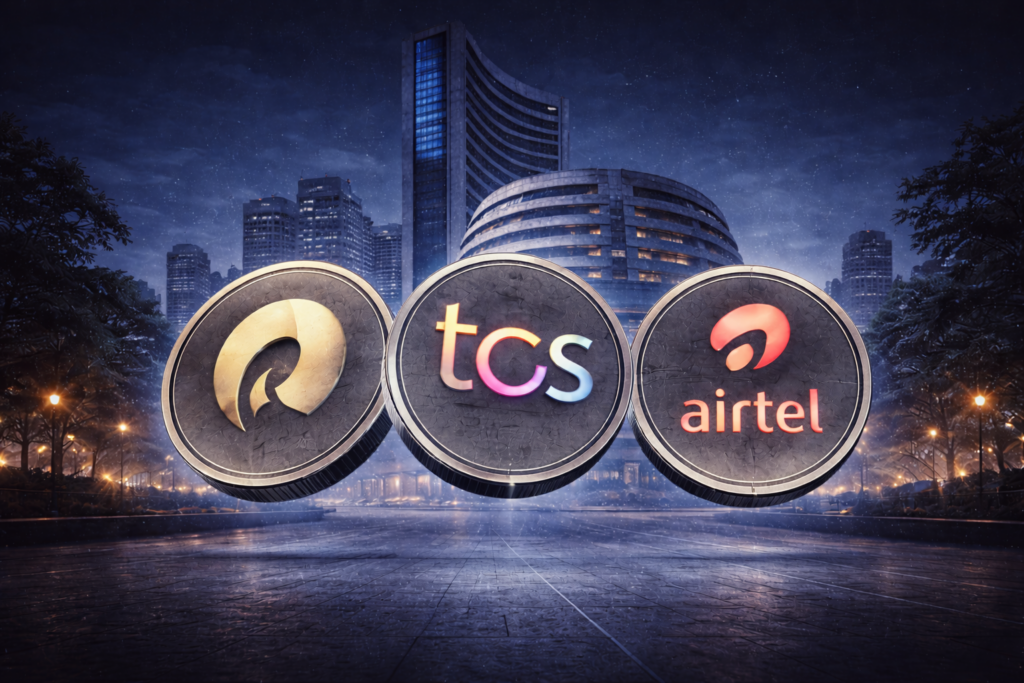
- Reliance Industries leads the list, followed by major companies such as TCS, HDFC Bank, ICICI Bank, and Bharti Airtel.
- Market capitalisation shows a company’s overall market value and can help investors understand its size, scale, and influence on major indices.
- Large-cap companies generally offer greater stability and liquidity, but investors should still consider valuations, growth prospects, and risks before investing.
- The top 10 rankings can change with share prices and business performance, so investors should check updated market-cap data before making investment decisions.
What Is Market Capitalization? A Quick Primer
Before diving into rankings, let’s get the fundamentals right. Market capitalization — or market cap — is simply the total market value of a company’s outstanding shares. The formula is straightforward:
Market Cap = Current Share Price × Total Number of Outstanding Shares
So if a company has 100 crore shares trading at ₹2,000 each, its market cap is ₹2,00,000 crore (₹2 lakh crore). The market capitalization of Indian companies is typically categorized into three buckets by SEBI: large-cap (top 100 companies), mid-cap (101st to 250th), and small-cap (beyond 250th). The companies we’re discussing today are the cream of the large-cap universe — the top 10 by total value.
Market cap matters because it tells you the size and scale of a company relative to its peers. To properly evaluate these companies, you should also understand fundamentals like book value vs face value vs market value in stocks to assess whether their current valuations are justified. It influences how much weight a stock carries in indices like Nifty 50, how easily institutional investors can enter or exit positions, and how the stock responds to macroeconomic events. For investors, understanding the market capitalization of Indian companies is a prerequisite for building a well-informed portfolio.
Top 10 Companies in India by Market Cap (2025–26)
Here’s a snapshot of the biggest market cap companies in India based on current valuations. Note that figures fluctuate daily with share prices — this table reflects approximate data as of 12th August 2026.
| Rank | Company | Sector | Approx. Market Cap (₹ Lakh Cr) |
| 1 | Reliance Industries | Energy / Telecom / Retail | ~17.75 lakh crore |
| 2 | Tata Consultancy Services (TCS) | Information Technology | ~8.49 lakh crore |
| 3 | HDFC Bank | Banking & Finance | ~11.14 lakh crore |
| 4 | ICICI Bank | Banking & Finance | ~10.16 lakh crore |
| 5 | Bharti Airtel | Telecommunications | ~11.90 lakh crore |
| 6 | State Bank of India (SBI) | Banking (PSU) | ~9.97 lakh crore |
| 7 | Infosys | Information Technology | ~4.85 lakh crore |
| 8 | Life Insurance Corp. (LIC) | Insurance | ~5.18 lakh crore |
| 9 | Hindustan Unilever (HUL) | FMCG | ~4.83 lakh crore |
| 10 | Bajaj Finance | NBFC / Financial Services | ~6.75 lakh crore |
* Market cap data is approximate and subject to daily market fluctuations. Always verify with a live source before making investment decisions.
A Closer Look at Each Company
1. Reliance Industries — The Undisputed #1
Reliance Industries has held the crown as the company with the largest market cap in India for several years running, and with good reason. It’s not a single business — it’s essentially five major businesses under one roof: oil refining and petrochemicals, retail (Reliance Retail, India’s largest retailer), telecommunications (Jio, which fundamentally transformed how India accesses the internet), digital services, and a growing green energy ambition. With revenue exceeding ₹10 lakh crore and over 3.8 lakh employees, Reliance’s sheer scale is difficult to overstate. For investors, it offers diversification within a single stock, though the premium valuation means limited room for price error.
2. Tata Consultancy Services (TCS) — India’s IT Flagship
TCS is the crown jewel of the Tata Group and one of the largest IT services companies globally. Operating in over 55 countries with more than 6 lakh employees, TCS serves major global banks, retailers, and manufacturers with software development, cloud transformation, and digital services. What makes TCS a blue-chip favourite is its consistent profitability — the company routinely delivers industry-leading EBIT margins around 24–25%. It’s also one of the few Indian companies that competes directly with global giants like Accenture and Capgemini on the world stage.
3. HDFC Bank — The Gold Standard of Private Banking
After its transformative merger with parent HDFC Ltd in 2023, HDFC Bank has emerged as one of the largest banks in Asia by market value. It’s consistently ranked among the world’s top 100 most valuable banks. For investors, HDFC Bank’s appeal lies in its reliable earnings growth, low non-performing asset (NPA) ratios relative to public sector peers, and a dominant position in retail lending. With over 2 lakh employees and a network spanning thousands of branches and ATMs, HDFC Bank is often described as the most “boring” bank in the best possible way — consistent, predictable, and trustworthy.
4. ICICI Bank — Private Banking’s High-Growth Challenger
ICICI Bank has undergone a stunning turnaround over the past seven years under CEO Sandeep Bakhshi. Once burdened by a massive stressed loans problem, ICICI has dramatically cleaned up its balance sheet, pivoted to a technology-first strategy, and emerged as one of the fastest-growing large banks in India. Its iMobile Pay app has become one of the most widely used banking apps in the country. Revenue crossed ₹2.95 lakh crore in FY2026, with net profit near ₹50,147 crore — a track record that has made ICICI a favourite of both domestic and foreign institutional investors.
5. Bharti Airtel — The 5G Growth Story
Airtel has staged a dramatic resurgence after years of intense price competition with Jio. The company’s aggressive rollout of 5G networks, steady ARPU (Average Revenue Per User) improvement, and expansion into Africa through Airtel Africa have made it a compelling growth story. Airtel now serves over 350 million customers in India, and its B2B enterprise business — offering cloud, connectivity, and cybersecurity services — is quietly becoming a significant revenue driver. Among the top 10 companies in India by market cap, Airtel is perhaps the one with the clearest near-term growth catalyst in 5G monetization.
6. State Bank of India (SBI) — The Public Sector Titan
SBI is unlike any other bank in India — it’s not just a financial institution, it’s a piece of national infrastructure. With over 22,000 branches, 500 million customers, and a presence in virtually every corner of the country, SBI is the backbone of India’s banking system. In FY2025, SBI recorded its highest-ever net profit of over ₹67,000 crore, a testament to how effectively management has cleaned up the loan book and modernized operations. For conservative investors, SBI offers a combination of decent dividends, government backing, and broad economic exposure.
7. Infosys — The Global IT Consulting Powerhouse
Founded by N.R. Narayana Murthy and six co-founders with $250 in capital, Infosys has grown into a global IT services firm valued at nearly ₹7 lakh crore. Operating across 50+ countries with over 3 lakh employees, Infosys specializes in enterprise digital transformation, cloud migration, and AI-driven consulting. While TCS leads in scale, Infosys is often seen as the more agile and innovation-focused of the two. Its focus on large deal wins — multi-year contracts worth hundreds of millions of dollars — gives investors visibility into future revenue streams.
8. Life Insurance Corporation of India (LIC) — Insurance as a National Institution
LIC’s IPO in May 2022 was the largest in Indian stock market history. As India’s dominant life insurer with over 250 million policyholders and a massive investment portfolio of over ₹40 lakh crore in assets under management, LIC is a category unto itself. The company controls roughly 60% of the Indian life insurance market by premium income. For investors, LIC offers exposure to India’s rapidly expanding insurance penetration story — insurance premiums as a percentage of GDP in India remain well below developed market averages, suggesting significant long-term growth potential.
9. Hindustan Unilever (HUL) — The FMCG Anchor
Hindustan Unilever is the Indian arm of global consumer goods behemoth Unilever, and its products touch nearly every Indian household — from Surf Excel detergent to Dove soap to Horlicks. With revenue around ₹62,500 crore and a portfolio of 50+ brands across 13 product categories, HUL represents the most defensive bet in the Indian large-cap universe. When markets get choppy, FMCG stocks like HUL typically hold up well because demand for everyday consumer products doesn’t disappear in a downturn. The tradeoff: HUL rarely delivers spectacular growth either.
10. Bajaj Finance — The Digital NBFC Disruptor
Bajaj Finance has built one of India’s most admired fintech-meets-NBFC businesses. Starting from consumer durable financing, it has expanded into personal loans, home loans, business lending, insurance distribution, and even digital payments via the Bajaj Pay app. What sets Bajaj Finance apart is its data-driven underwriting approach, low delinquency rates, and ability to cross-sell products to an existing customer base of over 80 million. Its market cap surged past ₹5 lakh crore in 2025, cementing its position among the biggest market cap companies in India.
What the Rankings Tell Us: Sector Insights
Looking at the top 10 list as a whole reveals something important about India’s economic priorities and growth drivers. Banking and financial services dominate with four of the top ten spots (HDFC Bank, ICICI Bank, SBI, Bajaj Finance), reflecting how central the credit expansion story is to India’s growth. IT services claim two slots (TCS and Infosys), highlighting how deeply India has embedded itself in the global technology supply chain. Energy and telecom through Reliance and Airtel anchor two more positions, with insurance via LIC and FMCG via HUL rounding out the list.
Notably absent from the top 10 are sectors like manufacturing, pharma, infrastructure, and new-age technology — though companies like Adani Enterprises, Sun Pharma, Tata Motors, and Zomato are gradually climbing the ranks. This shift may reshape India’s top 10 market cap list in the years ahead as the country’s manufacturing and digital economy ambitions gain scale.
Why Market Capitalization of Indian Companies Matters for Your Portfolio
Understanding which companies hold the top positions by market cap isn’t just academic knowledge—it has practical implications for how you invest. Many of these companies are controlled by the top richest person in India, whose wealth reflects their businesses’ market dominance and growth potential.
• Index Fund Exposure: If you invest in Nifty 50 index funds (which millions of Indians now do through SIPs), you automatically have the highest exposure to these top 10 companies since they carry the most weight in the index. Understanding their businesses helps you understand your portfolio.
• Market Sentiment Gauge: When Reliance or TCS moves sharply on earnings day, it drags the broader index with it. Tracking these companies gives you an early read on market direction.
• Valuation Benchmarking: Large-cap leaders often trade at premium valuations. Knowing their P/E ratios and growth rates helps you benchmark smaller companies and assess whether they deserve a premium or discount.
• Global Investor Interest: Foreign Institutional Investors (FIIs) primarily buy large-cap stocks for liquidity. Tracking ownership changes in top 10 companies gives you insight into global capital flows in and out of India.
India’s Biggest vs. the World: A Perspective Check
To put things in perspective: Reliance Industries, India’s most valuable company, has a market cap of roughly $230 billion. That places it in roughly the same league as companies like Chevron or AstraZeneca globally — impressive, but still a fraction of US mega-caps. Apple’s market cap alone exceeds $3 trillion, more than 13 times Reliance’s value.
This gap is not a weakness but an opportunity. India’s total market capitalization crossed $4 trillion in 2024, making it the fourth largest in the world. As India’s GDP grows toward its $10 trillion target by the mid-2030s, the market capitalization of Indian companies is expected to grow proportionally. Investors who understand today’s leaders are better positioned to identify which companies will define that next chapter.
How to Invest in the Biggest Market Cap Companies in India
If you’re convinced that India’s corporate giants deserve a place in your portfolio, you have several practical options. For those who prefer a diversified, lower-effort approach, Nifty 50 and Nifty 100 index funds or ETFs automatically include the top companies by market cap, rebalancing quarterly as rankings shift. understanding what is a stock broker in the share market helps you choose a platform that gives you access to these blue-chip companies.
Large-cap mutual funds managed by AMCs like HDFC Mutual Fund, SBI Mutual Fund, or Mirae Asset typically hold heavy positions in these top 10 stocks. For NRIs or global investors interested in India exposure, some of these companies also trade on US exchanges as ADRs — Infosys, Wipro, HDFC Bank, and ICICI Bank all have ADR listings on the New York Stock Exchange.
The Bottom Line
India’s top 10 companies by market capitalization are not just the largest businesses in the country — they are mirrors of where the Indian economy has been and signposts for where it’s headed. Banking and financial services tell the story of credit deepening. IT companies reflect India’s integration into the global digital economy. Reliance’s sprawling empire is almost a microcosm of India’s ambition to lead in everything from retail to green energy.
For investors — whether you’re investing from Mumbai, Bengaluru, or watching Indian markets from New York — the market capitalization of Indian companies is a fundamental lens through which to understand the opportunity. The names at the top of this list today may shift, but the underlying story of a fast-growing, urbanizing, digitizing economy of 1.4 billion people is far from over. In fact, for long-term investors, the best chapters may still be ahead.
FAQs on top 10 Market Cap Companies in India
Q1. Which company has the largest market cap in India right now?
As of 2025–26, Reliance Industries holds the top position with a market cap of approximately ₹19 lakh crore (~$230 billion), making it the company with the largest market cap in India by a significant margin. Its diverse businesses across energy, retail, and telecom make it uniquely positioned to benefit from multiple growth themes simultaneously.
Q2. What is the total market capitalization of Indian companies listed on stock exchanges?
India’s total equity market capitalization crossed the $4 trillion mark in 2024, making it the fourth-largest stock market in the world after the United States, China, and Japan. This milestone reflects the significant growth in the market capitalization of Indian companies over the past decade, driven by economic expansion, digital adoption, and growing retail investor participation.
Q3. How often does the list of the biggest market cap companies in India change?
The top 10 list is relatively stable over medium-term periods since large-cap leaders don’t change overnight, but rankings do shift. To identify which companies deserve their top rankings, investors should master financial ratios and their significance in evaluating investments. In recent years, companies like Airtel and ICICI Bank have climbed significantly, while some Adani group companies have seen volatile swings. SEBI mandates that AMFI publish large-cap, mid-cap, and small-cap classifications every six months (January and July), which also triggers mutual fund portfolio rebalancing.
Q4. How does market cap differ from revenue or profit?
Market cap reflects what the market thinks a company is worth today — it’s forward-looking and based on investor expectations. Revenue is what a company earns, and profit is what remains after costs. A company can have high revenue but low market cap (like some PSU commodity companies) or high market cap but modest revenue (like a high-growth technology company). Market cap incorporates future expectations; revenue and profit reflect current reality.
Q5. Are Indian companies’ ADRs a good way to invest from the US?
Yes, ADRs (American Depositary Receipts) allow US-based investors and NRIs to invest in Indian companies through US stock exchanges without needing a demat account in India. Companies like Infosys (INFY), HDFC Bank (HDB), ICICI Bank (IBN), and Wipro (WIT) all have active ADR listings on NYSE or NASDAQ. However, ADR prices can diverge slightly from Indian market prices due to currency fluctuations and liquidity differences.
Q6. Should I invest only in the top 10 companies by market cap?
Not necessarily. While the top 10 market cap companies in India offer stability, liquidity, and proven business models, they often grow more slowly than mid-cap or small-cap companies precisely because of their size. A balanced portfolio typically includes large-cap exposure (for stability and dividends), mid-cap exposure (for growth), and possibly small-cap or thematic funds (for higher potential returns with higher risk). The top 10 are a strong foundation — but diversification beyond them adds value.
Q7. How do Indian large-caps compare to their US counterparts?
Indian large-caps are significantly smaller in absolute dollar terms. Apple alone is worth more than India’s entire top 10 combined. However, Indian companies often offer faster earnings growth driven by a younger population, rising income levels, and underpenetrated markets. The trade-off is higher volatility, currency risk for USD-based investors, and governance considerations. Many global investors treat India as a high-conviction growth allocation rather than a value play.
Disclaimer: Investments in securities markets are subject to market risks. Read all the related documents carefully before investing. The securities quoted are exemplary and are not recommendatory
Lorem ipsum dolor sit amet, consectetur adipiscing elit. Ut elit tellus, luctus nec ullamcorper mattis, pulvinar dapibus leo.