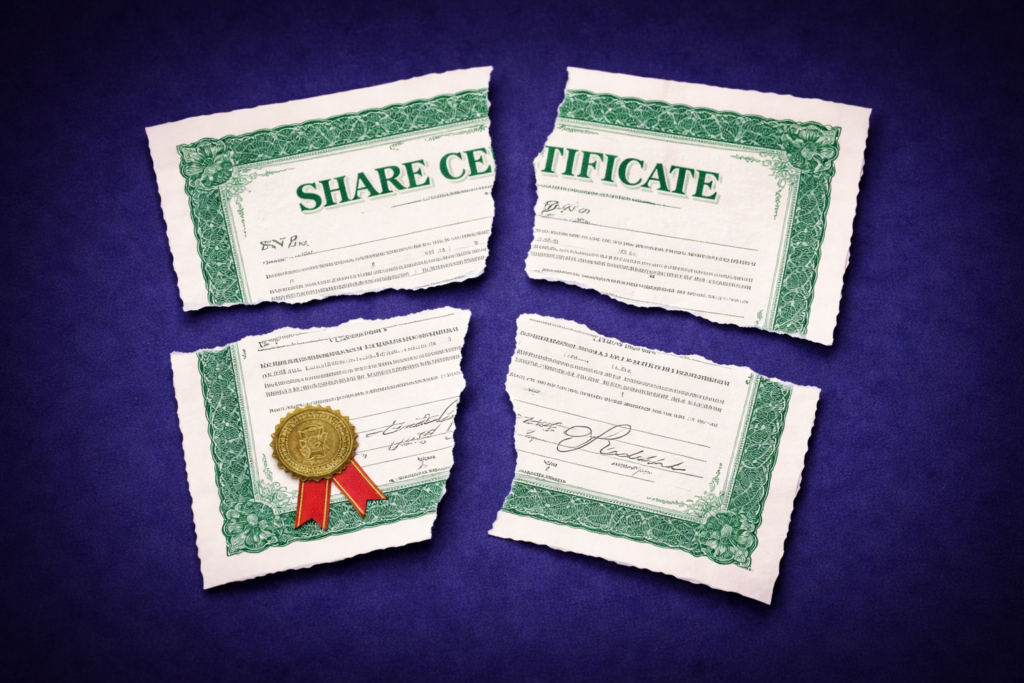
In today’s fast-paced world of stock markets, investors often discuss share split or look up recent stock splits to understand, analyse and predict share price movements. Contrary to what it seems, when a company does a stock split, it is an indication of how well things are going in the organization. In this blog post, we will see how this particular corporate activity is carried out, why organizations decide on doing this and what it really means for your stock holdings.
Key Takeaways
- A share split increases the number of shares while decreasing the stock price proportionally; the total market value of the company remains the same.
- Companies use this tool primarily to improve liquidity and make shares more affordable for retail investors.
- A stock split is often seen as a bullish signal, suggesting management is confident about future growth.
- Reverse stock splits do the opposite—they consolidate shares to increase the stock price, often to meet listing requirements.
What Is a Stock Split?
To answer what is a stock split, imagine you have a ₹2,000 note. If you exchange that single note for two ₹1,000 notes, your total wealth hasn’t changed, but you now have more “units” of currency. In the stock market, a share split means a company increases its total number of outstanding shares by issuing more shares to current stockholders.
The Stock Split Ratio
When a company announces a split, it provides a ratio, such as 2:1, 5:1, or 10:1. In a 2:1 split, you receive two shares for every one share you previously owned. For instance, if you held 50 shares, you would now hold 100.
Impact on Share Price and Share Volume
The first thing that happens after the split is that the price is proportionately reduced. Consider this – In case of 2:1 split, a share price of ₹4,000 will get split into ₹2,000. Although there would be a change in the number of outstanding shares, there will be no change in the market capitalization since the value remains the same.
Why Do Companies Conduct Stock Splits?
A company doesn’t split its shares because it is in trouble; usually, the opposite is true. Here are the strategic drivers:
1. Increasing Stock Liquidity
When a stock price reaches very high levels—say, ₹10,000—it becomes difficult for small investors to trade. By splitting the shares and lowering the price, the company invites more participants, which increases trading volume and stock liquidity. Liquidity refers to how quickly an asset can be bought or sold without affecting its price.
2. Making Shares More Affordable for Investors
Psychology plays a big role in investing. A retail investor might hesitate to buy one share of a company for ₹5,000 but might happily buy five shares at ₹1,000 each. Recent stock splits in the Indian market, such as those by tech and consumer giants, often aim to bring the “entry price” down for the common man.
3. Signaling Future Growth and Confidence
A split is a sign of success. It tells the market that the share price has risen so much that a split is necessary. Management typically only performs a split if they believe the price will continue to rise back toward pre-split levels.
4. Tracking Market Trends and Indices Inclusion
Certain indices are price weighted, wherein those stocks having higher share prices carry more weight. Therefore, organizations may decide on carrying out a split to maintain certain prices.
Different Types of Stock Splits
Not all splits look the same. Depending on the goal, companies choose different paths:
1. Forward Stock Split
This is the most common type, where the number of shares increases and the price drops. It is usually a “reward” for shareholders in a growing company.
2. Reverse Stock Split
A reverse share split means reducing the total number of stocks to boost the price per share. For instance, in a reverse stock split ratio of 1:10, ten stocks are combined to form one. Such a move tends to be defensive on the part of a company that is having difficulty to avoid a drop in stock price below a certain level (₹1 or ₹10) and consequently being de-listed from the market.
3. Dividend Stock Split
Sometimes, companies issue a split in the form of a “stock dividend.” While the result is the same—more shares at a lower price—the accounting treatment on the company’s balance sheet is slightly different.
How Stock Splits Affect Investors
From an investor’s perspective, a split is a “zero-sum” event on day one. You don’t get richer immediately because the total value of your investment stays the same.
Positive Impacts:
- Affordability: You can add to your position with smaller amounts of money.
- Psychological Boost: Market sentiment often turns positive following a split announcement.
- Option Liquidity: For advanced traders, lower share prices make it easier to trade option contracts.
Negative Impacts:
- Volatility: Increased retail participation can sometimes lead to higher short-term price swings.
- Reverse Split Stigma: If a company performs a reverse split, it often signals financial distress, which can lead to further selling.
Examples of Notable Stock Splits
Real-world stock split example cases help clarify how this works in practice.
1. Technology Sector Examples
In the global market, giants like Apple and Nvidia have performed multiple splits to keep their shares accessible. In India, Tata Consultancy Services (TCS) performed a 2:1 split in 2018. In this case, if you held 100 shares of TCS at ₹3,500, you ended up with 200 shares at ₹1,750.
2. Retail and Banking Sectors
Reliance Industries Limited has a history of stock splits and bonus issuance to thank shareholders for their loyalty. In 2025, HDFC Bank carried out a 2:1 split to allow increased participation of retail investors. Even Kotak Mahindra Bank adjusted its face value through a split in early 2026 to stay aligned with sector pricing.
Conclusion
Understanding what is a stock split is essential for any investor tracking the share split history of their holdings. While it doesn’t fundamentally change the value of the company, it changes the “packaging” of the stock to make it more attractive and liquid. Whether you are looking at recent stock splits to find new entry points or simply trying to understand why your share count doubled overnight, remember that the underlying business performance is what truly drives long-term wealth.
FAQs on Stock Splits
Your existing shares are replaced by a larger number of new shares. For a 5:1 split, you get five new shares for every one old share. This happens automatically in your demat account on the “Record Date.”
Initially, neither. The total value of your investment remains exactly the same. However, if the market reacts positively to the news and the share price starts rising post-split, you may see gains.
Yes, indirectly. They increase liquidity and often signal that the company is in a strong growth phase. Many of the most successful companies in history have split their shares multiple times.
A reverse split itself doesn’t take your money, but it is often a sign of a struggling company. The market usually views it as a “red flag,” which can lead to a further decline in the share price.
There is no set rule. Some companies like Berkshire Hathaway (Class A) never split, while others perform a split every few years once their share price crosses a certain “psychological” barrier.
Disclaimer: Investments in securities markets are subject to market risks. Read all the related documents carefully before investing. The securities quoted are exemplary and are not recommended.