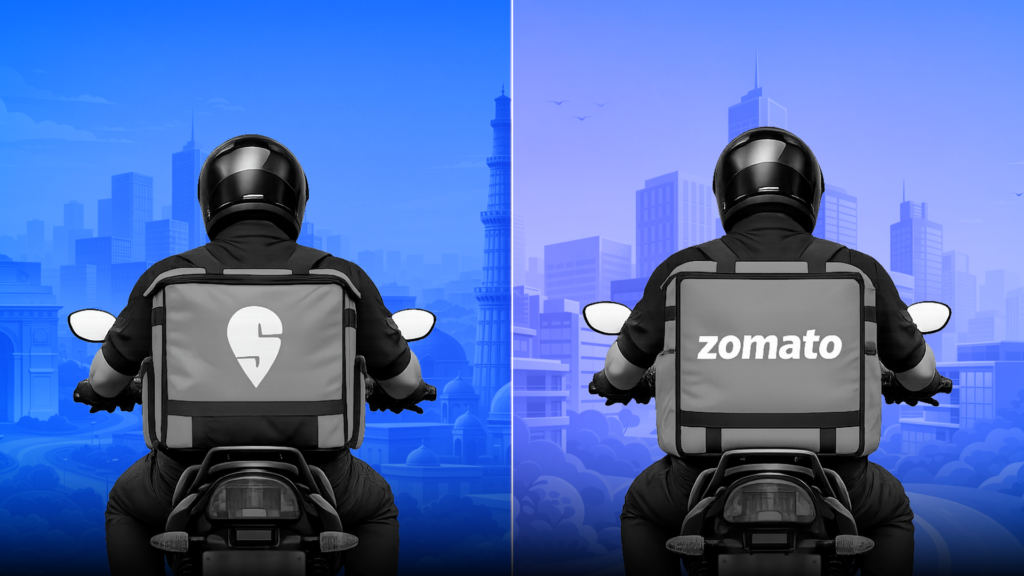
If you’re looking at Indian food delivery stocks and trying to decide between Swiggy and Zomato, the real question is not about brand recall or app popularity. It is about which business is better placed to convert scale into sustainable returns by 2026.
Both companies dominate the market, but they are taking very different paths on expansion, cost control, and profitability. Those choices will matter far more than headline growth numbers over the next few years.
This piece breaks down how Swiggy and Zomato compare on market position, financial performance, execution strength, and long-term risk—so you can judge which stock fits your investment approach.
Key Takeaway
- Zomato shows clearer progress on cost control and margin improvement, offering better visibility on profitability.
- Swiggy has broader growth options across multiple services, but that comes with higher execution and cash burn risk.
- Market share differences are narrow; financial discipline matters more than scale at this stage.
- By 2026, returns will depend on who manages costs and expansion more carefully, not who grows fastest.
Swiggy and Zomato – Market Overview and Market Share
The Indian food delivery market is largely a two-player space, led by Swiggy and Zomato. Together, they account for the majority of online food delivery orders across large and mid-sized cities.
In terms of market share:
- Zomato has held a marginal lead in food delivery order share over the last few quarters.
- Swiggy follows closely, with a stronger presence in certain southern and western markets.
The gap between the two is not wide. Market share shifts quarter to quarter based on discounting intensity, delivery speed, and restaurant partnerships rather than long-term customer loyalty.
On growth and revenue streams:
- Food delivery remains the primary revenue driver for both companies.
- Zomato’s revenue mix is more concentrated, with food delivery and quick commerce (Blinkit) doing most of the heavy lifting.
- Swiggy’s revenue is spread across food delivery, Instamart, and other hyperlocal services, which diversifies income but also raises costs.
Financial Performance Analysis of Swiggy vs Zomato
From a financial standpoint, the comparison is less about who is bigger and more about who is closer to stable profits.
Revenue and margins
- Zomato has shown steadier revenue growth with a visible improvement in operating margins.
- Swiggy’s revenue growth remains strong, but margins are under pressure due to continued spending on quick commerce and logistics.
EBITDA and profitability
- Zomato has moved closer to EBITDA breakeven at a consolidated level, supported by tighter cost control.
- Swiggy is still in an investment-heavy phase, with losses narrowing in food delivery but remaining elevated due to non-core verticals.
Recent performance and outlook
- Recent quarters suggest Zomato is prioritising financial discipline over rapid scale.
- Swiggy is betting that scale across multiple services will pay off over a longer period, even if near-term profitability stays weak.
For investors, the financial contrast is clear:
- Zomato currently offers clearer visibility on cost control and margin improvement.
- Swiggy offers higher optionality, but with greater execution and balance sheet risk.
Technological Innovations and Their Impact
Technology is no longer about features. For Swiggy and Zomato, it is mainly a cost and execution tool.
Customer-facing experience
For most users, the experience on Swiggy and Zomato now looks very similar:
- Both apps use demand forecasting to show realistic delivery times.
- Menu ranking, pricing visibility, and order tracking have become fairly similar.
- Real gains now come from fewer cancellations and faster issue resolution, not flashy features.
As a result, customer decisions are influenced more by delivery reliability and final cost than by app features. This makes user experience a hygiene factor rather than a competitive advantage.
Operations and logistics
The real role of technology sits in operations. Both companies use routing systems to reduce travel time and batch orders where possible to lower delivery costs.
During peak hours, algorithms decide how many delivery partners to deploy in each area to avoid long wait times or expensive last-minute incentives. Even small improvements here matter, because delivery costs form a large part of every order.
AI and analytics in decision-making
AI and analytics are mostly used behind the scenes. They help forecast demand by time and location, which allows both platforms to plan staffing and inventory better. These systems also guide decisions on where to expand or scale back quick commerce operations.
Importantly, analytics play a role in managing discounts, helping companies limit excessive price cuts that hurt unit economics. This layer of technology influences profitability more than growth headlines.
Swiggy vs Zomato Advantages and Challenges
Both companies compete in the same market, but their strengths and risks come from very different choices.
Swiggy: strengths
- Strong logistics network built over the years
- Broader presence across food delivery and hyperlocal services
- Better performance in markets where speed matters more than price
Key risk: Running multiple verticals stretches capital and management focus. Losses widen quickly if unit economics don’t improve on schedule.
Zomato: strengths
- Tighter control on costs and expansion
- Clearer progress toward profitability in food delivery
- Blinkit adds scale without spreading the business too thin
Key risk: A more focused model limits optional bets if demand patterns change sharply.
Challenges both companies face
Both companies face similar external pressures:
- Possible changes to gig worker pay and benefits
- Rising delivery costs during fuel price spikes
- Increased price sensitivity among users
- Smaller, niche players testing local or regional models
Strategic Partnerships and Acquisitions
How Swiggy and Zomato choose partners and acquisitions says a lot about how each company wants to grow—and what risks they are willing to take.
Swiggy’s approach to partnerships and acquisitions
Swiggy has used partnerships and acquisitions to expand its role beyond food delivery. The idea has been to increase how often users open the app, not just how much they order.
This has played out through:
- Entry into quick commerce and hyperlocal delivery
- Logistics-focused capabilities that support multiple use cases
The benefit of this approach is flexibility. Swiggy can tap into different demand cycles and reduce dependence on food orders alone. The trade-off is complexity. Each new vertical comes with different margins and operating challenges, which keep pressure on costs and delay a clean profitability path.
Zomato’s strategic collaborations and acquisitions
Zomato has followed a more contained strategy. Its partnerships and acquisitions are closely tied to food consumption rather than broad convenience.
The Blinkit acquisition reflects this thinking:
- It adds order frequency without moving too far from core delivery
- It keeps operational overlap high and execution risk lower
Zomato’s collaborations tend to prioritise clarity of returns over experimentation. This limits upside optionality, but it improves visibility on margins and cash flows.
Consumer Preferences and Market Demand Projection
Food delivery demand is no longer shaped by novelty. It is shaped by habits, pricing sensitivity, and service reliability.
How consumer behaviour is shifting
Indian consumers still order online, but the way they choose platforms has changed. Key shifts include:
- Less reliance on discounts
- Higher focus on the final order value
- Greater sensitivity to delivery reliability
Users are more willing to switch apps if pricing or service slips.
Demand outlook toward 2026
Growth is expected to continue, but at a steadier pace. What will drive demand:
- Urban work patterns that support regular ordering
- Smaller households and time constraints
- Higher-value orders rather than higher order counts
What will not drive demand is aggressive discount-led volume pushes. This makes margin discipline more important than raw order growth.
Impact of lifestyle and urbanisation
As food delivery expands beyond metros, cost structures will matter more. In smaller cities:
- Delivery density is lower
- Price sensitivity is higher
- Last-mile costs rise faster
Swiggy’s logistics depth may help it scale reach, while Zomato’s cost control could reduce downside risk. Their growth paths will depend on how well they adapt to these conditions, not just how fast they expand.
Start Investing in US ETF
“US ETFs (Exchange Traded Funds) offer a great opportunity for investors looking to diversify their portfolio with international exposure. With Appreciate, you can now access these ETFs easily, benefiting from the growth of US-based companies. Investing in US ETFs can be a strategic way to tap into global markets, adding stability and potential growth to your investment strategy.
Conclusion
The Swiggy vs Zomato debate is no longer about who delivers more orders. It is about who can run a large, complex operation without bleeding cash.
Zomato currently looks stronger on financial discipline. Its tighter focus, clearer progress on margins, and more controlled expansion give investors better visibility on where profits could come from.
Swiggy, on the other hand, offers broader optionality. Its push into multiple hyperlocal use cases gives it more ways to grow, but also raises complexity and cost pressure.
So, Swiggy or Zomato: which is better?
- Zomato suits investors who value steadier progress and clearer profitability signals.
- Swiggy suits investors willing to accept higher risk for the possibility of wider long-term gains.
By 2026, the winner will not be decided by market share alone. It will be decided by who controls costs, manages expansion carefully, and turns scale into sustainable returns. Similarly, investors exploring global diversification can learn how to invest in US stocks from India to access companies across different sectors and reduce concentration in a single market.
FAQs on Swiggy vs Zomato
At the core, both Swiggy and Zomato run marketplace-led food delivery platforms. The difference shows up in how they’ve expanded beyond that core.
Swiggy has built multiple verticals alongside food delivery, including Instamart and Genie. The focus is on becoming a daily-use convenience platform.
Zomato has stayed more tightly focused, with food delivery as the base and quick commerce (through Blinkit) as its main adjacent bet.
Food delivery is not a “growth at any cost” space anymore. Investors should look beyond order volumes and app popularity. Key things to track:
Progress toward profitability, not just revenue growth
Control over discounts and delivery costs
How quickly new verticals move toward breakeven
Cash burn and balance sheet strength
Customer satisfaction tends to vary by city and use case rather than one clear winner nationwide. Broadly:
Swiggy is often preferred for delivery reliability and speed in dense urban areas.
Zomato scores well on restaurant discovery, pricing transparency, and consistency.
Neither company has a permanent edge here. Service quality shifts based on logistics density, partner availability, and how aggressively discounts are being used in a given market.
There is no single policy that targets food delivery platforms alone, but a few areas remain relevant:
Gig worker regulations around minimum pay and benefits
Tighter rules on discounts and pricing practices
Data protection and consumer grievance norms
Any regulatory change is likely to raise costs across the industry rather than hurt only one player. The company with stronger cost control and pricing discipline will handle these changes better over time.
Disclaimer
The information provided in this article is for educational and informational purposes only. It should not be considered as financial or investment advice. Investing in stocks involves risk, and it is important to conduct your own research and consult with a qualified financial advisor before making any investment decisions. The author and publisher are not responsible for any financial losses or gains that may result from the use of this information.