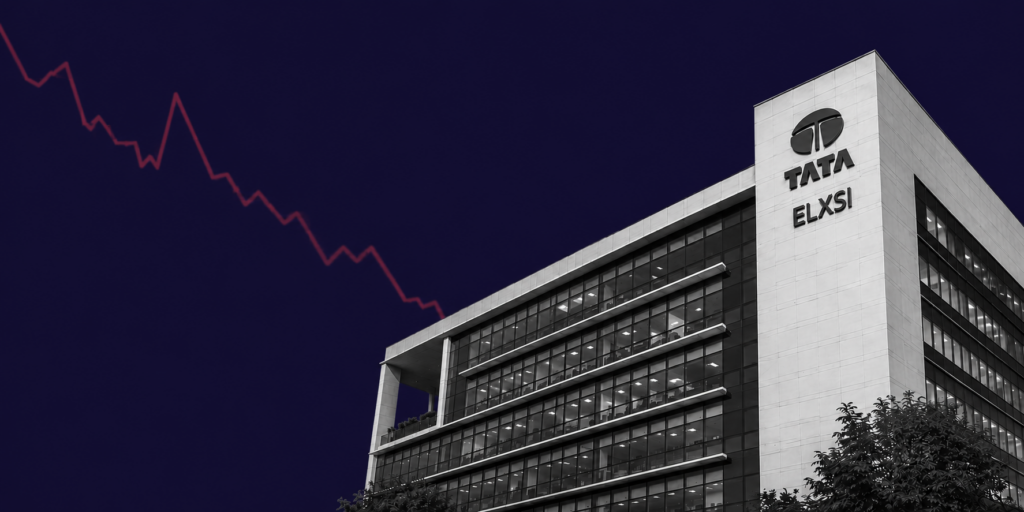
For most of the past year, owning Tata Consultancy Services (TCS) stock felt like watching a slow puncture. By late May 2026, the stock had tumbled roughly 35% over twelve months — a sharp underperformance against the Nifty 50, which slid only 3.49% over the same period, and even against the Nifty IT index, which fell 23%. The sector’s problems were well-documented: softening discretionary technology budgets among North American clients, delays in decision-making driven by US tariff uncertainty, and an existential unease about whether artificial intelligence would erode traditional IT outsourcing revenue.
Then, in just two sessions, TCS shares surged approximately 9% — before surrendering most of those gains on June 3, 2026, falling more than 5% in a single day.
The whipsaw tells an important story about where India’s IT sector stands today: cheap enough to attract buyers, but not yet stable enough to hold them.
The Descent That Set the Stage
Context matters here. As of May 27, 2026, TCS was trading at ₹2,269.70 on the NSE — its fifth consecutive session of decline at the time. Trading volumes had thinned considerably, with just 14.08 lakh shares changing hands versus a 30-day daily average of 40.07 lakh shares, a sign of investor indifference rather than active selling.
The stock’s trailing price-to-earnings multiple had compressed to 15.77x — a level last seen during the post-pandemic demand contraction, and meaningfully below the stock’s historical average. For a company that posted net profit of ₹13,718 crore in Q4 FY26 (a 12.22% year-on-year increase), that valuation gap was a coiled spring.
TCS’s full-year FY26 performance told a more nuanced story. Revenue for the year came in at $30,017 million — essentially flat, declining 0.5% year-on-year and 2.4% in constant currency — yet operating margins expanded to 25%, their highest in four years. Net margin reached 19.8%, also a four-year high. Annualised AI revenue crossed $2.3 billion in Q4 alone, while total contract value for the year hit $40.7 billion, among the highest ever recorded by the company. The fundamentals, in other words, had quietly improved even as the stock price told a different story.
Four Catalysts Behind the Two-Day Surge
The reversal, when it came on June 2, 2026, was sudden and broad. TCS shares surged over 6% in a single session; Infosys jumped nearly 6%; HCLTech, Tech Mahindra, Coforge, and LTIMindtree all rallied sharply. The Nifty IT index posted its largest single-day gain of the year — over 4%.
Four distinct catalysts converged.
1. AI spending signals from the US
The immediate trigger was strong quarterly earnings from Snowflake, the US cloud-data company, which signalled that enterprise technology spending — particularly on artificial intelligence infrastructure, cloud migration, and data transformation — remained robust in North America. For Indian IT firms, which derive the bulk of their revenue from US enterprises, this was direct reassurance. Markets had spent months pricing in AI as an existential threat to outsourcing. Snowflake’s results began shifting that narrative: large enterprises still need implementation partners, integration support, and managed services at scale — areas where TCS and its peers operate at competitive advantage.
2. Rate cut expectations
A second driver was growing conviction that the US Federal Reserve is moving closer to an interest rate reduction. Technology stocks globally carry a well-understood sensitivity to rate expectations: lower rates compress discount factors and improve the present value of future earnings. As that expectation built, global investors began rotating back into technology, and Indian IT — one of the largest and most liquid tech sectors outside the US — benefited directly.
3. Currency tailwinds
The rupee’s recent weakness provided a third lever. With TCS and peers earning a substantial portion of revenue in US dollars, a weaker rupee mechanically improves rupee-denominated revenue and margins. Even after a modest recovery from record lows, the currency remained relatively soft, supporting margin expectations heading into FY27 guidance.
4. Valuation mean-reversion
Finally, the selloff itself had created the opportunity. At roughly 15.77x trailing earnings, TCS was trading at a significant discount to its own history. For a company with nearly $30 billion in annual revenue, 25% operating margins, and a deal pipeline described by management as among the strongest ever, that discount was difficult to justify once sentiment began stabilising. Mean-reversion trades in deeply oversold quality stocks can be rapid — and this one was.
The Reversal: Profit-Booking Meets Macro Jitters
It didn’t last. On June 3, 2026, TCS fell more than 5%, dragging broader markets lower. The BSE Sensex dropped 889 points, or 1.19%, to 73,759.94; the Nifty declined 239 points, or 1.01%, to 23,244.45. US-listed ADRs of major Indian IT companies had already flashed warning signals overnight — the Infosys ADR declined 2.5%, Wipro’s dropped over 8%.
Analysts pointed to two factors. The near-term trigger was straightforward profit-booking: after a near-10% gain in two sessions, the trade had become crowded. Technical indicators reinforced caution — at Tuesday’s close, the RSI of the Nifty IT index had reached 66.5, approaching the overbought threshold of 70.
The macro backdrop also reasserted itself. New uncertainty around US-Iran negotiations rattled risk appetite broadly, reminding investors that the geopolitical and trade environment that had suppressed IT spending throughout FY26 had not been resolved.
What the Charts and Analysts Are Saying
Despite the June 3 pullback, the medium-term view among institutional analysts remains cautiously constructive. CLSA chartist Laurence Balanco stated on CNBC-TV18 that a mean-reversion trade is underway in IT stocks and identified another 12.5% upside potential in the Nifty IT index from current levels. The June futures contract for TCS had been trading at ₹2,280 before the correction — a modest premium that reflected expectations of stabilisation rather than a runaway rally.
The sustainability of any recovery, analysts broadly agree, hinges on three variables: whether AI-related enterprise spending in North America continues to hold up, whether the US Federal Reserve follows through on rate reductions, and whether TCS and its peers can convert the record deal pipeline ($12 billion TCV in Q4 FY26 alone, with five mega-deals signed during the year) into sustained revenue growth through FY27.
The Bigger Picture
What TCS’s volatile two-day ride illustrates is not a company in crisis — it is a market re-rating a fundamentally sound business that got priced for disaster. Full-year operating margins at a four-year high, the highest-ever total contract value, net profit growing 12% year-on-year in Q4, and annualised AI revenues crossing $2.3 billion — these are not the numbers of a company in terminal decline.
What is missing is conviction. The overhang of US macro uncertainty, the tariff environment affecting client decision-making, and the structural anxiety about AI disruption have kept institutional buyers cautious even as valuations became compelling. The two-day surge was a reminder of how quickly that calculus can shift. The reversal on June 3 was a reminder that it hasn’t shifted yet — not durably.
For investors, the question is no longer whether TCS is cheap. At 15.77x earnings with expanding margins and a record deal book, the answer to that is clear. The question is whether the macro conditions that suppressed its revenue growth through FY26 are truly turning — or whether the June 2 rally was, as bears will argue, simply a relief bounce in a longer adjustment.
The answer will likely arrive in the Q1 FY27 results, due in July.
Disclaimer: Investments in securities markets are subject to market risks. Read all the related documents carefully before investing. The securities quoted are exemplary and are not recommended