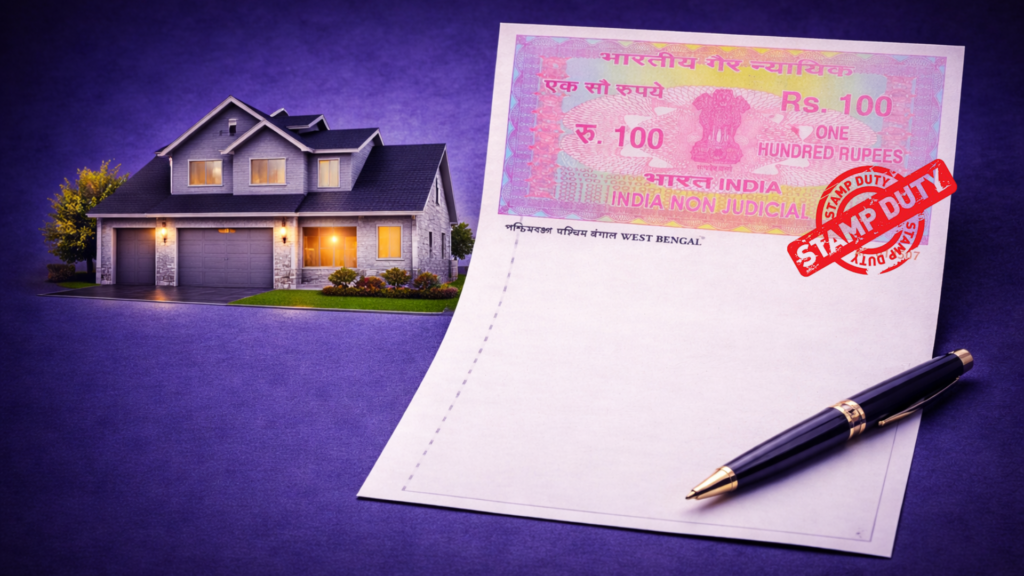
When you buy a house or sign a formal agreement, you often hear about a specific government fee. This payment is known as stamp duty. It is a type of tax that the government collects to record a transaction and make a document legally valid. Without paying this fee, your papers may not hold weight in a court of law.
In India, stamp duty is a major source of revenue for state governments. Whether you are purchasing a flat in a big city or leasing a shop, understanding these costs is vital. This blog post explains the meaning of stamp duty, how it is calculated and the various charges you may face in 2026.
Key Takeaways
- Stamp duty is a mandatory tax that makes legal documents and property transfers valid in court.
- State governments in India set the rates which often vary based on the location and the gender of the buyer.
- Non-payment or underpayment can lead to heavy penalties of up to ₹1,00,000 as per Maharashtra’s January 2026 stamp duty amendments.
- You can pay this duty through physical stamp papers, e-stamping or franking methods.
What is Stamp Duty?
Stamp duty is a direct form of taxation whereby a charge is imposed by the government upon execution of certain documents. Simply put, it is a charge for getting the “stamp” from the government for any transaction. This tax came into existence when the government stamped various transactions and agreements on the paper for verification. Currently, stamp duties are used as evidence of the execution of the transaction and its recording.
The Indian Stamp Act of 1899 in India regulates all the stamp duty payments. For instance, central government regulations deal with stamp duty payable in respect of certain financial documents while stamp duty rates in property transactions fall under state governments jurisdiction. Once the document has been charged with stamp duty, it automatically becomes admissible in courts. Documents that have not been “duly stamped” cannot be admissible to establish one’s claim in a lawsuit.
Types of Stamp Duty
There are two main ways the government collects this tax. The first is through Judicial Stamp Duty which is used for court cases and legal fees. The second and more common for most people is Non-Judicial Stamp Duty. This type applies to day-to-day transactions like buying a home or signing a business contract.
In modern times, you can pay this duty in three ways:
- Physical Stamp Paper: You buy a pre-printed paper from an authorised vendor.
- E-Stamping: You pay the duty online through a secure government portal which is now the preferred method in most Indian states.
- Franking: You take your printed document to a bank, where a machine marks it to confirm the tax has been paid.
Where is Stamp Duty Applied?
This tax applies to various documents that record a transfer of rights or property. If you are moving into a new phase of life or business, you will likely encounter one of these:
- Property Purchases: This is the most common use case. When you buy a flat, plot or commercial shop, you must pay duty on the sale deed.
- Leasing Agreements: Lease agreements for periods exceeding 11 months must be compulsorily registered and attract stamp duty. Short-term agreements of 11 months or less are commonly structured to avoid mandatory registration, though nominal stamp duty may still apply in some states.
- Share Transfers: When you buy or sell physical or demat shares of a company, a small duty is charged.
- Legal Documents: This includes gift deeds, powers of attorney and even some loan agreements.
How is Stamp Duty Calculated?
The amount you pay is not the same for everyone. It depends on several factors that the local authorities consider. The most important factor is the Circle Rate or Ready Reckoner Rate. This is the minimum value at which a property can be registered, as determined by the state government.
If you buy a flat for ₹80,00,000 but the government rate for that area says it is worth ₹85,00,000, you must pay duty on the higher amount. Other factors include:
- Location: Rates are usually higher for urban areas compared to rural parts.
- Property Use: Commercial buildings often have a higher tax rate than residential homes.
- Amenities: Some states charge extra if the building has a lift, swimming pool or clubhouse.
Many state portals now offer online calculators to help you estimate the cost before you go for registration.
Fees and Charges Related to Stamp Duty
Fees are generally divided into two categories. Some are Flat Rate Fees which stay the same regardless of the transaction value, such as for an affidavit. Others are Ad-valorem Fees which are a percentage of the total value.
The rates in major cities like Mumbai are quite specific:
- Standard Rate: 6% for men and 5% for women, these rates already include the 1% Metro Cess. The base stamp duty before Metro Cess is 5% for men and 4% for women.
- Concessions: Women buyers often receive a discount. In Mumbai, the rate for women is 5%.
- Registration Charges: On top of stamp duty, you pay a registration fee. This is often 1% of the value but is capped at ₹30,000 for properties valued above ₹30,00,000.
When is Stamp Duty Paid?
You must pay this tax either before or at the time of signing the document. It is not something you can delay easily. In most states, once you sign a deed, you have a very short window to get it registered and the duty paid.
Late payment can be problematic. If the authorities determine that you failed to make your payment at the prescribed time, then you will be fined. The fine can usually be calculated as interest per month on your outstanding balance. In worst-case scenarios, the paper could be impounded until all dues and fines have been paid in full.
Why is Stamp Duty Important?
The primary reason to pay this tax is legal protection. A stamped document acts as a legal shield. If someone tries to claim your property illegally, your stamped and registered deed is your primary proof of ownership.
It also helps in preventing fraud. Since every transaction is recorded in a government database, it becomes much harder for a seller to sell the same property to two different people. By paying stamp duty in India, you ensure that your financial interests are safe and that the transaction is recognised by the state.
Conclusion
Understanding what is stamp duty and its impact on your budget is a key step in any property or legal transaction. Because rates are subject to fluctuation within the budgetary period of a state, it is advisable to keep yourself abreast of the latest notices issued by your regional registration authority.
The appropriate management of such costs will save you from any legal complications and penalties. In case of any major deal that you might undertake, it would be wise to seek professional advice from an attorney or a chartered accountant.
FAQs on stamp duty
Stamp Duty in India is mostly a tax that varies from state to state, but it may be a uniform national tax in some other countries. This tax is also known by some other terms in various countries like Transfer Tax or Land Tax.
Yes, there might be exceptions to this rule in certain cases. For instance, some states provide lower costs or exceptions when gifts are made from parent to child using a deed of gift. Moreover, there could be reduced costs in certain programs for lower-income people.
You can apply for a refund if a property deal is cancelled after the duty is paid but before the deed is registered. Usually, you must apply within six months of the payment. The government typically deducts a small processing fee, often around 2% to 10% of the duty amount, before returning the rest.
If you do not pay the required amount, the document is not legally valid. Under the Maharashtra Stamp Act, a new penalty of up to ₹1,00,000 was introduced as of January 1, 2026, for underpayment or evasion. You may also face a penalty of 2% per month on the deficit amount.
Yes, indeed. The IT Act and other modern laws, such as the revised Stamp Act, provide for the validity of electronic transactions. For delivery-based purchases of demat shares on a stock exchange, stamp duty is 0.015% of the transaction value. Intraday transactions attract a lower rate of 0.003%.
Disclaimer: Investments in securities markets are subject to market risks. Read all the related documents carefully before investing. The securities quoted are exemplary and are not recommended.